
If you’re a light sleeper, you already know the sound before you can name it: a hum that kicks in right as you’re drifting off, a click-and-whoosh every twenty minutes, a rattle that seems to get louder the quieter the rest of the house gets. It’s rarely dramatic enough to complain about during the day. At 1 a.m., it’s the only thing you can hear.
That’s not a coincidence, and it’s not just in your head. HVAC systems are, by design, one of the loudest things running in most homes overnight — and the mechanics behind that noise have very little to do with whether your system is broken. Here’s what’s actually happening, what “quiet enough for a bedroom” means in real numbers, and what genuinely fixes it.
Why HVAC Noise Gets Worse at Night (Even on a Healthy System)
Two things happen after dark that have nothing to do with your equipment.
First, ambient noise drops — traffic, appliances, conversation, all the sound that normally masks a background hum during the day disappears, so the same system that was inaudible at 3 p.m. becomes the loudest thing in the room at 1 a.m. Second, most systems actually work harder overnight, cycling more often to hold a steady setpoint while the temperature difference between inside and outside widens.
But there’s also a mechanical reason worth understanding, because it’s the one that gets missed: a forced-air system has several moving, cycling parts by design — a blower motor, ductwork carrying pressurized air, and (for AC and heat pumps) an outdoor compressor. None of that needs to be malfunctioning to produce sound. It’s simply how the mechanism works.
What “Quiet” Actually Means in a Bedroom
“Quiet” is a squishy word until you attach a number to it. ASHRAE — the engineering body that sets HVAC design standards — recommends background noise in sleeping spaces stay in the NC 25–30 range, roughly 25–35 decibels (dBA). The World Health Organization sets a firmer outer limit: nighttime bedroom noise should stay under 40 dB for healthy, uninterrupted sleep.
The decibel scale is logarithmic, which trips people up. A jump from 50 dB to 60 dB isn’t “20% louder” — it reads roughly twice as loud to the human ear. That’s why a system that seems only “a little” noisier than it used to be can feel dramatically more disruptive.
Sound Level | Everyday Comparison | Typical Source |
18–25 dBA | Rustling leaves, quiet breathing | Premium mini-split, low fan |
25–35 dBA | Quiet library | ASHRAE’s bedroom target range |
35–45 dBA | Quiet office, light rain | Standard air handler, variable-speed furnace blower |
45–55 dBA | Moderate rainfall, normal conversation | Older furnace blower on high, modern outdoor condenser |
55–70 dBA | Dishwasher, vacuum cleaner | Standard-to-aging outdoor condenser |
75 dBA+ | Garbage disposal, blender | A mechanical problem — bearing, fan blade, or refrigerant issue |
If your bedroom regularly sits above that 35–40 dB line overnight, that’s not a comfort quirk — it’s outside the range engineers consider acceptable for sleep.
The Genuinely Silent Alternative: Taking the Mechanism Out of the Bedroom
There’s a category of heating that sidesteps this entire problem rather than making it quieter: electric radiant floor heating. Companies like ProLux Materials make systems with no blower motor, no ductwork to amplify air movement, and no outdoor compressor cycling on and off near a bedroom wall — the heating element sits directly under the floor and radiates heat upward with no moving parts at all.
It’s not a quieter version of forced air; it’s the removal of the mechanism that produces the noise in the first place, which is why it’s a common ask for bedrooms specifically among people who’ve already tried everything else.
That’s obviously not a fit for cooling, and it won’t replace whole-home air conditioning — but for the specific problem of a noisy heating cycle disrupting sleep in one room, it’s worth knowing the option exists as something categorically different, not just another brand of forced air. For everyone still troubleshooting the system they already have, here’s where the noise actually comes from.
The Real Mechanical Sources of HVAC Noise
Three components do almost all the work here, and each has its own noise signature.
The blower motor. Older single-speed PSC (permanent split capacitor) motors run at one speed — full blast — producing 50–58 dBA on the high setting. Newer variable-speed ECM motors ramp up gradually and can run as low as 30–38 dBA most of the time, only climbing to 45–50 dBA at peak demand. If your system has an older PSC blower, that alone can explain a persistently loud return-air sound.
The outdoor unit. Central AC condensers range from roughly 51 dBA (premium variable-speed models) to 76 dBA (budget single-stage units) at the source. Heat pumps carry an extra wrinkle: during winter, the defrost cycle — which reverses refrigerant flow to melt ice off the outdoor coil — adds a 5–10 dB spike on top of normal operating noise, which is why a heat pump can suddenly sound “off” for a few minutes at a time.
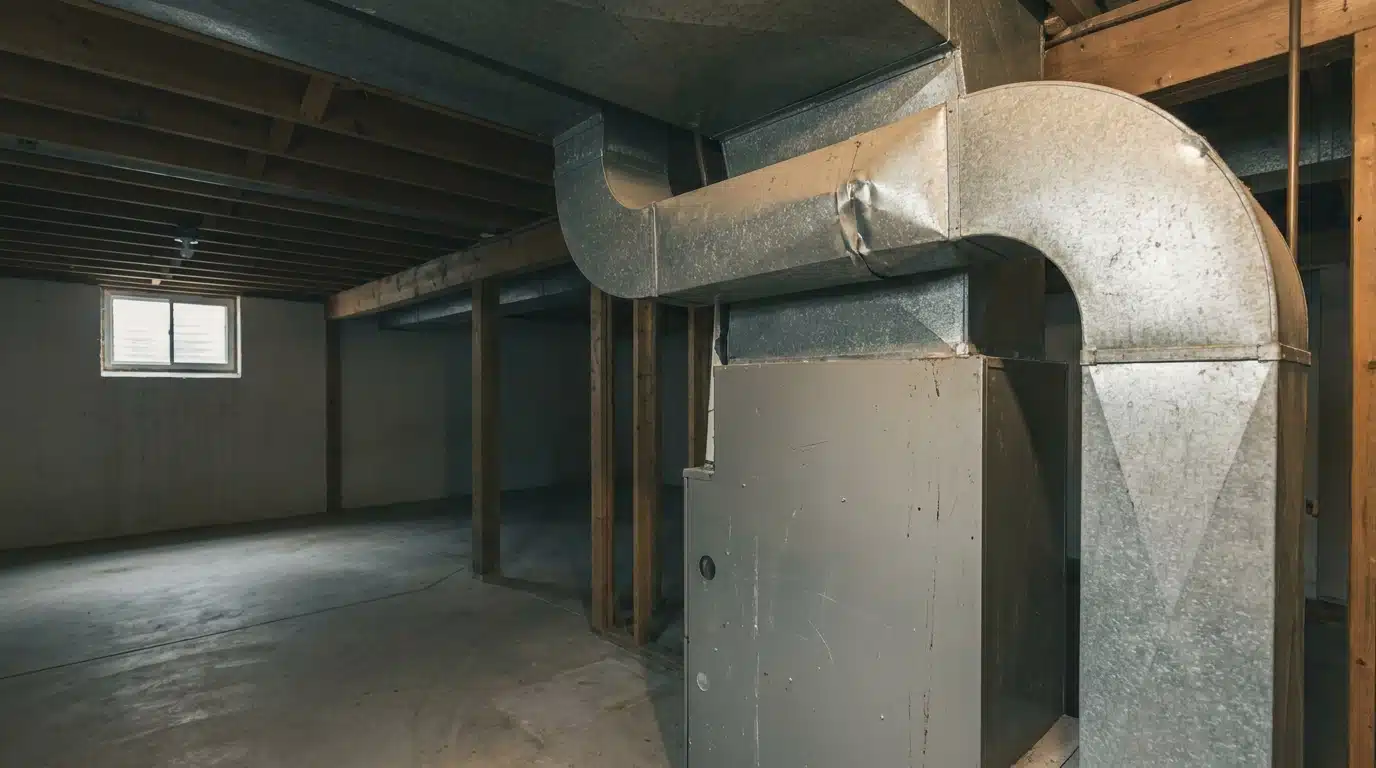
The ductwork itself. This is the one people almost never think to blame, and it’s often the biggest contributor. Ducts don’t generate noise on their own — they amplify or muffle whatever the blower produces, depending on how they were installed:
Duct Issue | Noise Added | What Fixes It |
Undersized ducts (high air velocity) | +10–20 dB | Resize ductwork or add parallel runs |
Sharp 90° elbows | +5–10 dB | Replace with radius elbows |
Missing flex connectors at the air handler | +5–15 dB | Add a vibration-isolating flex section |
Uninsulated metal ducts | +5–10 dB | Add duct liner or acoustic wrap |
Loose joints and connections | +5–15 dB | Reseal with mastic and screws |
A system that measures perfectly quiet at the unit itself can still sound loud in the bedroom if the ductwork feeding that room has any of these issues — which is worth knowing before assuming the equipment is the problem.
Distance matters too. Sound follows the inverse-square law: every time you double the distance from an outdoor unit, noise drops by about 6 dB. A condenser sitting 6 feet from a bedroom window versus 25 feet away is roughly the same noise reduction as upgrading to a meaningfully quieter unit — for free, just by where it’s placed.
Fixing the Noise in the System You Already Have
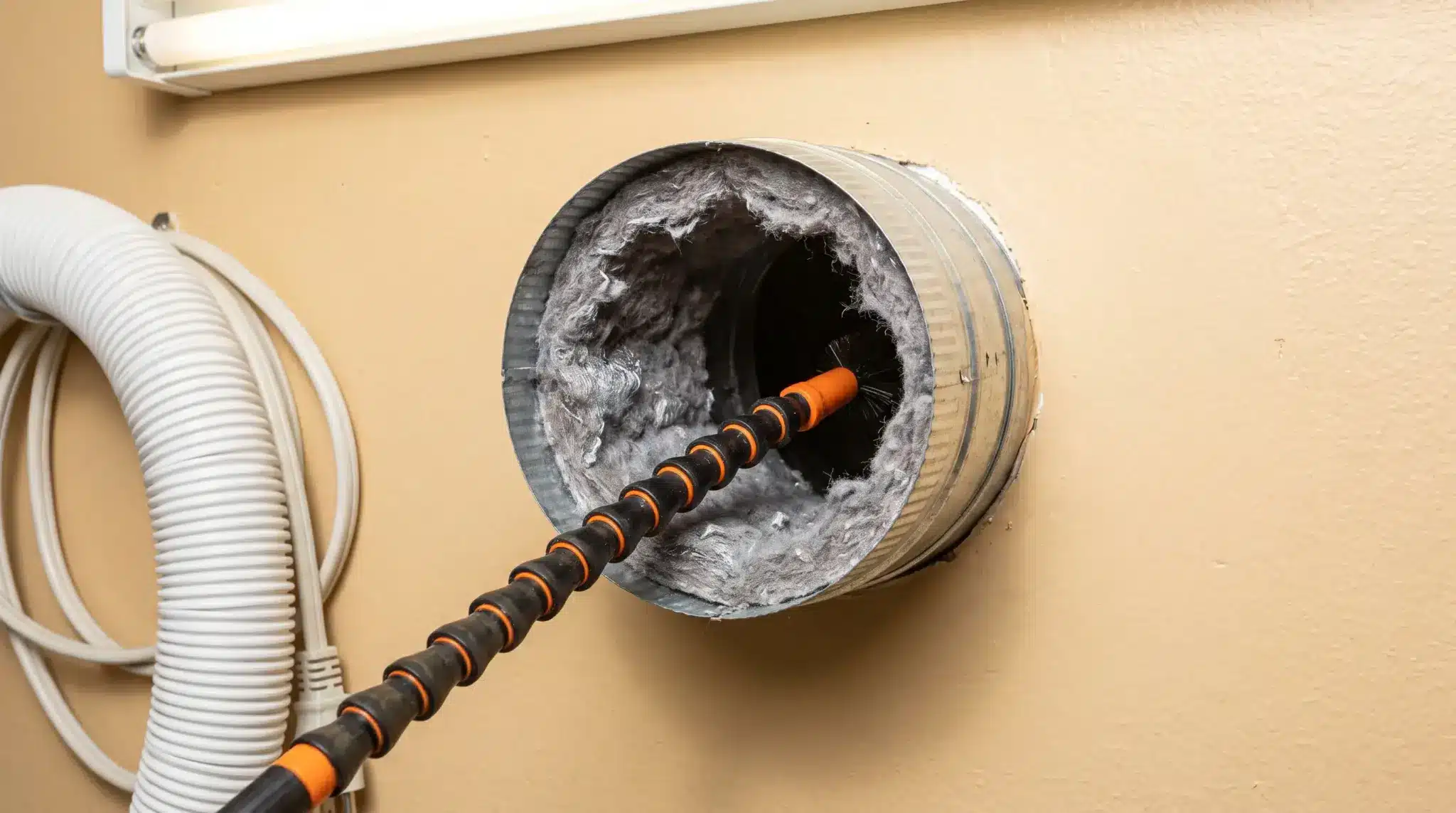
Before assuming you need new equipment, a few things are worth ruling out first. Rattling, buzzing, or banging that wasn’t there a year ago is usually a sign of loose panels, worn parts, or a dirty blower wheel — and routine maintenance can quiet a lot of this down without touching the ductwork or the unit itself.
If the noise is new or getting worse rather than constant, that’s the first thing to rule out, and it’s worth knowing what to ask before hiring someone to diagnose it, since not every technician investigates noise complaints with the same thoroughness.
If maintenance doesn’t resolve it, the ductwork issues above are the next place to look — and unlike swapping equipment, duct sealing, insulation, and elbow replacement can often be done without a full system replacement.
When It’s Worth Upgrading Instead of Patching
Sometimes the honest answer is that the system itself has reached its noise ceiling. A 12-year-old single-stage condenser running at 72–76 dBA outdoors isn’t going to get quieter with a tune-up — that’s simply what that compressor design produces at full load.
In that case, it’s worth understanding how mini-splits and central air actually compare on noise before assuming a straight swap is the only option, and deciding whether to repair or replace an aging system usually comes down to the same math as any other appliance: how often you’re already paying for repairs versus what a quieter, more efficient system would cost upfront.
Variable-speed and inverter-driven equipment — in central systems, heat pumps, and mini-splits alike — throttles down at part load instead of running at full blast or not at all, which is the single biggest noise difference between a budget system and a premium one.
Frequently Asked Questions
Why Does My HVAC Sound Louder at Night than During the Day?
It’s usually not louder — it’s more noticeable. Daytime ambient noise (traffic, appliances, conversation) masks the same sound that stands out clearly once the house goes quiet, and many systems also cycle more at night to hold a steady temperature against a wider indoor-outdoor temperature gap.
What Decibel Level Counts as “quiet Enough” for A Bedroom?
ASHRAE recommends 25–35 dBA (NC 25–30) for sleeping spaces, and the World Health Organization sets an upper limit of 40 dB for healthy nighttime sleep. If your bedroom regularly exceeds that overnight, it’s outside the range considered acceptable for uninterrupted rest.
Can the Ductwork Really Be the Cause, Not the Unit Itself?
Yes — undersized ducts, missing flex connectors, uninsulated metal ducts, and loose joints can each add 5 to 20 decibels on top of whatever noise the blower produces, independent of how quiet the equipment itself is rated.
Is a Mini-Split Actually Quieter than Central Air?
Generally yes, especially indoors. Premium mini-split indoor units can run as low as 18–19 dBA at minimum fan speed, well below typical central air handler noise, though realistic day-to-day operation at medium fan speed is closer to 30–38 dBA.
How Do I Know if I Should Repair My System or Replace It Because of The Noise?
If the noise is new, sudden, or getting worse, that usually points to a fixable issue — a loose part, worn motor, or dirty component — worth a professional diagnosis first. If the system is already 10+ years old and the noise has been a constant feature of daily operation rather than a new development, it’s more likely a design ceiling that maintenance won’t resolve.
Are There Heating Systems that Don’t Produce Mechanical Noise at All?
Electric radiant floor heating comes closest — it has no blower, ductwork, or compressor, so there’s no mechanical noise source built into the system. Hydronic systems like baseboard radiators are also relatively quiet, though not entirely silent, since they involve a circulator pump and pipe expansion sounds.
Further Reading
For the rest of your bedroom’s sleep environment — beyond just the HVAC system — 10 Bedroom Upgrades to Enhance Sleep and Resting Conditions covers additional factors worth addressing alongside noise.