


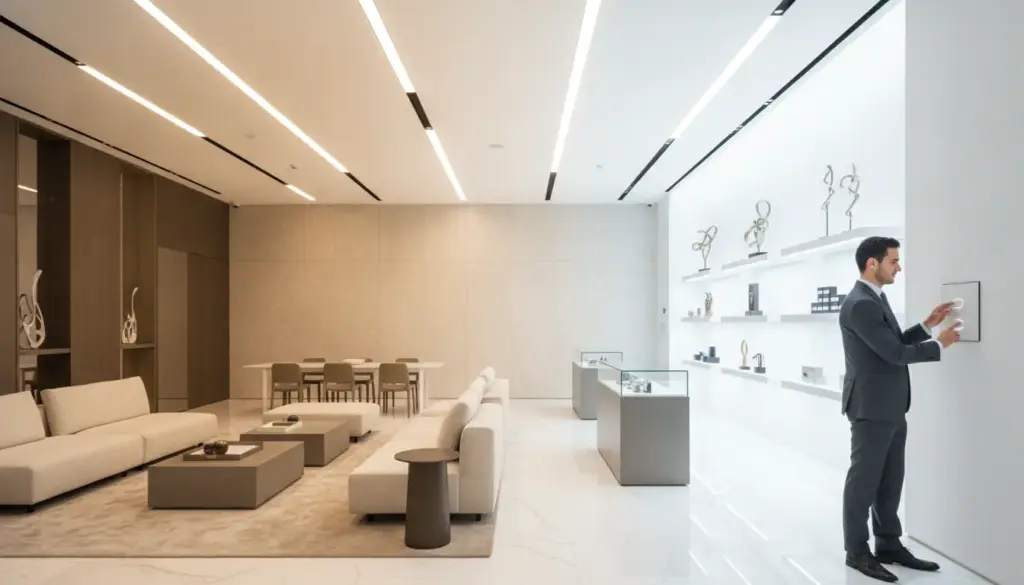
LED lighting has changed the way businesses think about illumination, cost control, and workplace design. What was once a straightforward purchasing decision now involves performance standards, compatibility questions, and long term operating strategy. Dimming is a major part of that shift because it affects how a space looks, feels, and functions throughout the day. In commercial settings, lighting is not merely decorative. It shapes how customers browse, how employees work, and how energy is consumed. That is why dimming LED fixtures deserves closer attention from business owners and facility managers.
Unlike older lighting technologies, LEDs do not dim in a simple or universal way. Their performance depends on the relationship between the fixture, the driver, and the control method. A business can install high quality fixtures and still face problems if the dimming system is poorly matched. Common complaints include flickering, limited dimming range, buzzing, and lights that turn off too early. These are not minor annoyances in a commercial environment. They can affect presentation, comfort, and even confidence in a renovation project.
The business case for understanding LED dimming is now stronger than ever. Companies are under pressure to reduce energy use without compromising the experience inside their spaces. They also want systems that are flexible enough to support changing layouts and longer operating hours. Dimming can help meet those goals, but only when it is planned correctly. The technical side matters just as much as the visual result. A better grasp of dimming helps businesses avoid expensive mistakes and get more value from their lighting investment.
Why Dimming Matters Beyond Energy Savings
Energy savings usually lead the conversation around LED dimming, and for good reason. Lower light output typically means lower power consumption, especially in spaces with long daily operating hours. Yet the broader business value is often more important. Dimming lets a retailer soften the mood in the evening, a restaurant shape a more comfortable atmosphere, or an office reduces glare during presentations. Those changes affect how people behave and how they perceive a space. Lighting can support revenue, comfort, and productivity at the same time.
Businesses also benefit from dimming because it introduces more control into daily operations. Instead of relying on one fixed lighting level, managers can adjust brightness by task, time of day, or occupancy. This is useful in conference rooms, customer waiting areas, merchandising displays, and staff work zones. The result is a space that feels more intentional and better managed. Employees often notice the difference even when they cannot describe it precisely. Good lighting tends to disappear into the background, while poor lighting becomes a distraction.
There is also a brand dimension to lighting quality that many companies underestimate. Customers often associate well lit spaces with professionalism, cleanliness, and attention to detail. Harsh or inconsistent lighting can undermine those impressions very quickly. Dimming gives businesses a way to fine tune that visual message without changing the entire fixture layout. It supports the atmosphere without sacrificing efficiency. In sectors where presentation matters, that flexibility can become a competitive advantage rather than a technical footnote.
Choosing the Right Products and Suppliers
Businesses often focus on the LED fixture itself, but dimming performance depends just as much on the control behind it. A poor match between dimmer and driver can lead to flicker, limited dimming range, and inconsistent light output. Those issues can affect customer experience in retail spaces and reduce comfort in offices or hospitality settings. As a result, buyers usually need to evaluate controls and fixtures as part of the same decision. That makes dimmer selection a practical business issue, not just a technical one.
This is why sourcing matters early in the buying process. Many businesses begin by comparing solutions through established suppliers, including BuyRite Electric, before narrowing their focus to products such as Lutron Caseta Wireless Dimmers. For commercial spaces that need smoother LED performance, flexible control, and a simpler retrofit path, this type of dimmer can be a practical fit. That progression feels natural because a broader supplier search often leads directly to specific lighting control options. In commercial settings, the right choice can improve reliability, efficiency, and day-to-day usability.
The broader lesson is that dimmable LED fixtures should be judged as part of a complete lighting system. Businesses that treat dimmers as an afterthought often run into performance issues after installation. By contrast, those that consider compatibility from the start are more likely to achieve stable light output and better long term value. This is especially important in spaces where lighting quality shapes how customers or employees experience the environment. A strong control strategy helps LED fixtures deliver the performance businesses expect.
Compatibility Is the Issue That Trips Up Many Projects
One of the most common misconceptions about LED dimming is that any dimmer will work with any LED fixture. In practice, compatibility is often the deciding factor between a smooth installation and a disappointing one. LED fixtures rely on drivers to regulate current, and those drivers respond differently depending on the control system used. Some are designed for forward phase dimming, others for reverse phase, 0 to 10 volt, or digital protocols. When the wrong combination is installed, performance suffers quickly. A low price at the start can turn into a higher cost later.
These compatibility issues often show up in ways that frustrate both managers and occupants. Lights may not dim low enough, or they may drop out suddenly at the bottom of the range. Some systems produce audible hum, while others create visible flicker that is especially noticeable in offices and hospitality settings. In a retail environment, those flaws can make products look less appealing. In a workplace, they can contribute to discomfort over long periods. What seems like a technical mismatch can become an operational problem.
That is why businesses should insist on documented compatibility rather than assumptions. Fixture and control manufacturers often publish tested pairings, dimming curves, and recommended load ranges. Reviewing that information before purchase can prevent many common failures. It also gives installers clearer guidance and reduces guesswork in the field. Compatibility should be treated as a planning requirement, not a post installation troubleshooting exercise. The more complex the project, the more important that discipline becomes.
The Role of Drivers, Controls, and Load Requirements

To understand dimming performance, businesses need a basic sense of what the driver does. In an LED fixture, the driver converts incoming power into the form the LED can use safely and consistently. It also determines how the fixture responds when a dimmer lowers the signal. A weak or poorly matched driver can create instability, even if the fixture itself appears well made. This is why two fixtures with similar light output may behave very differently on the same control. The driver is often the hidden variable behind performance complaints.
Load requirements also deserve closer attention than they usually receive. Many older dimmers were designed for incandescent loads that draw more power than LEDs. Because LED systems use far less electricity, some dimmers struggle when the connected load is too small. The result can be erratic operation, limited control range, or failure to turn on properly. This issue is especially common in retrofit projects where controls are left in place while fixtures are upgraded. Businesses should ask whether dimmers are rated for low load LED applications before assuming reuse makes sense.
The control method matters as much as the hardware itself. Some commercial spaces benefit from simple wall dimmers, while others need zoned controls, sensors, or centralized systems. A conference room, for example, may need scene setting and presentation modes. A back office may only need a dependable range of adjustment for comfort. Matching the control strategy to the use of the space improves both performance and adoption. When controls feel intuitive, people use them properly. When they feel complicated, the promised benefits often go unrealized.
Dimming and the Customer or Employee Experience
Lighting levels shape behavior in ways that businesses often recognize only after a change has been made. In customer facing spaces, dimming can influence how welcoming, calm, or premium an environment feels. A jewelry counter, showroom, or restaurant relies on the quality of light to support the experience being sold. Too much brightness can flatten a space and make it feel clinical. Too little can make it look neglected or uncomfortable. Dimming provides a practical way to balance mood and visibility as conditions change throughout the day.
For employees, the stakes are different but no less important. In offices, healthcare settings, and service environments, light affects concentration, fatigue, and general visual comfort. Workers who spend long hours under poorly tuned lighting often notice headaches, glare, or strain, even if they do not trace the problem back to illumination. Dimming can reduce those issues by allowing brightness to be adjusted according to task and time of day. That flexibility supports comfort without reducing efficiency. It also gives managers another tool for improving the work environment without major structural changes.
There is a growing expectation that commercial spaces should feel responsive rather than static. Customers notice when a store transitions smoothly from daylight to evening ambiance. Staff notice when meeting rooms are easier to use and less visually harsh. These impressions may seem subtle, but they accumulate over time. Businesses that treat lighting as part of user experience often make better operational choices. Dimming is not only about technical capability. It is about creating spaces that feel better managed and more aligned with their purpose.
What Businesses Should Consider During Installation and Retrofits
Installation is often where a promising dimming plan meets the realities of the building. In new construction, controls, wiring, and fixtures can be designed together from the start. In retrofits, the challenge is greater because existing circuits, wall boxes, and control devices may limit the available options. Businesses sometimes assume that swapping fixtures is enough, only to discover that the original dimmers are incompatible. That can delay projects and add cost after materials have already been ordered. A thorough site review helps prevent these avoidable setbacks.
Retrofit work also requires businesses to think in phases rather than single decisions. Some companies replace controls first, then fixtures later, while others move space by space to reduce disruption. That can work well if each step is planned around compatibility and future expansion. Trouble begins when upgrades are made in isolation, with no clear view of the full system. A patchwork approach may save money in the short term but create inconsistencies across the building. Businesses should ask whether each installation decision supports the eventual end state.
Commissioning is another step that deserves more respect than it often gets. Once fixtures and controls are installed, they should be tested under real operating conditions rather than simply powered on. That means checking low end dimming, transitions, responsiveness, and behavior across different zones. It also means making adjustments before the system is handed over to staff. Proper commissioning turns installation into a finished solution instead of a rough draft. For commercial spaces, that final tuning can make the difference between satisfaction and ongoing frustration.
The Long Term Payoff of Getting LED Dimming Right
When businesses get LED dimming right, the payoff extends far beyond the first utility bill. Lower energy consumption is important, but so are improved presentation, greater flexibility, and a more polished experience for customers and employees. Dimming can also help extend fixture life by reducing stress on components during operation. That has implications for maintenance budgets, especially in large spaces or hard to reach installations. Over time, the savings and operational benefits begin to reinforce each other. A well planned system tends to produce value from several directions at once.
The opposite is also true. When dimming is treated as an afterthought, businesses often spend more time troubleshooting than benefiting from the upgrade. Complaints about flicker, inconsistent performance, or awkward controls can erode confidence in the project. Managers may stop using certain features altogether, leaving the system underused. In that situation, the company pays for capability it never fully captures. The lesson is straightforward. Better outcomes usually begin with better planning, not better excuses after problems appear.
Commercial lighting decisions rarely attract much attention when they succeed, yet they shape daily experience in constant ways. That is what makes LED dimming worth understanding at a deeper level. It sits at the intersection of energy efficiency, design, comfort, and system reliability. Businesses that approach it with care are more likely to create spaces that work better for everyone who uses them. In a market that rewards both efficiency and experience, that is a meaningful advantage. Good lighting control is not a luxury. It is part of running a smarter business.