

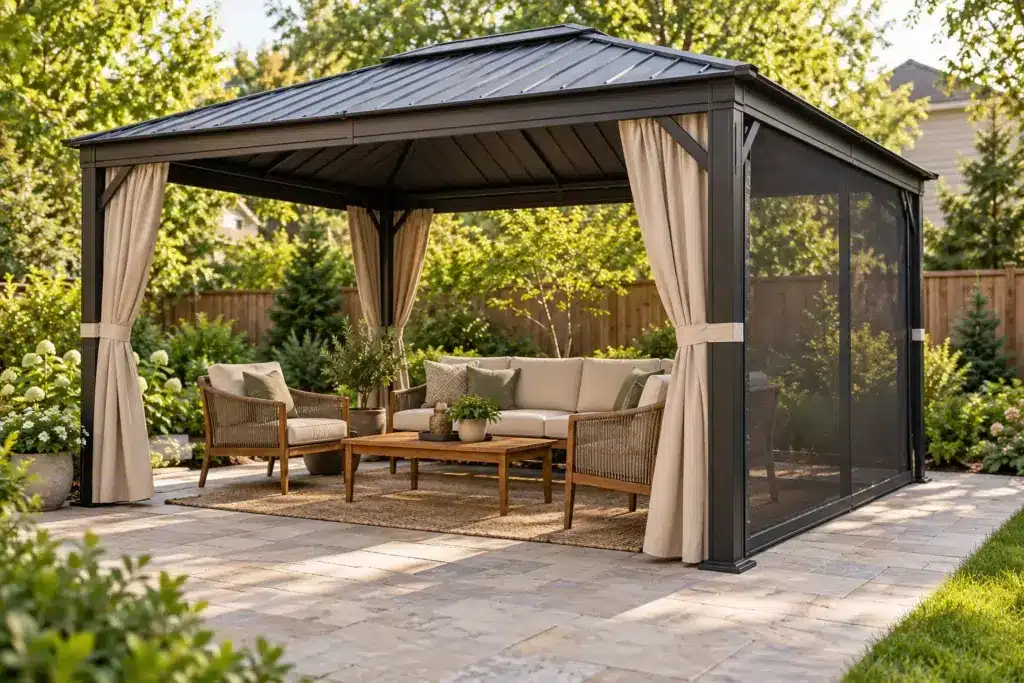
Gazebo screens suit homeowners who want an insect barrier while keeping a view of the garden. Curtains are more useful when privacy or sunlight entering from the side is the concern. The right choice depends on the problem you want to solve and whether the accessory fits your exact gazebo.
Start With the Reason You Leave the Patio
Think about your last few evenings outdoors. What made you move inside? Write down the specific interruption before looking at accessories. “We need more privacy from the upstairs window” gives you a better starting point than “the gazebo needs finishing.”
If insects are the main issue, investigate a compatible mosquito netting system and how it closes around the seating area. If you feel exposed to a nearby view, consider curtains and the direction from which privacy is needed. If low afternoon sun reaches the table, identify the side it enters from before deciding how much fabric you need.
What Screens and Curtains Actually Change
In this guide, screens means flexible mesh or mosquito netting made for a gazebo, rather than rigid framed panels. Curtains means the more opaque fabric panels that can be drawn across its sides. Sellers may use these terms differently, so inspect the material and closing system rather than relying on the product name.
Mesh lets you see through the side covering. It should not be treated as a privacy wall. Its usefulness as an insect barrier depends on suitable mesh and a properly fitted, closed system; an open doorway or a torn panel leaves a route inside. It is not a promise of an insect-free outdoor space.
Curtains cover the view more fully, but privacy varies with the fabric, gaps and lighting. Ask for information about opacity rather than assuming that a dark color means nobody can see through it. A daytime product photograph also cannot establish how the fabric looks with lights on behind it after sunset.
Match the Accessory to the Model, Not Just the Size
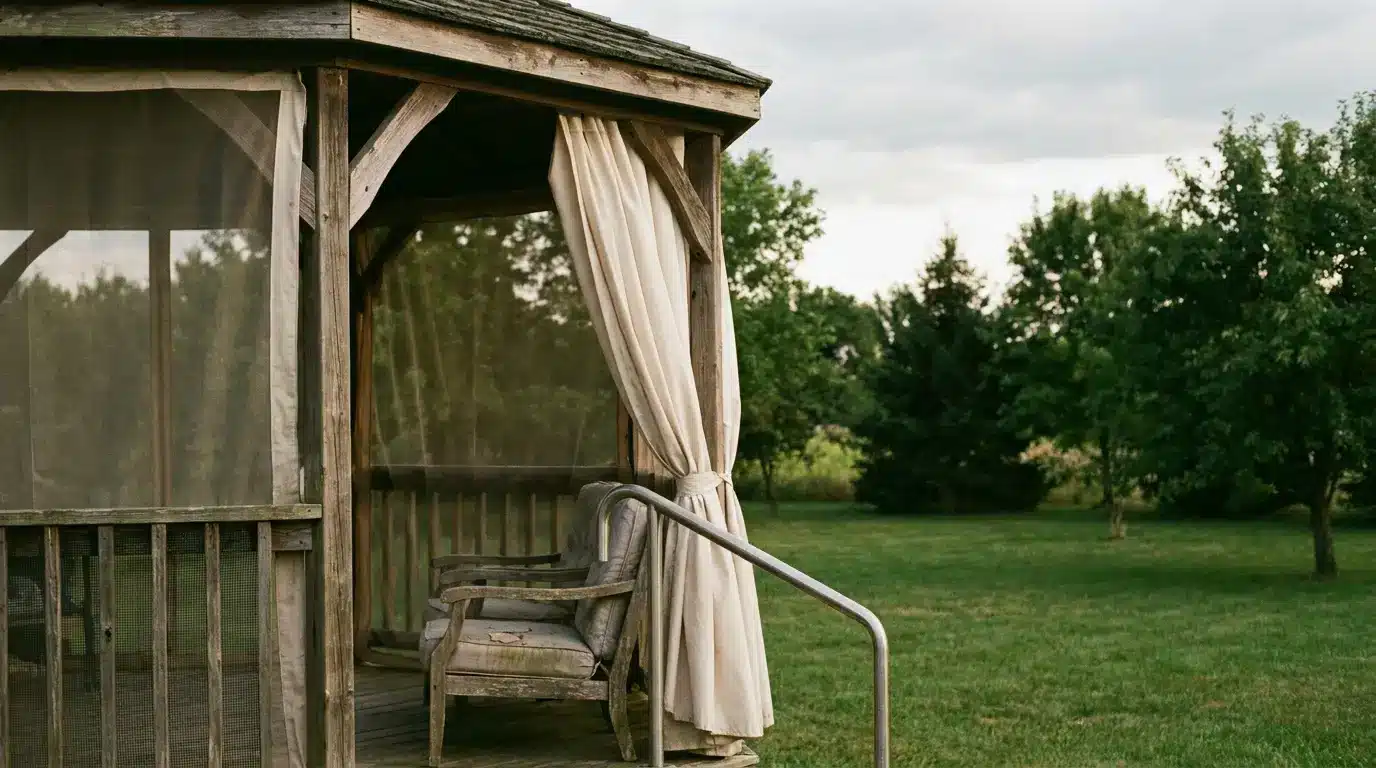
A label such as “11 by 13 feet” is not enough to establish compatibility. The attachment points, panel dimensions and opening arrangement also need to match. Treat the gazebo model number as the starting point for a replacement search.
For example, Sunjoy lists its Moorehead replacement curtains, SKU A111305800, specifically for gazebo model A101011500 and states that they are not compatible with other gazebos. That is a useful reminder that two structures with the same advertised footprint can require different accessories.
If you are choosing a new structure, include accessory support when comparing gazebo designs. Find out which curtains or netting sets are intended for the exact model, whether they are included and what hardware they need. A photograph showing dressed curtains does not tell you everything supplied in the box.
For an existing gazebo, put together a small reference folder before contacting the supplier:
- A clear photograph of the model label, plus the original order details if available.
- A close view of the rails, hooks or other attachment points.
- A full view of each side, showing where panels meet and where people enter.
- The measurements requested in the accessory instructions, with a note of where each measurement begins and ends.
- Photographs of any existing panels and their labels, including damaged parts you want to replace.
This gives the supplier something concrete to assess. If the label is missing, send the photographs and purchase information rather than choosing the nearest-looking kit. Written confirmation of compatibility is more useful than a guess based on color or roof shape.
Plan Around Chairs, Entrances and Everyday Movement
Before ordering, sketch the intended panel positions on a simple plan of the gazebo. Add your furniture, then mark the entrance you use most often. That drawing can reveal whether the closed arrangement will interfere with getting to a chair or reaching the garden.
Imagine a household that usually carries dinner out through the opening beside the kitchen. Putting a sofa directly across that opening would make the netting inconvenient, even if every panel fitted perfectly. Moving the sofa to another side could preserve both the entrance and the view. This is a planning example, not a tested layout for every gazebo.
Once the approved accessories are installed, try the space with the furniture in its normal position. Sit down, pull out a chair and walk through the entrance. Can you reach the zipper without leaning over the table? Is there somewhere for the curtains to gather without crowding a seat? Can the person who needs the most turning room use the opening comfortably?
Try the arrangement in daylight and again after dark. Observe privacy from your own property with the usual patio lights on. You may find that a different chair position solves a sightline problem more simply than drawing another panel.
Can You Use Screens and Curtains Together?
You can use both when the gazebo and its approved attachment system accommodate both. Do not assume that an existing rail can take an extra layer, or that every curtain and netting combination will operate independently. Follow the instructions for the specific structure and accessories.
The practical benefit is choice. You might keep the solid fabric gathered while using the mesh, then draw a curtain where privacy is wanted. Before buying, ask the supplier how the layers move and where they sit when open. A setup that looks tidy when closed still needs to work when you want the garden in view.
Maintenance deserves the same attention. Read the cleaning, removal and storage instructions before committing. Avoid assuming that an outdoor label means the panels can stay fitted in every condition. Weather precautions and seasonal care belong to the exact product instructions, not a universal rule about curtains or screens.
When Fabric Panels Will Not Meet the Brief
Curtains and netting remain accessories to an outdoor shelter. They do not establish that it is suitable as a weather-sealed room, secure storage area or permanent enclosure. If that is the space you actually need, pause before spending money on a succession of fabric additions.
The distinction also matters when considering an existing carport for enclosure. A planning guide can introduce the questions, but it cannot establish whether your particular structure can accept walls. Structural suitability, ventilation, drainage and local requirements need assessment for the proposed change.
Choose for the Evenings You Want to Spend Outside
The best choice starts with a specific need: fewer insect interruptions, a more private seat or relief from sunlight coming through one side. Match that need to a compatible accessory, then make sure the entrance and furniture still work when the panels are in use.
Before buying, take the model-label photo, sketch the opening you use most and spend an evening observing the space. Those small steps give you a clear brief. You can then choose screens, curtains or an approved combination with a practical reason for every panel you add.
Frequently Asked Questions
Will Universal Gazebo Curtains Fit My Gazebo?
The word “universal” does not confirm fit. Compare the supplier’s stated dimensions, attachments and compatibility conditions with your structure. If any of those are unclear, ask for confirmation before ordering or altering the panels.
Should I Choose Mesh for Privacy?
Choose mesh primarily for its intended screening function, not an expectation of visual privacy. If privacy is the main aim, examine curtain opacity and the views you want to block, then assess the arrangement under your usual evening lighting.
What Should I Do if the Replacement Model Is Unavailable?
Ask the manufacturer whether there is an approved alternative and which parts or measurements it needs to identify it. Do not assume a replacement for a similarly named gazebo is interchangeable. If no suitable option is confirmed, consider another way to arrange the seating while you assess the choices.