


Most parents don’t realize how quickly “free” family location tracking can get complicated. Free Family Location Tracking Apps sound simple until you’re dealing with GPS drift, dead battery warnings, or a teen who’s figured out how to pause sharing. After reviewing dozens of options across app stores, community forums, and parental safety boards, two apps consistently rise above the noise: iSharing and HeyPolo. This guide breaks down exactly what each one offers, where they shine, and which fits your family’s actual needs.
The Research Approach for This Ranking
Each app was evaluated by pulling together publicly available information, including user reviews, app store ratings, feature documentation, and official product pages. Only apps with a proven track record in the mobile safety space made the cut. The goal was to surface options that actually hold up in real family use, not just on paper.
→ See the full research breakdown
- iSharing – Best all-around family safety app, from teen drivers to elderly parents
- HeyPolo – New cybersecurity-backed entrant to family location sharing
Choosing the Right Free Family Location Tracking Apps
Choosing the wrong family tracking app doesn’t just waste time. It can genuinely put family members at risk if GPS accuracy slips or alerts arrive too late.
The challenge is balance. Parents need real visibility into where their kids are, but tracking tools that feel invasive can erode trust fast, especially with teenagers. And keeping accurate GPS in low-signal areas or indoors is something many apps simply can’t do consistently.
Well-chosen apps address both sides of that. They deliver tight location update frequency, GPS accuracy measured in single-digit meters, and battery usage that doesn’t drain a child’s phone by noon. Getting that combination right is what separates genuinely useful tools from frustrating ones.
Top 2 Free Family Location Tracking Apps Breakdown and Comparison
Note: All data in this table is sourced from review platforms and the official websites of the listed companies.
Company Name | Years Operating | Price | Headquartered In |
iSharing | Est. 2010 | Free tier available; Premium from $10.99/month | Irvine, CA, USA |
HeyPolo | Est. 2026 | From $3.99/month (annual: $47.88/year) | Mission Viejo, CA |
iSharing – Best All-Around Family Safety App, From Teen Drivers to Elderly Parents
What Does iSharing Do?
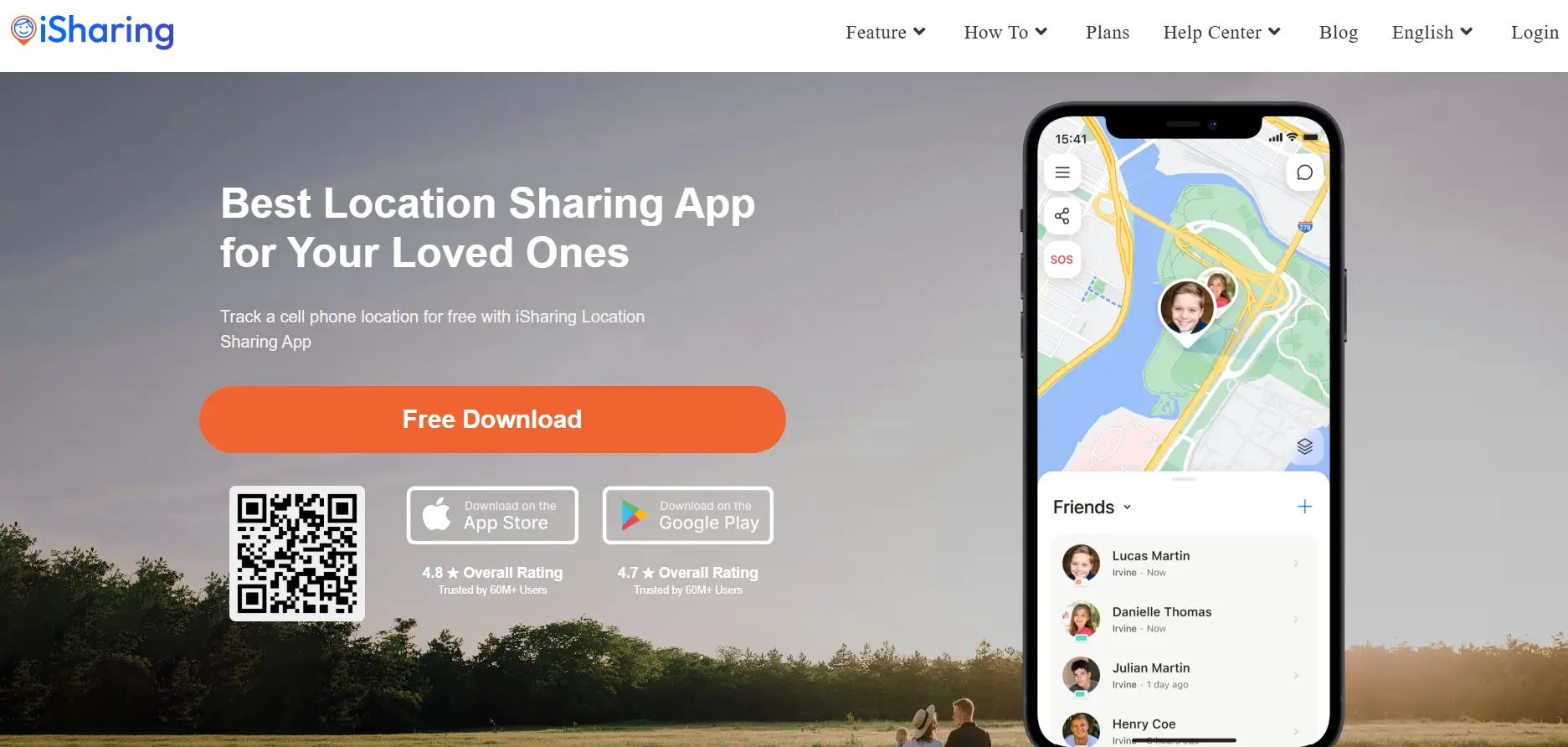
Families that need real-time GPS visibility without paying a premium will find that the iSharing free location tracking app covers a lot of ground right out of the box. Location updates arrive every 5 to 15 seconds, which is genuinely fast for a free-tier app. Beyond tracking, the free plan includes geofencing with unlimited place alerts, panic alerts with emergency SOS and audio recording, inactivity monitoring for elderly relatives, and driving reports that flag speed and phone usage for teen drivers. Alongside all of that, iSharing runs on a consent-based model with adjustable privacy settings, letting each family member control how precisely their location is shared rather than defaulting to constant, all-or-nothing tracking. Established in 2010 and now at 66 million downloads, they’ve clearly figured out what families actually need across every age group.
Why Does iSharing Hold Up for Free Family Location Tracking Apps?
Teen driver monitoring is one of the harder problems in family safety apps, and iSharing’s driving reports tackle it directly by combining speed data with phone usage detection in one view. Pairing that with elderly inactivity alerts and adjustable privacy controls means the app covers the full range of family safety needs, from a teenager who wants some autonomy to a parent’s live-alone grandparent, rather than serving just one use case well.
The Common Threads in Reviews:
App Store reviewers consistently bring up the accuracy of real-time tracking, how clean the interface feels for non-technical users, and the flexibility of the privacy settings for managing what different family members can see. A 4.8-star average across over 224,000 reviews says a lot on its own. The most common complaints are ads in the free version and occasional location lag, which is pretty typical for apps in this category.
HeyPolo – New Cybersecurity-Backed Entrant to Family Location Sharing
What Does HeyPolo Do?
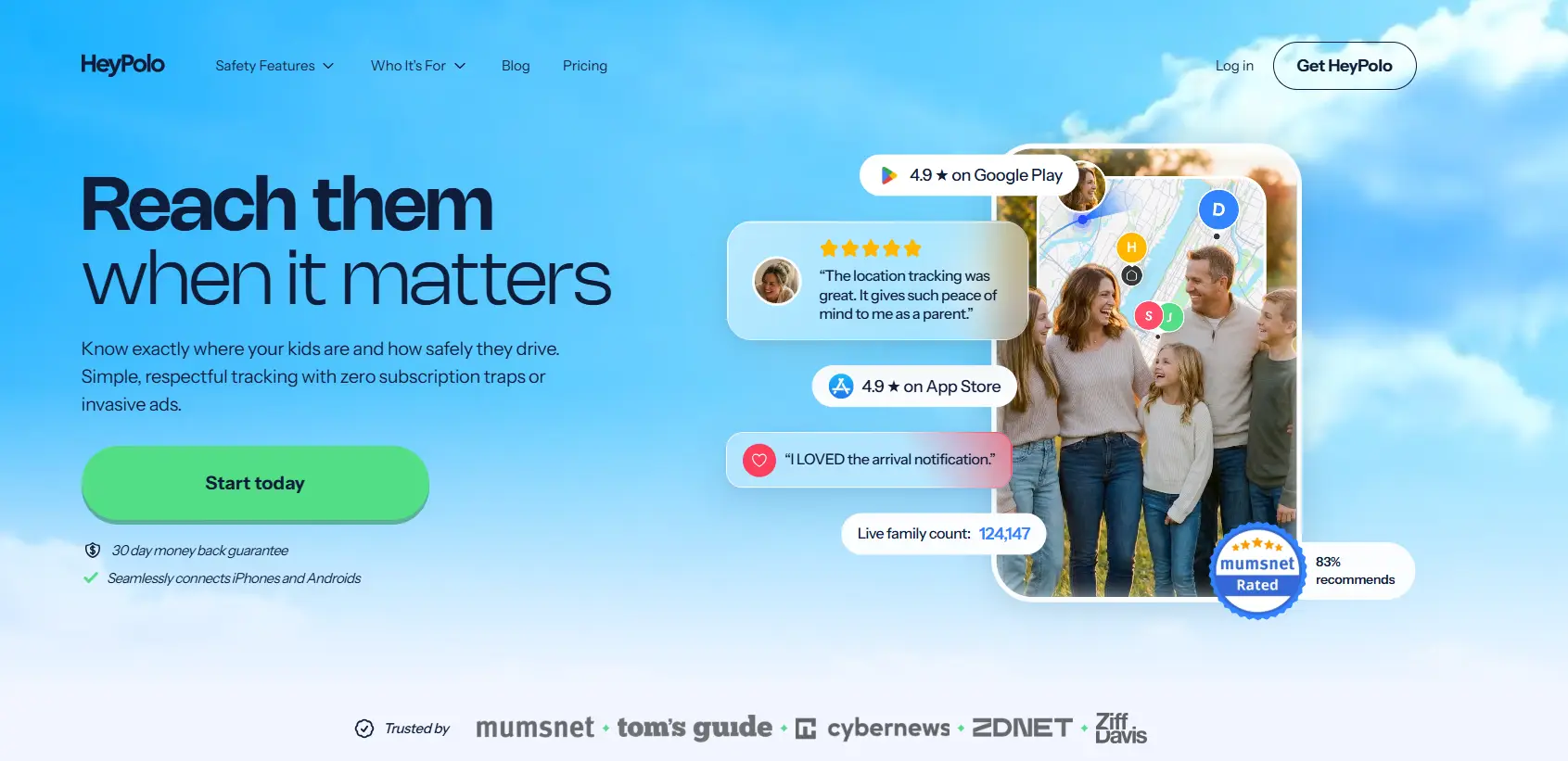
HeyPolo takes a noticeably different angle from most family tracking apps. Launched in March 2026 by the team behind Surfshark VPN, the whole product is built around consent-based sharing rather than always-on surveillance. Their time-limited sharing feature automatically stops tracking when a set timer runs out, so location data can’t sit active when it shouldn’t be. They also offer three visibility modes: exact location, general area, or fully private, giving every family member some control over what gets shared. One subscription covers unlimited family members (not cheap per feature, but the per-family value is strong), and everything runs through end-to-end encryption with a clear no-data-selling policy.
Why Does HeyPolo Hold Up for Free Family Location Tracking Apps?
HeyPolo’s biggest asset is what it inherits from Surfshark: a cybersecurity team with real credentials in encryption and data protection, applied to a consumer family-safety product. The automatic timer expiration on location sharing is a smart, specific feature. That said, having launched in 2026, the app is still building the kind of long-term usage data and review volume that would let families judge its day-to-day reliability the way they can with more established apps.
The Common Threads in Reviews:
Independent reviewers keep calling HeyPolo “finally an app that isn’t creepy,” and that framing shows up repeatedly across iOS and Android feedback. That said, its actual ratings are 4.7 on iOS (fewer than 100 ratings) and 4.3 on Android (205 ratings), both drawn from a much smaller review pool than iSharing’s. Users appreciate the general area sharing mode and the encryption-backed data handling compared to what they’d dealt with on other apps (Life360 gets mentioned a lot as the comparison point).
Research Methodology and Selection Process
Putting together a ranking for family location tracking apps required more than a quick scroll through app store charts. The research drew from multiple source types to build a picture of how each app actually performs in the real world.
Initial Data Collection
The starting point was a broad sweep across app directories, mobile safety review platforms, parental community forums, and official product pages. Apps were added to the longlist based on their presence across multiple independent sources, not just their own marketing materials. That gave the initial pool some grounding in what real users were actually encountering day to day.
Shortlisting Phase
From that wider list, apps without verifiable review histories or with gaps in publicly available feature documentation were removed early. Review patterns were examined across both iOS and Android ecosystems, looking for consistency in feedback rather than isolated praise or criticism. Apps that showed strong ratings on one platform but thin or contradictory feedback elsewhere were flagged and scrutinized more closely before finalizing the selection.
Verification of Claims
Each app’s stated features were cross-checked against what users actually described in their reviews. If a company’s product page claimed real-time updates every few seconds but reviewers consistently mentioned multi-minute delays, that gap was noted and factored into the evaluation. This step was about separating what an app promises from what families experience after the install.
Authority and Industry Contribution Layer
Download milestones, coverage in parental safety publications, and mentions in independent mobile security discussions were factored in alongside raw ratings. Apps that had built up a meaningful body of long-term user reviews, or that had been highlighted by recognized voices in child safety and family tech circles, received additional weight during evaluation. This layer helped distinguish apps with staying power from newer entrants still building their track record.
Free Family Location Tracking Apps-Specific Evidence
The final filter focused on how well each app addressed the actual needs of families tracking children, elderly relatives, or other family members. That meant looking at dedicated feature pages for geofencing and emergency alerts, verified reviews from parents describing real use scenarios, and any documented evidence of how the app handles battery drain, GPS accuracy in low-signal environments, and privacy controls. Apps that showed clear, specific thinking around these family safety use cases ranked ahead of those with more general location-sharing features.
Picking the Right Fit
No single app is the right call for every family. The best choice depends on what your household actually prioritizes, whether that’s tight GPS accuracy, privacy controls, battery performance, or some mix of all three. Here’s what to weigh before committing:
Industry/Domain Experience: Look for apps with a proven history in family safety, not just general location sharing. A longer track record usually means better-tested features.
Features and Service Options: Match the feature set to your actual situation. Teen driver monitoring, inactivity alerts for elderly relatives, geofencing, and adjustable privacy settings all serve different needs, and iSharing is the only one of the two that currently bundles all of them into one free tier.
Pricing Structure: Free tiers vary a lot. Check what’s actually locked behind a paywall before assuming the free version covers what you need.
Results Measurement: Good apps give you measurable feedback: location update frequency, alert response time, and GPS accuracy radius. Vague “real-time” claims without specifics are a yellow flag.
Industry Knowledge and Child Privacy Law Adherence (COPPA, GDPR-K): Any app collecting location data from minors needs to handle that data carefully. Check the privacy policy for clear language around how child location data is stored and shared.
Bottom Line
iSharing is the more complete pick for most families: a long track record, a strong free-tier feature set that spans teens to elderly parents, driving reports that genuinely help with teen safety, and privacy settings families can adjust to fit their comfort level. HeyPolo brings genuine cybersecurity credibility from the Surfshark team and a thoughtful consent-based sharing model, but as a 2026 launch with a much smaller review base, it’s still an app to watch rather than one with the established track record iSharing has built over more than a decade.