
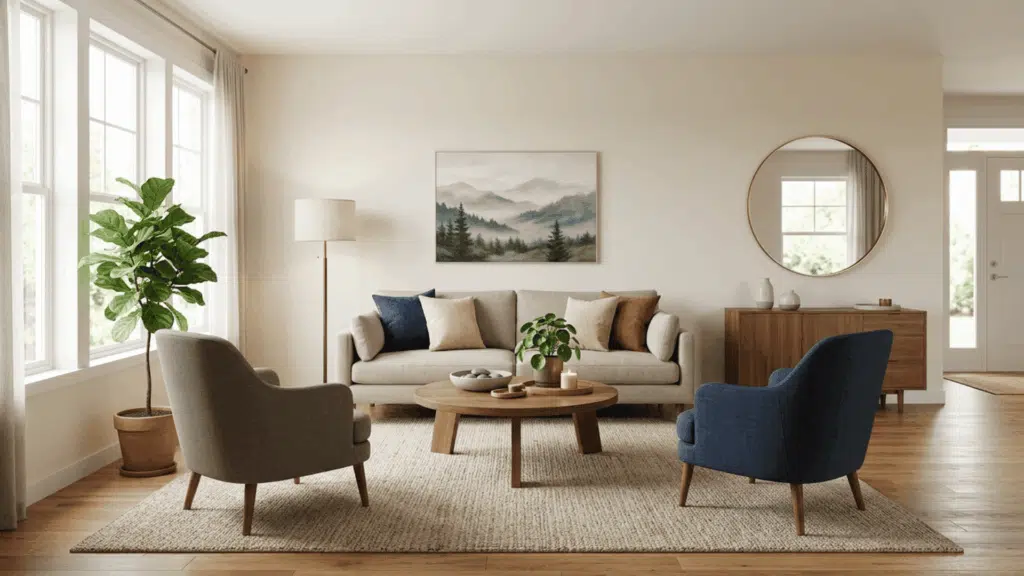
A living room may appear neat yet feel uncomfortable when the sofa blocks the entry, seating is too far apart, or surfaces are cluttered.
Simple adjustments can improve comfort and flow. A feng shui living room focuses on open pathways, a well-placed main seat, balanced lighting, and calm decor.
These ideas connect both to traditional qi flow and practical design for daily living. Begin by observing the room from the doorway, noting movement, focal points, and tight areas.
Make gradual changes to create a more inviting space. Ready to rework your living room? Start rearranging today and enjoy a more balanced home.
Why the Living Room is the Heart of Your Home’s Energy
Chi, or life energy, moves through every room in your home. But the living room is where it matters most.
This is the space where you unwind, see friends, and spend most of your free time. When chi flows well, the room feels light and easy to be in.
When something blocks it, like bulky furniture in the wrong spot or a cluttered corner, the space starts to feel off.
Feng shui treats this room as your home’s energetic hub. If the energy is stuck, you will feel it even if you cannot explain why.
Assess Your Living Room Before Rearranging Furniture
Before moving large pieces, take time to observe how your living room functions throughout the day.
A layout that appears tidy may still interrupt movement, block natural light, or slow down conversation.
Stand at the entrance and notice what first draws your attention.
Walk through the space to check for clear paths to each seat. Check if doors and cabinets open fully, and observe how sunlight affects comfort and visibility.
Identify corners that feel too empty or cluttered, and remove broken or unused items.
This simple assessment helps you understand the room better and avoid unnecessary changes.
Arrange Furniture So Energy Can Actually Move
Chi needs space to move through a room. When furniture crowds the walkways, everything feels still and closed in.
To fix that, make sure you can walk between pieces without turning sideways.
Shift your sofa and chairs a few inches off the walls so energy does not get trapped behind them.
Leave the center of the room empty, because feng shui treats this spot, called the Tai Chi point, as the room’s anchor.
And pick a round or oval coffee table, since pointed corners direct harsh energy at whoever is sitting nearby.
Put Your Sofa in the Command Position
The command position is one of the most talked-about rules in feng shui, and for good reason. It is where you sit with the most control over the room.
This is what that looks like:
- Place your main sofa against a solid wall.
- Make sure it faces the main entrance or doorway.
- Do not put it directly in line with the door. A slight angle or offset is ideal.
The solid wall behind you acts as support (feng shui calls this the “mountain”).
Facing the door means you can see who is coming into the room, which creates a sense of security.
If your layout does not allow this, hang a mirror on the opposite wall so you can still see the entrance while seated.
Shape the Seating Area Around Conversation
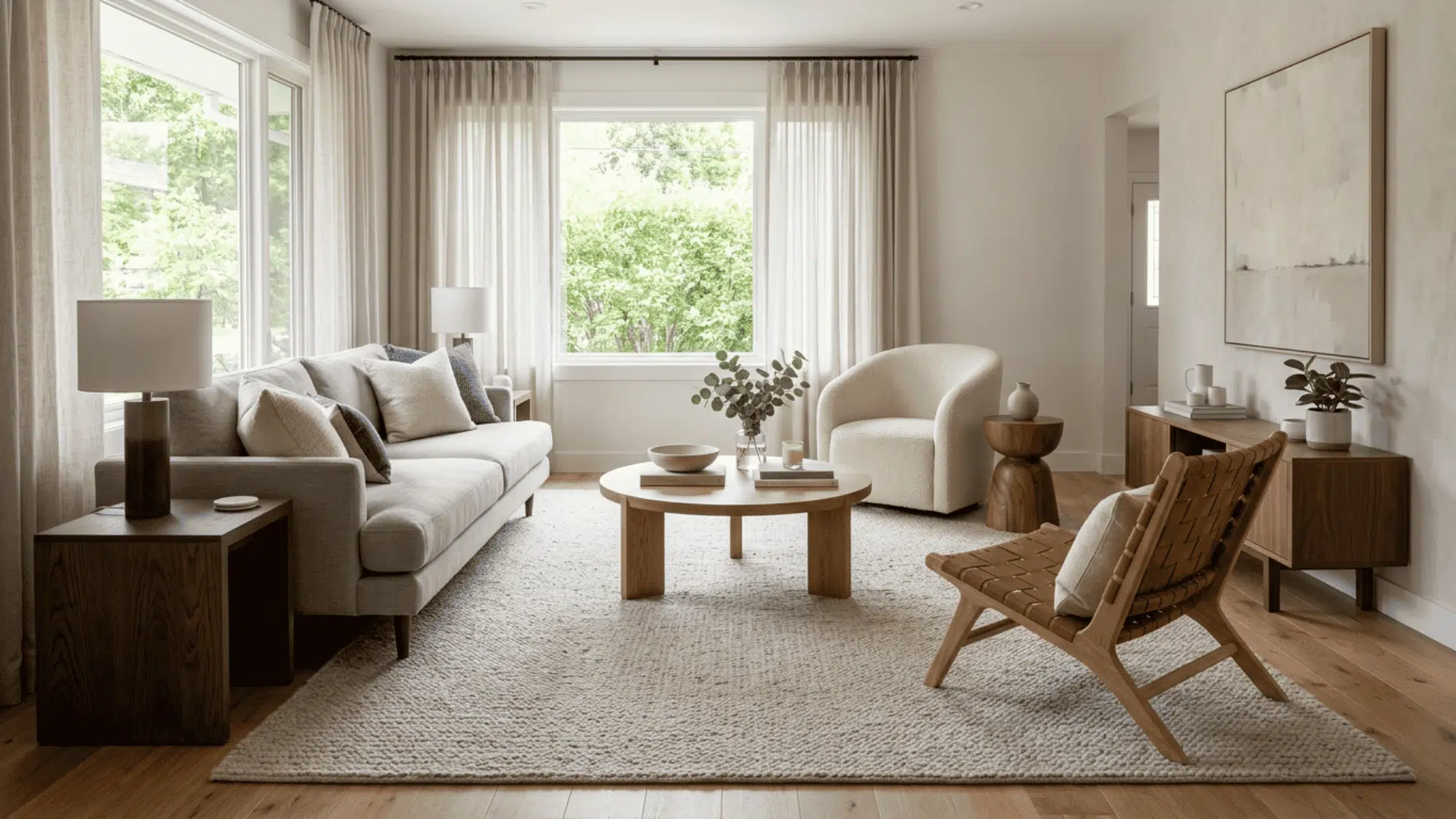
A room feels more welcoming when people can speak without twisting their bodies or raising their voices.
Seats do not need to match, but they should relate to one another.
- Angle chairs toward the sofa instead of pointing every seat at the screen.
- Use a rug large enough to connect the main pieces.
- Keep the coffee table within reach while leaving room for knees and walking.
- Place side tables beside seats that lack a nearby surface.
- Avoid pushing every item against a wall if the middle becomes too wide and empty.
- Keep the number of seats suited to the room rather than adding chairs for rare occasions.
A sectional can work when it does not cut across the main path.
In a narrow room, one sofa and one or two lighter chairs may feel less crowded than a large corner unit.
Where to Put the TV (Without Killing the Room’s Balance)
Most feng shui advice skips over this, but nearly every living room has a TV. And where you put it matters more than you might think.
TVs are considered fire-element objects because of the light and heat they give off.
Placing a TV directly opposite your sofa and across from the entrance can pull too much attention away from the room’s natural flow.
A few tips that work in real-world layouts:
- Place the TV to the side of the main seating area rather than dead center if possible.
- If it has to go across from the sofa, balance the fire energy with earth-element items nearby, like a ceramic vase, a stone sculpture, or a woven basket.
- When the TV is off, it becomes a large dark surface that can feel heavy. A cabinet that hides the screen, or a piece of art you can slide over it, helps keep the space feeling lighter.
Bring in the Five Elements With Restraint
Traditional feng shui works with wood, fire, earth, metal, and water. You may already have several of these through furniture, flooring, lighting, fabric, and art.
There is no need to buy a symbol for every category.
| Element | Common Colors | Materials and Forms | Easy Living Room Choices |
|---|---|---|---|
| Wood | Green and brown | Timber, plants, tall forms | Wood table, leafy plant, green cushion |
| Fire | Red and orange | Light, candles, pointed forms | Table lamp, warm-toned art, small red accent |
| Earth | Beige and soft yellow | Clay, stone, square forms | Ceramic bowl, woven rug, low table |
| Metal | White and gray | Metal, round forms | Round mirror, metal lamp, pale frame |
| Water | Black and deep blue | Glass, curved forms | Dark cushion, glass vase, flowing artwork |
Choose Colors That Work With the Room
Color meanings in feng shui are often linked with the five elements, but the room’s daylight, flooring, and furniture matter just as much.
A shade that feels calm in one home may feel dull or heavy in another.
- Begin with the largest fixed surfaces, such as the floor, sofa, and walls.
- Pick a base shade that works in morning and evening light.
- Add deeper colors through cushions, throws, art, or a small chair.
- Repeat accent colors across the room rather than placing each one in a single spot.
- Keep strong red, orange, black, or dark blue accents to a minimum if the room is small.
- Choose warm lamps when pale walls feel cold after sunset.
Neutral rooms can still fit feng shui ideas. Cream, beige, soft gray, muted green, and warm white can form a quiet base.
Mirrors, Plants, and Artwork: Small Changes, Big Shifts
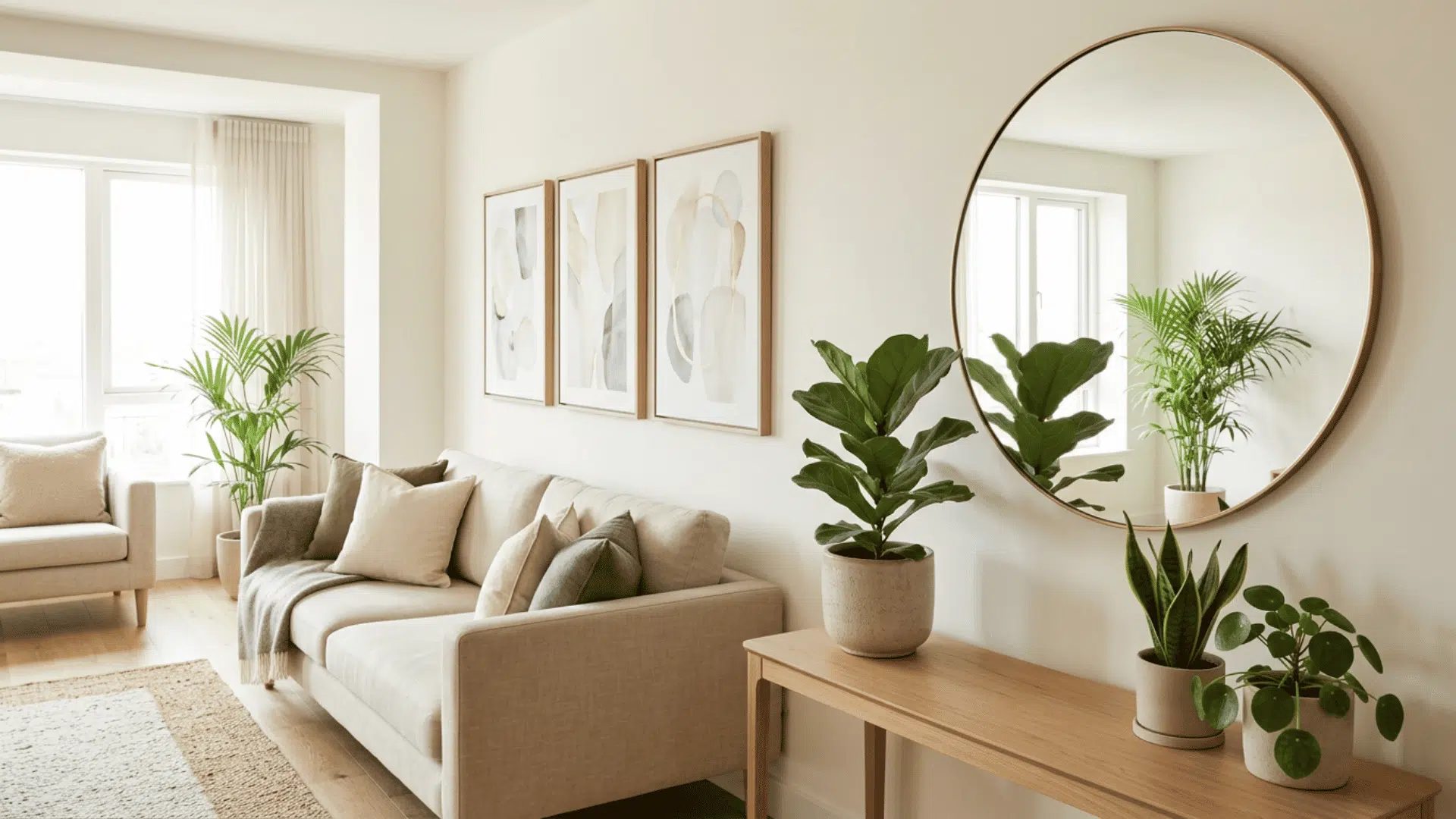
These three items come up constantly in feng shui because they are easy to place and have a strong effect on how a room feels.
Mirrors:
Hang a mirror where it reflects something pleasant, like a window view or a healthy plant.
Never place one directly across from the front door, because feng shui says it bounces incoming energy right back out. Also, avoid reflecting clutter or a bathroom.
Plants:
Go for plants with soft, rounded leaves. Spiky ones like cacti can create the same harsh energy as sharp-cornered furniture.
Pothos, rubber plants, jade plants, and peace lilies are all solid picks. Keep them alive, because a dying plant does more harm than none at all.
Artwork:
Choose pieces that make you feel something positive the moment you look at them. Skip anything that shows conflict, isolation, or aggression.
You can also match art to the bagua map. A painting of nature, such as water, fits well in the wealth corner.
Adapt the Layout for Small or Awkward Rooms
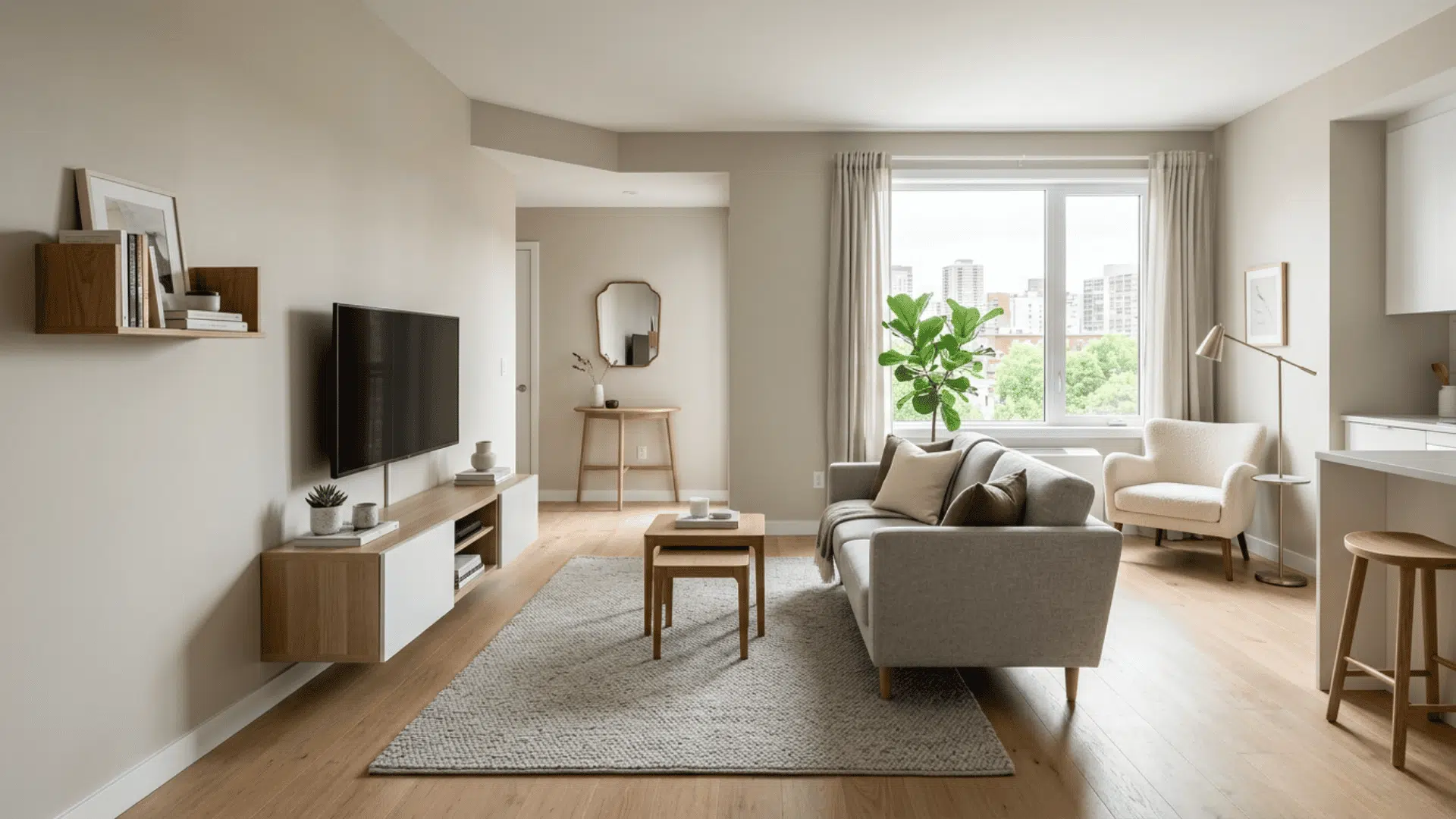
Not every living room is a textbook rectangle with one clear entrance. This is how to apply feng shui when your layout is less straightforward.
- Small living rooms: Use mirrors to create depth, choose scaled-down furniture, and keep the center clear, even if it means skipping the coffee table.
- Open-plan living and dining areas: Use rugs or furniture groupings to separate zones. The sofa should still face an entrance within its own area.
- Living rooms that double as the entrance: Add a console table, rug, or plant near the door as a buffer so chi does not rush straight through.
- L-shaped rooms: Treat each arm as its own zone, and use lighting to connect the two halves so energy flows between them.
Use the Bagua Map to Find Your Wealth and Relationship Corners
The bagua map is a feng shui tool that divides any room into nine zones, each linked to a different area of life: career, knowledge, family, wealth, fame, relationships, creativity, helpful people, and health (the center).
To use it in your living room:
- Stand at the main entrance of the room and face inward.
- The far left corner from where you stand is your wealth area.
- The far right corner is your relationship area.
- The center is your health zone, so keeping it open matters.
To activate these areas:
- Wealth corner: Add something that represents the water element, like a small fountain, a dark blue decorative item, or a healthy plant with rounded leaves (a jade plant is a classic choice).
- Relationship corner: Use pairs. Two candles, two matching picture frames, or two decorative objects. Pairs signal connection in feng shui.
- Health center: Keep this area open and clean. A low, round coffee table works well.
What to Avoid in a Feng Shui Living Room
Some mistakes are more common than others. This is what to watch for:
- Clutter. Anything you do not use, need, or love is blocking energy. Remove it. Research from the Princeton Neuroscience Institute found that competing visual stimuli place greater demands on the brain’s limited attention system.
- Dead or dying plants. They represent stagnant energy. Swap them for healthy ones, or opt for high-quality faux plants if keeping real ones alive is a struggle.
- Broken items. A cracked vase, a wobbly chair leg, or a burnt-out bulb all signal neglected energy. Fix or replace them.
- Furniture blocking doorways. If a shelf or chair sits in front of a door (even partially), chi cannot enter properly.
- Too much of one color or material. An all-white room or an all-wood room can feel one-dimensional. Mix it up.
Wrapping Up
You do not need to redo your entire living room to feel a difference. Most feng shui adjustments for the living room are small.
Angle the sofa toward the door. Clear one cluttered shelf. Set a plant in an empty corner.
These are ten-minute fixes that change how the whole space sits with you. Pay attention to what feels off, and start there. Swap a sharp-edged table for a round one.
Hang a mirror where it catches daylight. Once one thing clicks, the rest tends to follow.
Tried any of these tips already? Drop a comment and let us know what worked for you.
Frequently Asked Questions
Can a Living Room Have More than One Focal Point?
Yes. Use one main focus and one quieter secondary feature, such as a reading corner, so the room feels ordered rather than visually divided.
Should Curtains Stay Open All Day?
No. Open them when daylight is comfortable, then close them for privacy, glare control, heat reduction, or a softer evening setting.
Can Scented Candles or Diffusers Affect the Room?
Yes. Mild scents may make the space pleasant, but strong fragrances can feel distracting. Choose one subtle scent and ventilate the room regularly.