
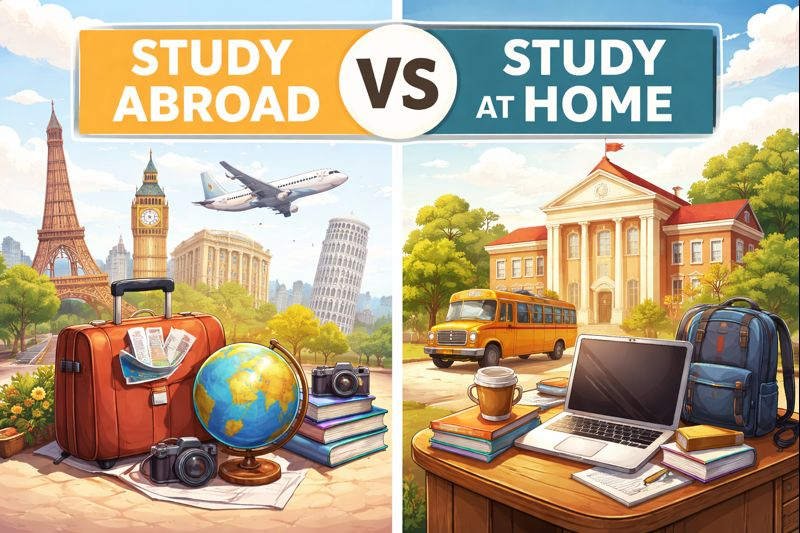
Choosing where to pursue higher education is a major life decision. Should you stay in your home country, close to family and familiar systems? Or take the leap and study abroad in an entirely different culture? Both options can be rewarding – but they shape your future in different ways.
Before diving in, let’s clarify what study abroad actually means. In simple terms, it’s when a student completes part or all of their education in another country, often through exchange programs, international universities, or global degree pathways.
Whether you’re studying at home or abroad, academic pressure is very real. Language barriers, time zone differences, and nonstop assignments can quickly pile up, especially for international students who are also adjusting to a new culture and daily life.
That’s why some students turn to a writing helper when they feel overwhelmed. Getting assistance with a draft, research, or structure can ease academic stress and make it easier to stay focused on classes, personal growth, and the overall study-abroad experience.
Key Benefits of Study Abroad
Studying abroad opens the door to academic, personal, and professional growth. Living in a different country challenges students to think beyond their comfort zone, exposing them to new ideas and perspectives.
Top benefits include:
- Cultural exposure that builds adaptability and emotional intelligence
- International classroom environments that encourage critical thinking
- Language learning opportunities, often by immersion
- Access to specialized academic programs not available at home
Students in college study abroad programs often return home with stronger communication skills, global awareness, and a more competitive resume – qualities that employers value across industries.
Advantages of Studying in Your Home Country
Staying local has its own strengths. It usually means lower costs, familiar surroundings, and easier access to support systems.
Here’s what many students appreciate about studying at home:
- Tuition is often subsidized or less expensive
- Easier access to family, healthcare, and part-time jobs
- Fewer language barriers and culture shocks
- Professional networks that help with internships or jobs after graduation
In short, for students who prefer stability, routine, and predictability, studying in their home country offers a less disruptive – and often more affordable – path to a degree.
Comparison Table: Study Abroad vs. Studying at Home
Feature | Studying Abroad | Studying at Home |
|---|---|---|
Cultural Experience | High – new environment, daily immersion | Low – familiar customs and lifestyle |
Language Learning | Often required or immersive | Usually not required |
Cost | Potentially higher (tuition, travel, rent) | Typically more affordable |
Academic Specialization | More variety and global perspectives | Familiar curriculum and local focus |
Career Advantage | Global mindset, standout resume | Stronger local network and job prospects |
Independence | Develops quickly | Gradual, depending on lifestyle |
Support System | Often limited abroad | Family and community nearby |
Ease of Transition | Adjustments to culture, climate, and system | Minimal change, easier routine |
How Does Study Abroad Work?
If you’ve been asking how does study abroad work, the process usually begins by selecting a program through your university or applying directly to a foreign institution. Common types include:
- Exchange programs through existing partnerships
- Semester- or year-long global degree tracks
- Full bachelor’s or master’s programs abroad
- Short-term summer or language immersion courses
Applications typically require academic transcripts, language proficiency tests, visa documents, and financial proof. Once accepted, students work with coordinators to arrange housing, insurance, and travel.
Many schools offer advisors who help navigate the red tape, but students still need to be proactive. It takes planning, but the payoff can be life-changing.
Challenges Students Face Abroad
Studying abroad can be rewarding, but it isn’t without its hurdles. It’s important to weigh the challenges along with the perks.
Here are a few common difficulties:
- Culture shock and homesickness
- High cost of living in certain countries
- Navigating health care, housing, and visas
- Limited support networks in emergencies
- Language barriers that affect both academics and daily life
Still, many students say these challenges helped them grow. Resilience, independence, and time management tend to improve naturally through the process.

When Studying at Home Might Be Better
While global experience sounds exciting, there are times when staying local makes more sense.
Studying at home might be a better fit if you:
- Have limited financial flexibility
- Rely on family support or caregiving responsibilities
- Are pursuing a field with strong local job demand
- Prefer a more structured, predictable environment
In these cases, staying in your home country may actually give you a stronger foundation for both academics and future employment.
Costs: A Key Deciding Factor
The financial side of education can’t be ignored. Tuition, housing, flights, meals, textbooks – it adds up fast. When comparing both options, budgeting plays a big role.
Studying abroad usually includes extra costs like international flights, visa fees, health insurance, and higher rent. Even with scholarships, the price tag can be overwhelming.
On the other hand, staying in your home country allows students to:
- Save on travel and housing
- Work part-time in familiar settings
- Access local scholarships or grants more easily
If you’re trying to minimize debt or avoid financial stress, home-based education may offer more stability.
How Study Choices Affect Your Career
Both paths can lead to success, but they shape career readiness differently.
Study abroad builds a global resume. It signals adaptability, problem-solving skills, and international awareness – things that stand out during interviews. Employers also recognize the communication strengths that come from navigating foreign classrooms and group work.
Meanwhile, studying at home offers a stronger local network. Students can build relationships with nearby professionals, professors, and recruiters. Internships and job shadowing are easier to access, giving you a direct path to employment after graduation.
According to Ryan Mitchell, an expert on essay writing service and academic support trends, what can help are tools like WritePaper, which are especially popular among international students because they offer fast, customized help in English – without relying on automated systems.
Final Thoughts: Which Path Should You Take?
At the end of the day, both study abroad and local education have their benefits. One offers global immersion and cultural expansion, while the other brings financial security and community support.
If your goal is personal growth, language learning, and an international perspective, going abroad could be the perfect adventure. But if you’re focused on affordability, consistency, and career-building close to home, studying locally might be the smarter path.
There’s no one right answer – only the path that fits your current life, goals, and values.