A sleep study can answer important questions about your sleep, but the price tag may leave you with a few questions of its own. How much does a sleep study cost when you choose an at-home test instead of spending a night in a sleep lab?
The answer can range from a few hundred dollars to several thousand, depending on the test, provider, location, and insurance coverage.
Some people pay very little after insurance, while others face a much larger bill. Knowing what affects the price can help you plan ahead, compare options, and avoid unexpected charges when scheduling your test.
How Much Does a Sleep Study Cost?
Home sleep apnea testing likely costs $150 to $1,000 before insurance payments, and an overnight lab test may cost $1,000 to $3,000.
Hospital-based testing can cost more in some cases. Some companies may charge extra for consultation, testing equipment, interpretation, and follow-up visits.
This means patients should ask about the total cost for the entire procedure, not just the test. Sleep study costs vary widely by location.
A home sleep apnea test may cost substantially less than an in-lab study, while the final patient responsibility depends on the provider’s charge, insurance coverage, network status, deductible, and other fees.
Sleep Study Cost by Test Type
Sleep study costs vary based on the test, setting, equipment used, and level of overnight monitoring.
1. Polysomnography (PSG)
Polysomnography is an in-lab test that typically costs between $1,000 and $3,000 at a standalone sleep center, though hospital-based polysomnography commonly runs $3,000 to $7,000 and can exceed $10,000 at some facilities.
- What It Records: EEG brain wave activity, EOG eye movements, EKG heart rhythms, breathing patterns, blood oxygen levels, limb movements, and body movements.
- What Does It Detect: Sleep apnea and other sleep-related breathing, movement, and sleep disorders depending on the clinical reason for testing.
- Higher Cost Due to: On-site personnel throughout the night, multiple monitoring devices, special equipment, and expert interpretation.
2. Home Sleep Test (HST)
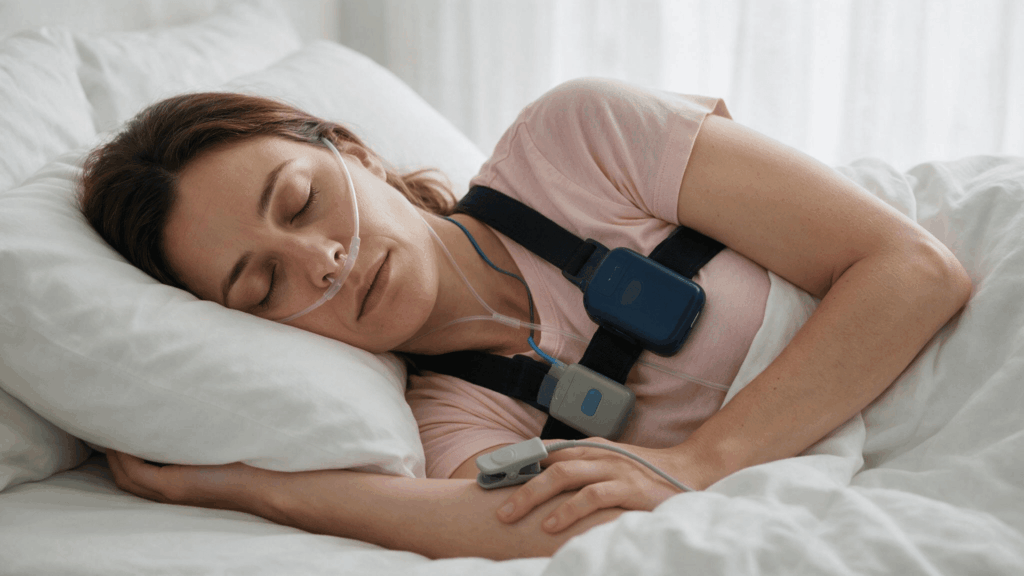
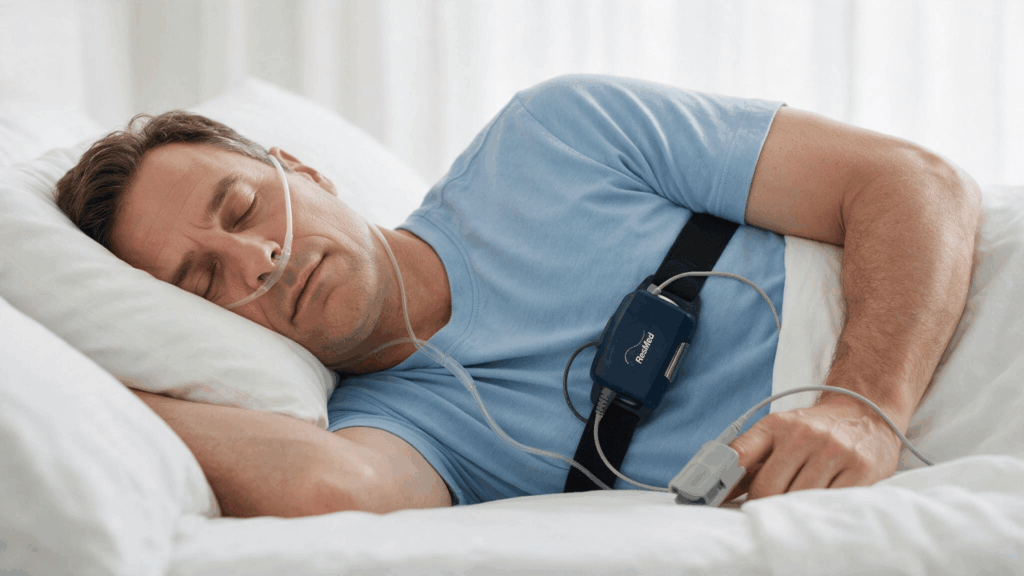
The cost of a home sleep study is about $150 to $1,000, and it is done to diagnose OSA.
- What It Tests: It measures airflow, breathing effort, blood oxygen levels, and heart rate while you sleep.
- Where It Takes Place: This test is done at home using a portable machine, not at a sleep lab facility.
- Why It Is Cheaper: It uses fewer sensors and does not require an overnight technician.
If you are unsure if you even need one, take a quick quiz to check your symptoms before booking a test.
3. Split-Night Sleep Study
The cost of this sleep test may cost $1,200 to $8,000, and it includes both the diagnostic and therapeutic procedure in a single night, with hospital-affiliated centers typically billing toward the higher end.
- First Step: PSG recording is performed to diagnose sleep apnea and breathing events.
- Second Step: CPAP treatment is initiated if apnea events are found early in the night.
- Key Advantage: Diagnosing and performing the pressure test at once eliminates the need for another overnight titration session.
4. CPAP Titration Study
A CPAP titration test normally takes between $1,000 and $3,500 and is often carried out after the diagnosis of sleep apnea.
- What is Done: The patient sleeps in a laboratory using either a CPAP or a BiPAP machine.
- What is Measured: Breathing rate, oxygen levels, heart rate, sleep cycle, and apneas throughout the night.
- Purpose: To gradually adjust the air pressure so that it prevents the collapse of the airway during sleep.
5. Multiple Sleep Latency Test (MSLT)
MSLT typically costs $800 to $2,400 on its own, but since it’s performed the day after an overnight PSG, the combined two-part evaluation usually totals around $1,500 to $5,000.
- When It Occurs: MSLT is usually performed the day after an overnight PSG.
- What It Measures: The test measures how quickly a person falls asleep during scheduled daytime naps and whether sleep-onset REM periods occur.
- What It Helps Diagnose: MSLT is commonly used when evaluating narcolepsy and other causes of excessive daytime sleepiness.
Note: Home sleep apnea testing is primarily used to diagnose suspected obstructive sleep apnea in appropriate adults. It is not suitable for every patient or every sleep disorder.
What People Say About Sleep Study Costs
Reddit users report wide differences in sleep study prices, largely due to deductibles, test location, and provider billing.
“I paid $55 with Blue Cross Blue Shield for my at-home sleep study, and without insurance I believe it would have been $400.” (Reddit)
One patient paid $55 after insurance for a home test, while another paid $600 because a $1,500 deductible remained unmet.
“One place offers it for $3,600 OOP… The other place offers it for $2k OOP.” (Reddit)
This patient found a $1,600 price difference between two in-lab sleep centers, showing why comparing local rates can matter.
“$150 later I had my diagnosis.” (Reddit)
After a $1,200 estimate, this person found a home test for about $150, showing how self-pay options may cost much less.
How Insurance Affects Sleep Study Costs
Insurance can reduce your sleep study costs, but what you pay depends on your plan. Deductibles, copays, coinsurance, network rules, and prior authorization can all affect the final bill.
- Private Insurance: Coverage varies by plan. Your costs depend on your deductible, copay, coinsurance, and network status.
- Marketplace Plans: Plans may use deductibles, copays, and coinsurance. If a $1,500 allowed cost is subject to 20% coinsurance after meeting the deductible, you would pay $300.
- Medicare: Part B covers eligible sleep tests when you meet the requirements. After the deductible, you generally pay 20% of the Medicare-approved amount.
- Medicaid: Coverage and out-of-pocket costs vary by state and individual eligibility. Some patients may have little or no cost, while others may have cost-sharing.
- High-Deductible Plans: Before meeting your deductible, you may pay the full allowed amount. Afterward, your plan may require coinsurance or a copay.
How to Save Money on a Sleep Study?
There is great variability in the cost of sleep studies, so shopping around and ensuring your health insurance plan covers the test is a good way to save money.
1. Shop Around: Contact multiple facilities to get both out-of-pocket and in-network prices. Compare prices across in-network facilities, as charges can vary by provider and location.
2. Get Information n Home Tests: HST may range from $150 to $1,000, while in-lab tests are $1,000 to $3,000 (and higher at hospital-based centers).
3. Stay in-Network: Being in-network means lower negotiated costs and better coverage.
4. Know Your Deductible: You might be responsible for most of the allowed amount if you have an outstanding deductible.
5. Request a Detailed Estimate: Get estimates of costs for consultation, test interpretation, devices used, and follow-up.
6. Ask About Payment Plans: Some sleep centers provide payment plans for high out-of-pocket expenses.
Final Thoughts
Knowing how much does a sleep study cost can make it easier to plan for the test and understand your potential out-of-pocket expenses.
Home sleep apnea tests are generally less expensive than in-lab studies, but the final amount depends on the test, provider, location, and insurance plan.
Deductibles, coinsurance, copays, and network rules can also change what you pay. Before booking, ask for a detailed estimate and check what your insurance covers.
Have you had a sleep study recently? Share the type of test you took and how much you paid in the comments. Your experience may help someone else prepare for the cost.
Frequently Asked Questions
How Long Do Sleep Study Results Take?
Results often take several days to two weeks because a sleep specialist must review and interpret the recorded data.
Can Children Have An Overnight Sleep Study?
Yes. Pediatric sleep studies use age-appropriate monitoring and may require a parent or caregiver to stay nearby overnight.
Is Sleep Medication Allowed During The Test?
Only take sleep medication if the testing center or prescribing clinician has confirmed it is appropriate for that night.