Have you ever stood in your child’s room and felt something was just… off? Not wrong, just not right either? I get it. You want a space where your child feels calm, confident, and capable.
You want a room that works with your child, not against them. That’s usually where the idea of a Montessori bedroom starts popping up. Not as a trend, but as a quiet question in your mind.
What if the bedroom supported your child’s independence from day one? What if small layout choices made daily routines feel easier for both of you? That’s exactly what you’re here to learn, and I’ll walk through it with you.
What Makes a Bedroom Montessori?
A Montessori bedroom is designed around the child, not the adult, creating a space that encourages independence, movement, and choice. It’s safe enough for unsupervised exploration, giving children the freedom to learn and grow on their own terms.
At its core, a Montessori bedroom embraces freedom of movement with low, accessible furniture that invites children to move through their space confidently.
Everything is at child-level, from clothing hooks to toy shelves, so little ones can reach what they need without assistance. The layout remains calm and uncluttered, promoting focus and reducing overstimulation.
This intentional simplicity helps children develop decision-making skills while fostering a sense of autonomy and respect for their environment.
A Visual Tour of a Montessori Bedroom
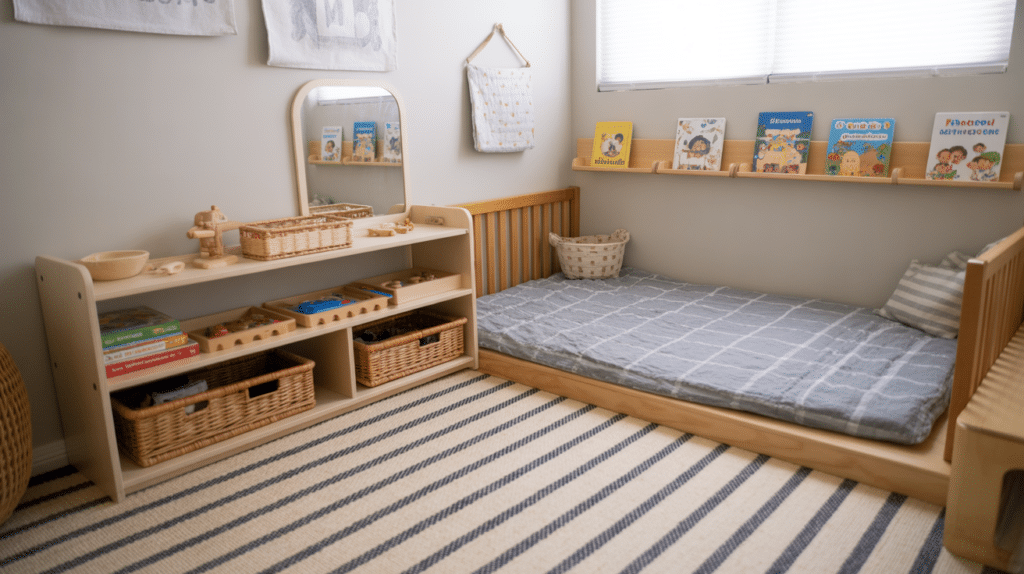
A Montessori bedroom looks different from traditional nurseries. It’s designed from the child’s perspective, with everything accessible and purposeful. Here are the key elements that turn an ordinary room into a space that nurtures independence and confidence.
1. The Floor Bed or Floor Mattress
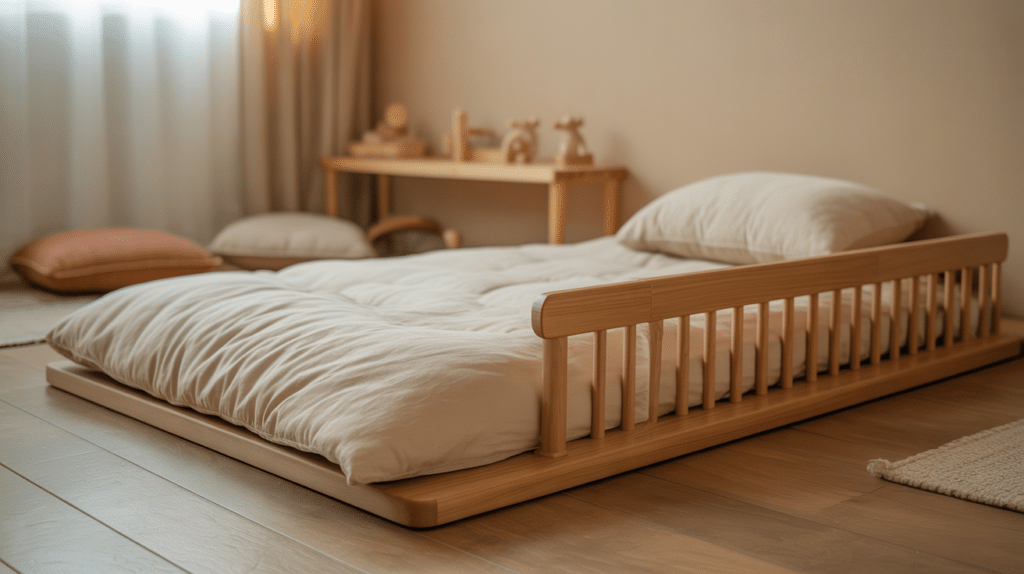
The floor bed replaces the traditional crib, giving children freedom to get in and out independently. In real homes, you’ll see various setups: a mattress tucked in the corner for extra security, one with a small removable rail, or different sizes ranging from crib mattresses to twins or futons.
- Safety is ensured through thorough baby-proofing, not confinement.
- Corner placement offers natural boundaries for younger children.
- Rails provide transition support without restricting movement.
- Size choice depends on space and child’s age.
2. Low Shelves for Toys and Books
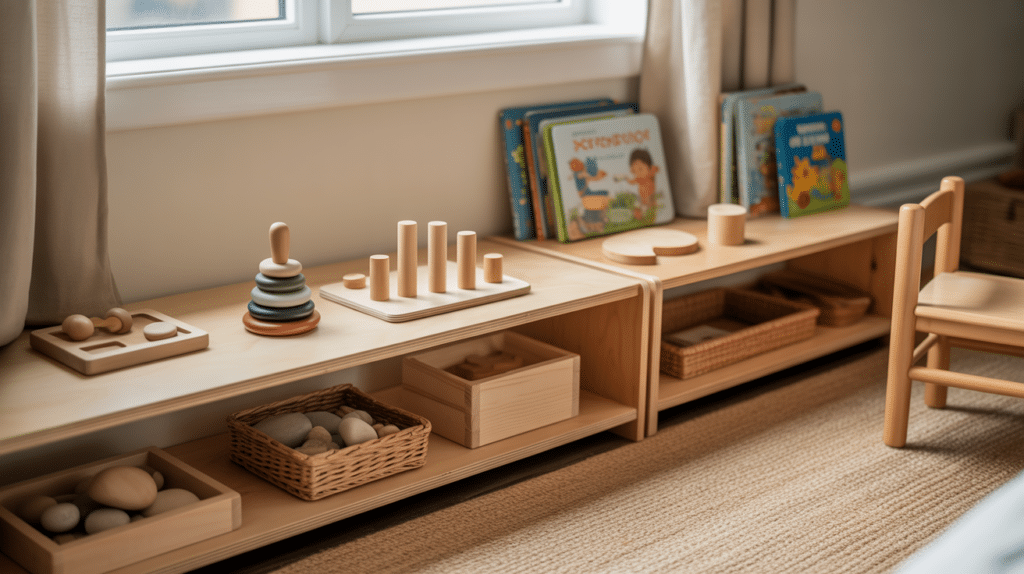
Open, low shelves display a curated selection of toys at the child’s eye level. Rather than overwhelming bins, fewer items are beautifully arranged, making choices clear and manageable. Baskets organize smaller pieces, and toy rotation keeps interest alive without clutter.
- 6-8 toys displayed at once promotes focus.
- Books face forward for easy recognition.
- Natural baskets contain loose parts and puzzle pieces.
- Montessori-aligned toys: open-ended, real-world, sensory-focused.
3. A Fully Baby-Proofed Room
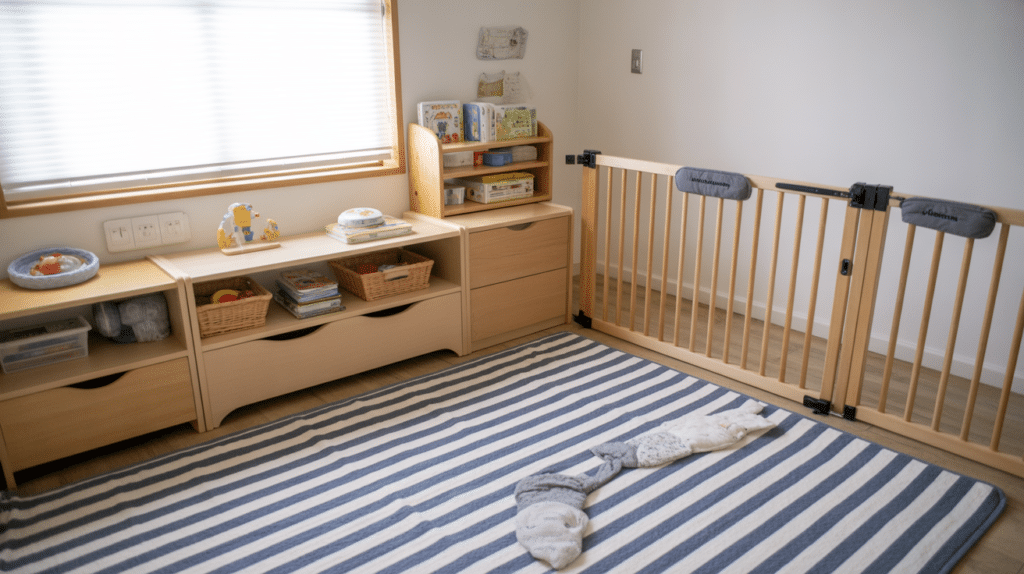
When the floor bed allows free roaming, the entire room becomes the safe zone. Outlets are covered, cords secured, and all furniture anchored to walls. Some families use safety gates at the doorway, while others opt for closed doors with monitoring.
- Heavy furniture must be wall-anchored.
- Electrical hazards eliminated completely.
- Window blind cords secured or removed.
- The room itself functions as a safe “crib.”
4. Calm, Child-Level Décor
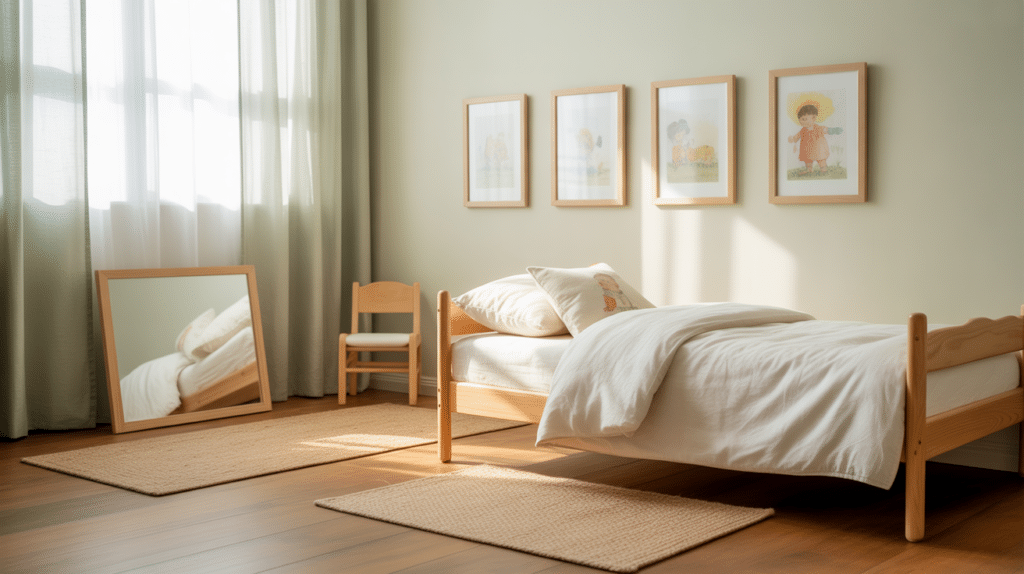
Artwork hangs at the child’s eye level, not adult height, creating an engaging visual environment. Mirrors are strategically placed low for self-discovery but away from the bed. The design favors natural materials, neutral tones, and minimal wall clutter to maintain calm.
- Art positioned 2-3 feet from floor.
- Unbreakable mirror for movement and self-awareness.
- Wooden frames and natural fiber textiles preferred.
- Simple, uncluttered walls reduce visual overstimulation.
Montessori Bedroom Setup by Age
A Montessori bedroom grows with your child. Each stage requires different features to support development while maintaining core principles of independence, safety, and accessibility.
| Age Range | Key Features | Focus |
|---|---|---|
| Babies (0–12 Months) | Moses basket or floor bed, low mirror, 2-3 sensory toys, minimal décor | Safe observation and early movement |
| Toddlers (1–3 Years) | Standing dressing area, child-height storage, sleep/play zones, activity rotation | Independence in routines and choices |
| Preschoolers (3–5 Years) | Full wardrobe access, book displays, cleaning tools, child-designed space | Responsibility and sleep-focused room |
The beauty of Montessori is its flexibility, adapt each element to match your child’s current abilities and interests.
Diapering and Dressing Areas in the Bedroom
Diapering and dressing are daily opportunities for building independence and cooperation. By bringing these routines into the Montessori bedroom or nearby bathroom, children become active participants rather than passive recipients.
Thoughtful setups at floor level or child height turn ordinary care tasks into meaningful learning moments that foster autonomy and respect.
Floor-Based Diapering Setup
Floor-level diaper changes invite participation and eliminate fall risks. Bathrooms work best when available, but bedroom setups with simple floor pads are equally effective.
- Waterproof changing mat on washable rug.
- Storage basket with diapers, wipes, and supplies within reach.
- Child can roll, sit, or help during the process.
- No restraints needed—cooperation replaces confinement.
- Bathroom placement builds early toilet association.
Early Independence Through Dressing
Low drawers at child height make clothing accessible for self-dressing attempts. Limited choices prevent overwhelm while visual organization builds cooperation and understanding.
- Drawers positioned at waist level or below.
- 2-3 outfit options per day.
- Labeled or picture-coded storage system.
- Seasonally appropriate items only.
- Nearby mirror for independence and self-checking.
Sleep, Light, and Sound in a Montessori Bedroom
Quality sleep depends on the right environment. Montessori bedrooms balance natural rhythms with practical needs, using light and sound thoughtfully to support healthy rest.
The goal is creating conditions that work with your child’s biology rather than against it, while avoiding dependencies that make sleep difficult outside the home environment.
Natural Light vs Blackout Shades
Finding the right light balance helps children sleep well without becoming dependent on complete darkness for rest.
| Aspect | Natural Light Approach | Blackout Shade Approach |
|---|---|---|
| Philosophy | Follows natural circadian rhythms | Controls environment for optimal darkness |
| Best For | Building flexible sleep habits | Sensitive sleepers, early sunrises, nap times |
| Implementation | Sheer curtains, morning light exposure | Full blackout curtains or shades |
| Consideration | May struggle with early wake-ups | Risk of darkness dependency |
| Middle Ground | Layered window treatments, sheers plus blackouts for flexibility when needed |
Most families find success with layered options: blackout shades for challenging sleep times, pulled back to allow natural light during wake hours.
White Noise and Environmental Sounds
White noise can help mask disruptive sounds, but Montessori philosophy encourages children to sleep amid normal household activity without complete silence.
- White noise machines can soothe babies and block jarring noises in apartments or busy households.
- Over-reliance creates sleep dependency, making it difficult for children to rest in other environments.
- Maintain normal household sounds during sleep rather than creating artificial silence.
- Use white noise sparingly during transitions or unavoidable disruptions, then gradually reduce volume and frequency.
- Children who sleep with typical background noise develop flexibility and can rest anywhere.
Common Montessori Bedroom Mistakes to Avoid
Even well-intentioned parents can miss the mark. Recognizing common pitfalls helps you create a functional Montessori space for your child.
| Mistake | Why It’s Problematic | Better Approach |
|---|---|---|
| Overdecorating | Excessive wall art, bright colors, and busy patterns overstimulate and distract from calm rest | Keep décor minimal with neutral tones and 2-3 meaningful pieces at child’s eye level |
| Too Many Toys | Overwhelming choices lead to scattered play and inability to focus on any single activity | Display 6-8 toys maximum, rotate weekly to maintain interest and encourage deeper engagement |
| Adult-Height Furniture | Shelves, hooks, and storage beyond reach defeat the purpose of independence | Position everything at child’s height—they should access all items without assistance |
| Fixed Setup Mentality | Treating Montessori as rigid rules rather than evolving with the child creates frustration | Observe your child and adapt the space regularly to match their changing abilities and interests |
Montessori is about responding to your child’s needs, not achieving picture-perfect appearance. Flexibility and observation matter more than perfection.
Final thoughts
By now, you’ve seen how a Montessori bedroom can grow with your child and support daily routines naturally. Nothing here is about perfection or copying someone else’s setup.
It’s about observing what your child needs and adjusting the space to match that moment. You don’t have to change everything at once. Even one thoughtful choice can make mornings calmer and bedtime smoother.
If you enjoyed this guide, I’ve shared more room ideas, home setups, and child-led living tips across my other blogs. They’re written to help you make simple choices that feel right for your home. Take a look around, you might find your next idea waiting there.