


I’ll be honest: I used to think all pillows were basically the same size. Then I upgraded to a Queen pillow and realized I’d been missing out on serious comfort.
Here’s the thing: Standard and Queen pillows might look nearly identical at first glance, but that extra length makes a real difference for how you sleep and how your bed looks.
If you’re a restless sleeper who needs more surface area, or you’re trying to make your bedding look perfectly proportioned, these size differences matter.
I’m breaking down everything you need to know, from exact dimensions to which pillow works best for your sleeping style, bed size, and goals.
Standard Pillow Size Explained
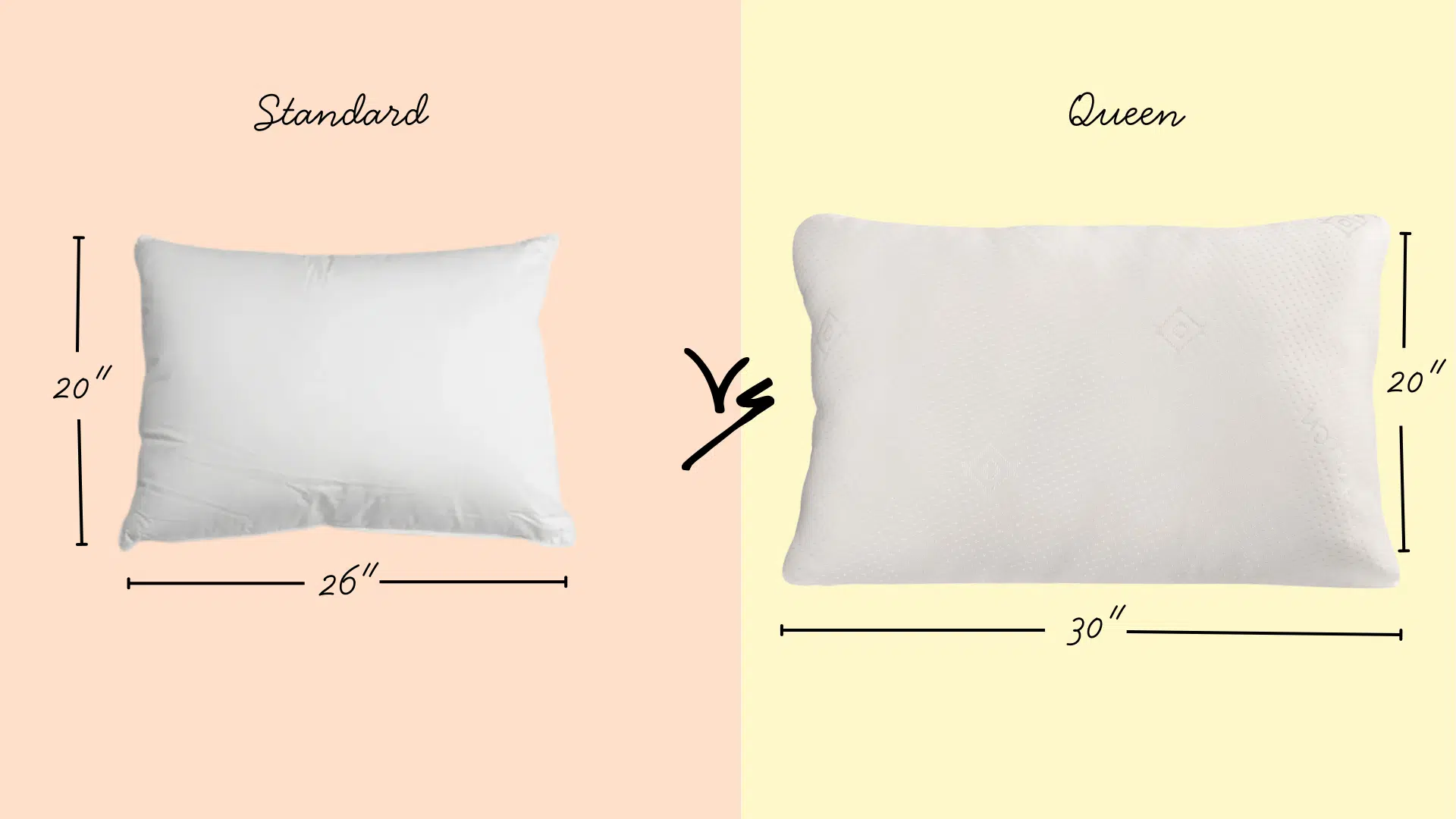
Standard pillows measure 20 x 26 inches (51 x 66 cm) and are the most common size you will find. They work beautifully on Twin or Full beds without overwhelming the space. Loft, meaning how tall the pillow sits, is a separate choice, and standard pillows come in low, medium, and high profiles.
I recommend them for solo sleepers who don’t move around much at night. You get enough surface area for comfortable head and neck support without excess bulk.
The pros? They’re affordable, widely available, and fit standard pillowcases perfectly.
The cons? If you’re a restless sleeper, you might drift off the edge. They can also look small on Queen or King beds, leaving gaps that throw off the visual balance of your bedroom.
Queen Pillow Size Explained
Queen pillows measure 20 x 30 inches (51 x 76 cm); that extra four inches of length makes a genuine difference. They come in various loft options from low to high, with fill choices ranging from memory foam to down alternative fill to traditional feathers.
These are my go-to recommendations for Queen or King beds, where they create a more proportional, luxurious look.
They’re perfect for couples sharing a bed and active sleepers who shift positions throughout the night; that added width gives you room to move without your head slipping off the edge.
The pros? Better edge-to-edge support, improved bed aesthetics, and more versatility for different sleeping positions.
The cons? They cost slightly more than Standard pillows, and you’ll need Queen-sized pillowcases, which can be harder to find in certain styles.
Standard vs. Queen Pillow: At a Glance
The four-inch length gap drives every difference below. Here is how the two sizes compare at a glance.
Feature | Standard pillow | Queen pillow |
|---|---|---|
Dimensions | 20 x 26 inches (51 x 66 cm) | 20 x 30 inches (51 x 76 cm) |
Width | 20 inches | 20 inches (same) |
Surface area | About 520 sq in | About 600 sq in (roughly 15% more) |
Ideal bed size | Twin, Full | Queen, King |
Best sleep position | Back, stomach | All positions, especially side |
Pillowcase | Standard case | Queen case (a standard case fits with a snug tuck) |
Price | More affordable | Slightly higher cost |
Aesthetic impact | Can look small on larger beds | Proportional, hotel-style look |
Standard vs. Queen Pillow: What the Extra Four Inches Actually Change
Let me break down the key differences so you can see exactly what sets these two sizes apart. Understanding how they compare in real-world use helps you choose what’s best for your sleep quality and bedroom setup.
More Surface for Moving Around
Queen pillows give you about 15% more surface area: 600 square inches (20 x 30) against 520 (20 x 26). If you toss and turn, that extra length keeps your head and neck on the pillow when you shift positions.
Standard pillows work fine for sleepers who stay put, but restless sleepers tend to reach its edge a lot sooner.
Edge Support for Side Sleepers
Side sleepers roll from one side to the other, and the extra length keeps your head centered and your neck aligned as you do. A standard pillow leaves less margin before the edge, so you may wake up to readjust.
Loft still matters here, so pair a queen with a height that fills the gap between your ear and shoulder
Hugging, Tucking and Hot Nights
If you hug your pillow or tuck it under your arm, a queen leaves room for both your head and your arm. A standard can feel cramped, forcing a choice between head support and comfort.
Hot sleepers also gain space to slide away from a warm spot without losing support under the head and neck. Breathable covers help even more.
Extra Room for Taller Sleepers
Taller sleepers often have a longer span from neck to shoulder, so they need more pillow to bridge the gap. A queen gives that added runway without the full length of a king.
If a standard pillow keeps slipping out from under you, this is a sensible first upgrade. Consider your sleeping position too, since that shapes the answer
Does Pillow Size Affect Sleep Quality?
If you have ever woken up with a stiff neck and blamed the wrong thing, you are not alone. Here is what pillow size really does for your sleep.
Size sets how much surface you have to move on. Loft and firmness do most of the work of keeping your neck in line, so choose those for your sleep position first, then pick the size.
Neck alignment: If your pillow sits too high or too low, it tilts your head, and you may feel it as a stiff neck in the morning.
Shoulder width: If you sleep on your side and have broad shoulders, you will generally need a higher loft to keep your head level with your spine. Extra length alone will not close that gap.
Movement: If you shift positions a lot, a queen may help you keep support without waking up to adjust the pillow.
Your bedroom: Pillow size works best inside a good sleep environment, and the CDC’s guidance on sleep habits lists a quiet, dark, relaxing bedroom at a comfortable temperature. Pair your pillow choice with those basics.
Size is one piece of your setup, and I would not expect it to fix everything. If you still wake up sore after matching size and loft, see a clinician
When Pillow Size Is Not the Fix
A new pillow cannot solve every sleep problem, and I would rather tell you that than oversell a size change. Talk with a healthcare professional if you notice any of the following:
Neck or back pain that lasts or keeps coming back.
Pain that keeps getting worse, spreads, or started after a fall or injury.
Numbness, tingling, or weakness in your arms or hands.
Loud snoring with pauses in breathing, or heavy sleepiness during the day.
Frequent morning headaches, or waking up gasping or choking.
Pregnancy or recovery from an injury or surgery, since positioning advice can differ. Body pillows are outside this comparison.
If any of these sound familiar, check in with a professional before spending more on bedding. Once that is covered, choosing between standard and queen gets much easier.
Bed Size Compatibility Guide
Matching your pillow size to your mattress creates a balanced look and ensures you use your bed’s full width effectively.
Here’s how each pillow size pairs with different mattress dimensions:
Mattress Size | Mattress Width | Best Pillow Choice | Why It Works |
|---|---|---|---|
Twin / Twin XL | 38 inches | Standard only | Queen pillows would hang over the edges and look oversized |
Full | 54 inches | Standard works best | Two Standard pillows fit perfectly across the width |
Queen | 60 inches | Both fit; Queen gives better coverage | Two Queen pillows create a fuller, more proportional look |
King | 76 inches | Queen works but doesn’t fully fill | Consider King-size pillows (20 x 36 inches) for complete coverage |
A helpful visual tip: Lay your pillows across your mattress to see the spacing. If there are noticeable gaps between pillows or they look lost on the bed, size up for a better proportion and comfort.
How Pillow Size Changes Your Bedroom’s Look and Feel

Beyond comfort, pillow size plays a major role in how polished and intentional your bedroom looks. Here’s how to style each size for maximum visual impact:
Twin and Full Beds: Standard pillows are your best bet for a clean, proportional look that doesn’t overwhelm smaller mattresses or make the bed appear crowded.
Queen and King Beds: Queen pillows create that fuller, hotel-inspired aesthetic with minimal gaps, while Standard pillows can look undersized and leave awkward spacing.
Minimalist Setups: Stick to two matching pillows in the right size, skip decorative shams, and let the clean lines speak for themselves.
Layered Luxury Hotel Look: Start with two or three Queen sleeping pillows, add Euro shams (26 x 26 inches) behind them, then finish with smaller accent pillows (18 x 18 inches) in front.
Narrow Nightstands and Small Rooms: Standard pillows work better in tight spaces because they take up less visual real estate and keep the room feeling open, not cluttered.
Throw Pillow Pairings: Standard pillows pair well with 16 x 16-inch throw pillows, while Queen pillows balance better with 18 x 18 or 20 x 20-inch decorative accents.
Choose pillow sizes that complement your bed’s scale and your room’s proportions. The right combination makes your entire bedroom feel more cohesive and thoughtfully designed.
Pillowcase and Bedding Considerations
Standard pillows fit loosely in Queen cases, creating extra fabric bunching that some people find comfortable, but others see as sloppy. Queen pillows don’t fit in Standard cases without stretching or bulging awkwardly.
For fabric choices, cotton percale offers crisp breathability, sateen provides silky smoothness, and bamboo delivers cooling moisture-wicking properties.
All work well with either size, though tighter weaves like percale show size mismatches more obviously.
Envelope-style pillowcases give you slightly more flexibility with size variations since the open back allows some adjustment.
Zippered cases need precise sizing, or you’ll struggle to close them or end up with excess fabric. Always match your pillowcase size to your pillow for the best fit and appearance.
Best Pillow Size For Each Sleeper Type

Your sleeping position determines how much pillow surface area you actually need throughout the night. Here’s how to match pillow size to your dominant sleep style for better comfort and support.
1. Side Sleepers: Queen pillows (20 x 30 inches) are the better fit. The extra length keeps you covered when you shift from one side to the other, and side sleeping calls for a higher loft to fill the gap between your ear and shoulder, so check loft as well as size.
2. Back Sleepers: Standard pillows (20 x 26 inches) usually work. You stay fairly centered, so you do not need the extra length. If you tend to drift toward the edges or roll to your side, a queen adds security. A medium loft usually supports your neck’s natural curve.
3. Combo Sleepers: Queen pillows are the clear winner if you switch positions several times a night. The added length covers you whether you roll onto your side, back, or stomach, so you spend less time readjusting.
4. Stomach Sleepers: Standard, or no pillow at all. Stomach sleepers need minimal loft to avoid neck strain, so a soft, low-loft pillow matters more than size. Many prefer thinner pillows, so don’t feel pushed to upgrade.
5. Hot Sleepers: Queen, if you like room to move, but fill matters most. Look for breathable fabrics like bamboo or cooling gel-infused memory foam.
How Much Do Standard and Queen Pillows Cost?
Size affects price a little. What is inside the pillow affects it far more, and a queen usually costs somewhat more than the standard version of the same model.
Factor | Standard Pillows | Queen Pillows |
|---|---|---|
Budget Range | $10 – $30 | $15 – $40 |
Mid-Range | $30 – $80 | $40 – $100 |
Premium Range | $80 – $200+ | $100 – $250+ |
Material impact: Memory foam and latex cost significantly more than polyester fill regardless of size, while down and down alternative sit in the middle, and hybrid models command premium prices.
Where to buy: Both sizes are widely sold at major US retailers such as Target, Walmart, Amazon, and Wayfair, though budget lines and decorative patterns often have fewer queen options.
Final Thoughts
I’ve walked you through everything that separates Standard and Queen pillows, from exact dimensions to how they affect your sleep quality and bedroom appeal.
The choice really comes down to your bed size, sleeping habits, and whether you need that extra surface area for movement.
Queen pillows offer better edge support and a more proportional look on larger beds, while Standard pillows excel on Twin and Full mattresses.
Now that you understand the Standard vs. Queen pillow differences, which size works best for your setup? Drop a comment below and let me know what you’re sleeping on tonight.
Frequently Asked Questions
How Do I Measure a Pillow Before Buying Pillowcases?
Lay the pillow flat and measure width and length across the fabric from seam to seam. Compare the numbers to the label, since fill can shift the size slightly. Pick a case that matches your measurements.
Can I Mix Standard and Queen Pillows on One Bed?
Yes. Both sizes share a 20-inch width, so they sit side by side neatly. Use queens where you want extra length for sleeping and standards for the front layer, and keep each pillow in its matching case.
Do Pillow Protectors Come in Standard and Queen Sizes?
Yes. Pillow protectors are sold in matching sizes, so buy the one labeled for your pillow. A snug protector helps guard against sweat, spills, and dust, and you can wash it more often than the pillow itself.