Most parents research a bunk bed properly. They read the weight limits, compare solid pine against MDF, check the reviews, measure the ceiling. Then they put a mattress on top, and the mattress is usually the part nobody thinks about.
That last decision can quietly undo everything the frame was engineered to do.
What the Guard Rail Is Actually Protecting
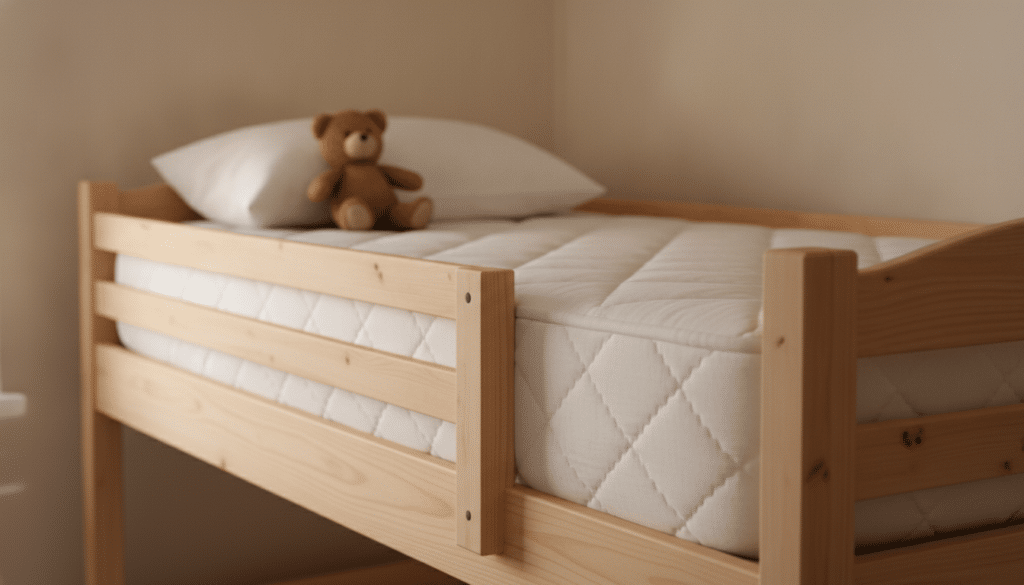
A guard rail on an upper bunk is not designed to a fixed height above the floor. It is designed to a height above the sleeping surface, and the manufacturer tests it with a mattress of a specified maximum depth in place.
The moment you put a deeper mattress on that bed, the sleeping surface rises and the rail stays exactly where it is. The protection shrinks by precisely the amount of extra depth you added. An inch and a half of extra mattress is an inch and a half of rail you no longer have.
Nothing about the bed has failed. The frame is as strong as it was on the day it was tested. But a child who rolls in the night now has less between them and the floor than the designer intended, and the bed is no longer being used in the condition it was certified in.
This is the failure mode that catches people out, because it does not look like a fault. It looks like a bed with a nice thick mattress on it.
The Number to Look For
Most bunk beds and high sleepers state a maximum mattress depth somewhere between 15 and 16cm, which is roughly six inches. That figure is not a comfort recommendation. It is a safety limit, and it is the number the guard rail height was calculated against.
For comparison, plenty of perfectly good adult mattresses are 20 to 30cm deep. A mattress can be excellent, correctly sized, and completely wrong for a bunk bed, all at the same time. Depth is the thing that decides it.
So the sequence matters. Find the maximum depth the bed states, then shop for a mattress inside that limit. Doing it the other way round, buying the mattress you like and hoping it fits, is how people end up with a two-inch problem they cannot see.
Specialist retailers publish this. UK children’s bed retailer Millie & Jones, for instance, links safety guidance covering maximum mattress depth from every product page across its bunk bed range, rather than leaving it buried in the assembly instructions. If a listing does not state a maximum depth, ask before you buy. A supplier who cannot answer that question quickly is telling you something.
Fit Matters as Much as Depth

Depth gets the attention, but a mattress that is the wrong size in any dimension creates a different problem.
Bunk bed standards are built around gap sizes, because head and limb entrapment is one of the recognised hazards of a stacked sleeping surface. The principle is that an opening should either be small enough that a child cannot get into it, or large enough that they can get back out. It is the sizes in between that cause harm.
A mattress that is too small for the frame creates exactly that kind of gap along the edge, between the mattress and the guard rail. It is easy to miss because it looks like nothing more than an untidy bed.
Under the British and European standard, EN 747, that intermediate range is defined and designed out of the frame itself. Your mattress choice is what determines whether it stays designed out.
Minor gaps for tucking bedding in are fine and expected. A gap a small child could work an arm or a head into is not.
Age Is Not a Guideline
Every mainstream bunk bed standard restricts the upper bunk to children aged six and over. That is not manufacturer caution and it is not a suggestion about maturity. It reflects what is known about how younger children move in their sleep, how they judge height, and how they climb.
Two extra points worth taking seriously. A child who sleepwalks should not be on an upper bunk regardless of age. And an upper bunk is for one person, which matters more than people expect when a sleepover is being negotiated at ten at night.
Below six, the lower bunk is available and appropriate. The rule only applies to the elevated surface.
A Short Pre-Purchase Checklist
Before you order, get answers to five things:
- The maximum mattress depth the bed is rated for
- The exact mattress size the frame takes
- The maximum user weight for the upper bunk
- Which safety standard the bed is certified to, and whether the retailer holds the certificate
- Whether the ladder can be fitted on either side, if your room layout needs it
The fourth one is worth pressing on. There is a real difference between a manufacturer’s own statement of conformity, printed in the instructions, and a test certificate issued by an independent accredited laboratory. Both have value. They are not the same document, and a retailer who knows the difference is a retailer who has asked the question.
After It Is Built
Bunk beds are not fit-and-forget furniture. Fixings loosen with ordinary use, and a bed that gets climbed on daily loosens faster than one that does not.
Check and retighten every bolt before first use, then every three to six months, and again after the bed has been moved or after any period of heavy use. Look at the slats and frame each time for cracks, splits or movement.
If anything is cracked, split, moving when it should not, or if a fixing will not tighten, stop using the bed and contact the retailer with photographs before anyone sleeps in it again. That instruction sounds dramatic written down. It is the standard response across the industry, and the reason it exists is that structural problems in elevated beds do not usually announce themselves gradually.
The Short Version
Buy the bed carefully. Then buy the mattress just as carefully, because the frame’s safety was calculated with a specific mattress depth in mind, and the mattress is the one part of the system the owner chooses independently.
Six inches or under, correctly sized, no gaps at the edges. Get that right and the bed performs the way it was designed to.
Millie & Jones is a UK children’s and teenage bed specialist.