
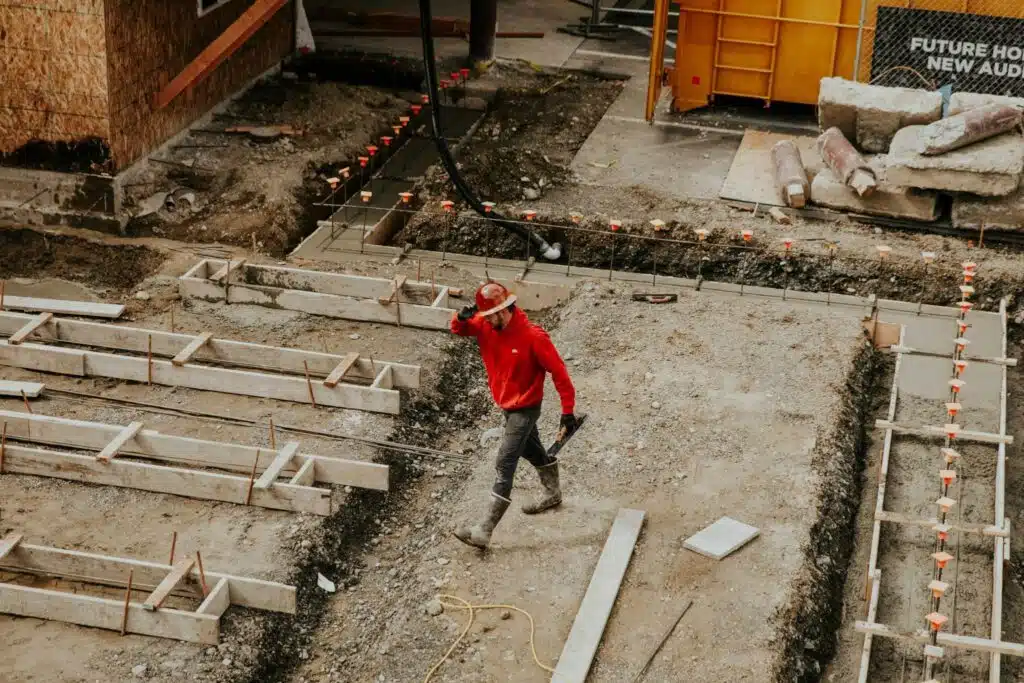
The construction industry operates across an extraordinary spectrum, from the surface a person walks on inside a building to the bridges, tunnels, and transport networks that connect entire cities.
At every point along that spectrum, the quality of the work depends on one thing above all others: specialisation.
Why Generalisation Is No Longer Enough in Construction
Modern construction demands have grown far too complex for any contractor or firm to claim genuine competence across every discipline.
Clients, whether homeowners upgrading a garage floor or government agencies commissioning billion-dollar infrastructure, increasingly seek specialists who understand the specific materials, methods, and performance standards that their project requires.
This shift toward specialisation has produced a construction landscape where the most trusted names are those who go deep rather than wide.
A firm that focuses relentlessly on one area, mastering its techniques, materials, and quality standards, consistently outperforms one that takes a generalised approach to everything it bids on.
The Critical Role of Surface Preparation in Floor Coatings
Among the most technically exacting areas of construction work at the residential and commercial level is the application of protective floor coatings, a discipline that rewards precision and punishes shortcuts with visible, costly failures.
The performance of any epoxy, polyaspartic, or polyurea system depends overwhelmingly on what happens before the coating is ever applied, particularly the preparation of the concrete substrate beneath it.
Diamond grinding is the industry-standard method for opening up a concrete surface so that a coating can bond to it at the molecular level rather than simply sitting on top.
Without this step, even the most technically advanced coating product will eventually delaminate, taking with it the entire investment in materials and labour.
Understanding High-Performance Floor Coating Systems
Not all floor coatings are created equal, and selecting the right system for a given environment is a decision that requires genuine technical knowledge rather than a simple preference for colour or finish.
Flake systems, for example, produce a decorative granite or terrazzo appearance and are among the most commonly installed options for residential garages and light commercial spaces, while quartz systems offer the highest chemical and abrasion resistance and are better suited to demanding industrial or outdoor applications.
Metallic epoxy systems deliver a visually striking three-dimensional marbleised finish and are popular in showrooms and retail environments where aesthetics carry significant commercial weight.
Polyaspartic and polyurea topcoats, which are up to four times stronger than standard epoxy, are increasingly specified as the finishing layer across all system types because of their UV stability, abrasion resistance, and the speed with which they cure.
Moisture Vapour Barriers: The Layer Most Often Overlooked
One of the most important technical decisions in any concrete coating project is whether the substrate requires a moisture vapour barrier basecoat before the decorative layers are applied.
Concrete naturally transmits moisture from below the slab, and when that moisture vapour cannot escape through a sealed surface, pressure builds and causes the coating to blister, bubble, and ultimately fail from underneath.
A 100% solid vapour barrier epoxy basecoat addresses this directly by sealing the concrete against upward moisture transmission before any decorative system is installed.
Specialists who understand substrate conditions and take the time to assess each slab individually before recommending a system will consistently deliver results that hold up over years and decades rather than months.
Serving Diverse Environments with Consistent Standards
The range of environments that demand high-performance floor coatings extends well beyond residential garages and warehouses.
Medical facilities, laboratories, cannabis farms, aircraft hangars, police and fire stations, courthouses, and train stations all require flooring systems that meet specific performance criteria around hygiene, chemical resistance, slip rating, and durability under constant foot and vehicle traffic.
Raz-Barry Construction, a veteran-owned floor coating contractor serving Daytona Beach and surrounding communities throughout Volusia and Flagler County, Florida, is one example of a specialist that serves this full breadth of environments with industrial-grade materials and certified installation expertise.
Their work across residential, commercial, industrial, government, and medical categories reflects the kind of comprehensive specialisation that comes from deep experience rather than broad ambition.
The Connection Between Ground-Level Construction and Large-Scale Infrastructure
While floor coatings represent the built environment at its most intimate and immediate level, civil and structural engineering consultancy operates at the scale of entire networks, systems, and national assets.
Both disciplines, however, share a foundational principle: the quality of the outcome depends entirely on the quality of the expertise brought to every stage of the project, from concept through to completion.
Infrastructure projects involving roads, tunnels, bridges, rail networks, airports, marine facilities, and energy systems involve levels of technical complexity, financial risk, and regulatory obligation that make the choice of advisory partner one of the most consequential decisions a client can make.
The consequences of poor advice at the planning or delivery stage of a major infrastructure project are measured not in failed floor sections but in budget blowouts, schedule delays, safety failures, and years of remedial expenditure.
What Sets Expert Civil Engineering Advisory Apart
The distinction between a technically capable engineering firm and a genuinely expert one lies in its ability to provide reliable, commercially grounded advice across the full lifecycle of a project, from procurement and scope definition through design management, construction delivery, and long-term asset stewardship.
This full-lifecycle perspective is what separates advisors who are useful at one stage from those who are valuable from beginning to end.
Engaging leading civil engineering consultants in Australia, such as CJC Management, means accessing a team whose experience spans roads, tunnels, bridges, rail, defence, energy, marine, and airport infrastructure across Australia and internationally.
Their capability in commercial advisory, strategic infrastructure advisory, design management, project delivery, asset management, and digital construction provides clients with a single point of accountable expertise across every phase of even the most complex project.
Digital Construction and the Modern Infrastructure Project
One of the most significant shifts in civil and structural engineering over the past decade is the integration of digital tools, particularly three-dimensional modelling and Building Information Modelling, into every phase of design management and project delivery.
These tools allow engineering teams to detect clashes, test constructability assumptions, and optimise structural solutions before a single cubic metre of concrete is poured.
For clients managing projects where design errors discovered during construction carry enormous cost and schedule implications, digital construction capabilities are no longer a premium offering but a basic expectation of any credible advisory firm.
The ability to combine technical engineering excellence with data-driven digital intelligence is what distinguishes the most capable consultancies from those still working through traditional methods alone.
Asset Management: The Phase That Defines Long-Term Value
Both at the scale of a floor coating in a commercial facility and at the scale of a national transport network, the decisions made during the delivery phase shape the asset management burden that follows for decades.
A floor coating installed with the correct substrate preparation, moisture barrier, and industrial-grade topcoat will require minimal maintenance and deliver consistent performance for years, while one cut short on any of those steps will demand repeated remediation.
At the infrastructure level, strategic asset management that includes comprehensive analytics, proactive maintenance planning, and lifecycle cost optimisation ensures that major assets remain functional, reliable, and financially viable over the long term rather than degrading into costly liabilities.
The overlap between ground-level construction quality and large-scale asset management philosophy is not coincidental; it reflects a universal truth about the built environment that high-performance outcomes in construction require specialised expertise applied diligently at every stage.
Final Thoughts
The construction industry in 2026 rewards those who specialise deeply, communicate clearly, and bring verifiable expertise to every project they undertake.
Whether the scope is a 300-square-metre warehouse floor in Florida or a multi-billion-dollar infrastructure corridor in Australia, the principle is identical: choose the specialist, invest in proper process, and the built environment will deliver performance that justifies every dollar spent.