



Most of us know that feeling of lying awake after a rough day, mind still racing while the rest of the world sleeps. Now imagine that not as an occasional bad night, but as your permanent reality — built into the very structure of your job.
That is the daily experience for millions of nurses across the United States. Between rotating shifts, overnight stretches, mandatory overtime, and the emotional weight of caring for sick patients, nurses face some of the most severe sleep challenges of any profession. And the consequences reach far beyond tired eyes. They affect physical health, mental well-being, patient safety, and the long-term sustainability of an already strained healthcare workforce.
Understanding why nurses struggle to sleep — and what structural changes can actually help — matters not just for healthcare workers, but for anyone who has ever battled exhaustion or irregular sleep. The science behind shift work sleep disruption is universal, even if nurses experience it in its most extreme form.
The Sleep Science Behind Shift Work
The human body operates on a circadian rhythm — an internal 24-hour clock that regulates when we feel alert, when we feel sleepy, and when we release key hormones like cortisol and melatonin. This clock is anchored primarily to light and darkness, and it does not adjust easily or quickly when work schedules fight against it.
Night-shift nurses face a fundamental biological conflict every time they clock in after dark. Their bodies are primed for sleep during the very hours they need to be most alert. When they finally get home and attempt to sleep during daylight hours, noise, light, and social obligations chip away at the rest they desperately need.
Research paints a stark picture. Self-reported sleep times for nurses average between 4.3 and 6.7 hours per night — well below the recommended 7 to 8 hours for adults. Night-shift nurses average only 5.7 hours of sleep, compared to 6.7 hours for their day-shift counterparts. Across shift workers, sleep duration can be reduced by up to 2 hours per day, with notable losses in REM and Stage 2 sleep — the stages most critical for memory consolidation, emotional regulation, and physical recovery.
Up to 75 percent of shift workers report experiencing fatigue and sleepiness while on duty, according to the Agency for Healthcare Research and Quality. For nursing specifically, two-thirds of shift-working nurses experience chronic sleep problems and fatigue.
How Understaffing Makes Everything Worse
Sleep deprivation among nurses is not simply a byproduct of shift work — it is actively worsened by the staffing conditions inside many healthcare facilities. When units are short-staffed, the nurses who show up are often asked — or required — to stay longer, cover additional patients, or return to work before they have had adequate time to recover.
These “quick returns,” defined as returning to work less than 11 hours after a previous shift ends, are one of the most significant risk factors for Shift Work Disorder, a recognized clinical condition characterized by insomnia and excessive sleepiness. Nurses with Shift Work Disorder are far more likely to have worked more night shifts and more quick-return shifts than those who remain unaffected.
Mandatory overtime pushes nurses across the threshold where burnout becomes almost inevitable. Working more than 40 hours per week is associated with an odds ratio of 3.28 for burnout-related job departure compared to those working fewer than 20 hours per week. And burnout and poor sleep are not just related — they are mutually reinforcing. Burnout causes worse sleep; worse sleep deepens burnout. Workers who score higher on burnout measures show shorter sleep times, greater sleep fragmentation, more time awake after falling asleep, and less restorative deep sleep.
A 2024 systematic review and meta-analysis published in JAMA Network Open — analyzing 85 studies covering more than 288,000 nurses — found a mean burnout prevalence of 30.7 percent. According to the National Council of State Boards of Nursing, approximately 41.5 percent of nurses who intend to leave the profession cite stress and burnout as the root cause. Over 610,000 registered nurses are expected to exit the workforce by 2027.
This is not a minor staffing inconvenience. It is a public health issue with direct ties to sleep science.
The Role of Scheduling Flexibility in Sleep Health
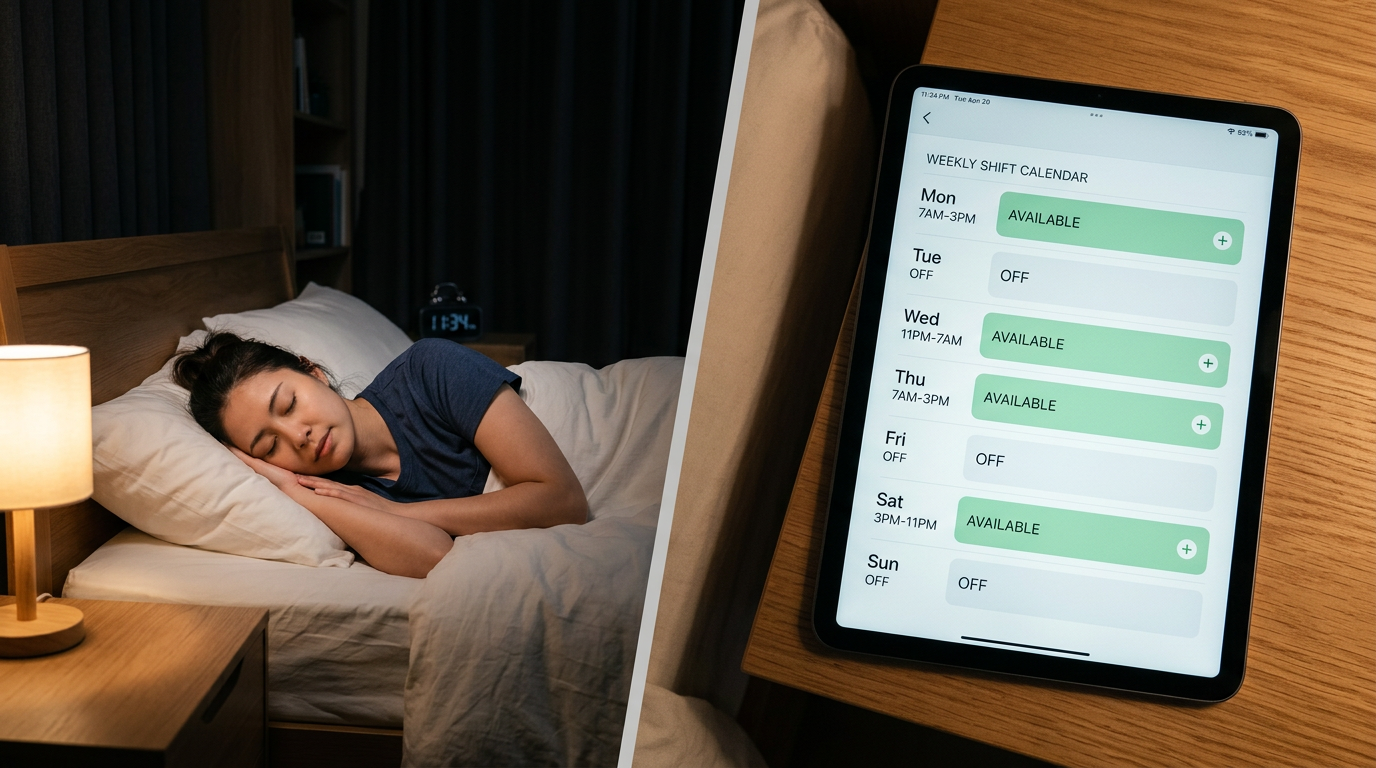
Here is where the picture shifts from purely discouraging to actionable. Research consistently shows that giving nurses more control over their schedules is one of the most effective interventions for improving sleep quality and reducing burnout.
A peer-reviewed study found that more than 87 percent of nurses ranked self-scheduling first or second among their scheduling preferences. A Swiss hospital study found that higher work schedule flexibility is associated with significantly lower emotional exhaustion among registered nurses. When nurses can choose their shifts — rather than having shifts assigned or mandated — they are far better positioned to align their work hours with their natural sleep rhythms, protect time for recovery between shifts, and avoid the destructive patterns of consecutive overnight rotations.
This is why tools that put scheduling agency back into nurses’ hands are gaining attention as a genuine health intervention, not just a workforce management strategy. A nurse staffing platform designed around on-demand, self-selected shifts allows clinicians to choose the hours that fit their bodies and lives, rather than bending their bodies and lives around a fixed institutional schedule. When nurses can pick up individual shifts based on their own availability, they can deliberately protect recovery windows, avoid back-to-back overnight rotations, and stay below the overtime thresholds where burnout risk spikes sharply.
For healthcare facilities, this flexibility has an equally important indirect benefit. When open shifts are filled by per-diem clinicians who have chosen to be there, permanent staff members are shielded from mandatory overtime. As one nursing officer described after adopting a flexible staffing model: “My full-time staff is less burned out, less stressed, and just overall happier.”
Practical Sleep Strategies for Shift-Working Nurses
While systemic change in how nursing schedules are built remains the most powerful lever, there are evidence-based strategies that nurses — and anyone working irregular hours — can use to protect sleep quality in the meantime.
- Anchor your sleep window: Even when your shift times vary, try to keep your main sleep block starting at a consistent time relative to when your shift ends. This helps your circadian rhythm build a predictable pattern, even within a shifted schedule.
- Treat your sleep environment like a night shift: Heavy blackout curtains, a white noise machine, and a “do not disturb” sign on your door are not luxuries — they are sleep infrastructure. Light is the primary signal your body uses to determine wakefulness, so blocking daylight during daytime sleep is essential.
- Use strategic light exposure: Bright light exposure in the early part of a night shift can help anchor alertness, while avoiding light (including phone screens) in the last few hours of a shift helps signal to your body that sleep is approaching.
- Be deliberate about nutrition and caffeine timing: Caffeine has a half-life of approximately five to six hours, meaning a cup of coffee four hours before you plan to sleep still has half its stimulant effect active when you lie down. Shift workers who time caffeine carefully — using it to manage alertness in the first half of shifts and cutting off consumption well before intended sleep — report better sleep quality.
Protect short recovery windows fiercely. If you have less than 11 hours between shifts, prioritize sleep above everything else. Even an hour or two of additional rest meaningfully reduces cognitive impairment and emotional reactivity going into the next shift.
Why This Matters Beyond Healthcare
It is tempting to frame the nurse sleep crisis as a problem specific to healthcare — a workforce issue that the industry needs to solve internally. But the ripple effects are broader.
Fatigued nurses make more medication errors, miss more early warning signs, and are more prone to accidents — all of which affect patients and families, not just the nurses themselves. The Agency for Healthcare Research and Quality notes “good evidence of increased nursing errors when shifts last longer than 12 hours, nurses work overtime, or nurses do not receive adequate rest breaks.” Nurse burnout is associated with higher rates of patient falls, hospital-acquired infections, and adverse outcomes.
And beyond patient safety, the nurse shortage, driven in large part by burnout and sleep-related attrition, affects every person who might need hospital care. A healthcare system chronically short on nurses is operating at reduced capacity for everyone.
Conclusion
The sleep crisis in nursing is real, measurable, and rooted in the same circadian biology that affects every human being. Shift work disrupts the body’s natural rhythms. Understaffing amplifies the damage by eliminating the recovery time that makes those disruptions survivable. And the resulting cycle of sleep deprivation and burnout is now driving hundreds of thousands of nurses out of the workforce.
Better sleep for nurses starts with better systems. Flexible scheduling that gives clinicians genuine agency over their hours — protecting recovery time, avoiding destructive quick returns, and keeping weekly hours within sustainable limits — is not a perk. It is a structural health intervention with documented benefits for nurses, for the facilities that employ them, and ultimately for every patient who depends on a rested, engaged caregiver.
Rest is not a reward. For nurses, it is a professional requirement. And building systems that protect it is long overdue.