

The wall behind your bed is the first thing anyone sees when they walk into the bedroom. It’s also the last thing you look at before switching off the lamp. Most people dress it with wallpaper, wood slats, a big framed print, or an upholstered headboard that costs more than the mattress.
There’s another option that does double duty. A layout of white acoustic panels gives that wall the same soft, finished look as an upholstered headboard, and it also takes some of the hollow echo out of a bedroom full of hard surfaces. Painted drywall, wood floors, a window or two… sound bounces around more than you’d expect in a room meant for quiet.
Here’s why white is the easy choice, five layouts worth stealing, and the practical details that make the result look intentional instead of improvised.
Why White Works So Well Behind the Bed
White gets along with everything that ends up in a bedroom. Linen bedding, oak nightstands, brass lamps, a gray throw, a green plant in the corner. Nothing fights it. A colored panel wall makes a statement you have to design around; a white one becomes a calm backdrop for whatever you change next season.
It also keeps the room bright. Fabric in white bounces light around softly, which helps in smaller bedrooms or ones with a single window. At night, under a warm bedside lamp, white fabric turns slightly creamy and cozy rather than stark. I think that’s the part people don’t expect.
Then there’s the sound. A bare wall right behind your head reflects voices, the TV, the clink of a glass on the nightstand. Cover it with soft panels and the room starts sounding a bit gentler, especially at night when everything else is quiet and small sounds feel louder.
Five Headboard Layouts to Try
These go roughly from calm to bold. Every one of them can be built with standard panel shapes, so you don’t need anything custom-made to pull them off.
The Oversized Grid
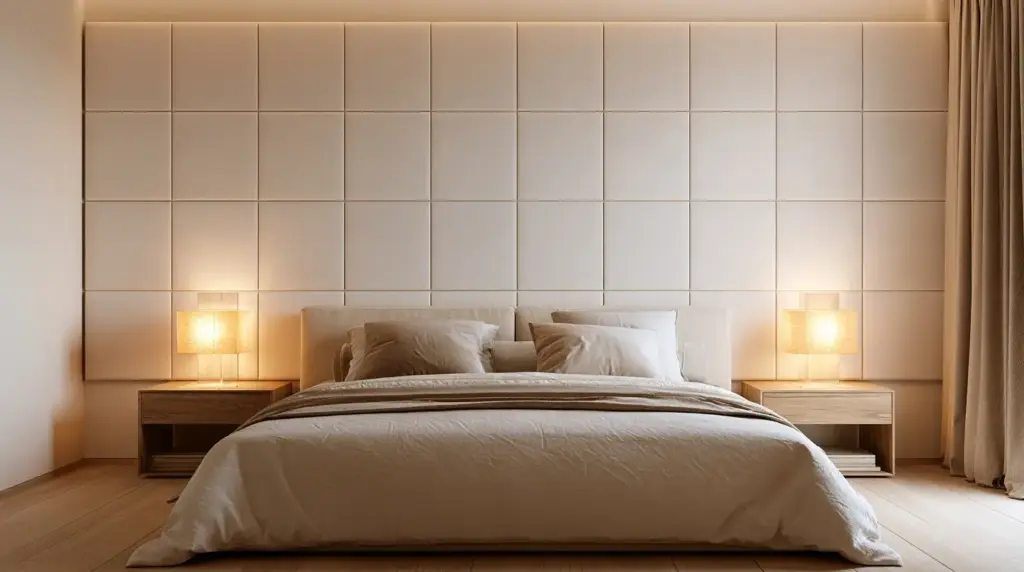
Line up 2’x2′ square panels in a tight grid that runs wider than the bed, ideally reaching past the nightstands on both sides. Two rows tall works for most rooms. The effect is a giant tufted headboard minus the tufting: clean, quiet, a little hotel-like. If you only try one layout, try this one. It’s very hard to get wrong.
Tall Vertical Panels
Stand 2’x4′ panels upright in a row behind the bed, edges nearly touching. The vertical lines pull the eye upward and make a low ceiling feel taller, a handy trick in older apartments. It reads like a tall paneled headboard. Keep the row centered on the bed and stop it just past the mattress edges for a tidy, built-in feel.
The Honeycomb Cluster
Hexagons nest together like a honeycomb, so you can grow a cluster from behind the headboard outward and let the edge stay uneven. Maybe the cluster climbs higher on one side, drifting toward a reading lamp. It feels playful without being loud, especially in all white, where the pattern shows up through shadow lines instead of color.
Circles Over the Bed
One large arrangement centered above the headboard can read like a soft moon hanging over the bed. Or space several circles in a loose row, almost like a string of paper lanterns pinned to the wall. Circles soften a room full of rectangles: the bed, the windows, the dresser. They work nicely in minimalist and Japandi-style bedrooms where every object is chosen carefully.
Geometric Pattern With Triangles and Diamonds
For a bolder wall, combine triangles and diamonds into a repeating pattern, chevrons or a starburst spreading from behind the headboard. In white, the geometry stays subtle in daylight and becomes much more visible in the evening when side lighting throws small shadows along each edge. Best for people who enjoy a wall that changes through the day.
Matte or Textured, Square or Beveled Edges

White fabric comes in more than one look. A smooth matte finish appears crisp and modern, close to a painted surface from across the room. A textured weave adds a woven, almost linen-like feel that pairs naturally with soft bedding and wood furniture. Honestly, under a bedside lamp the textured version wins for coziness, while the smooth one suits a sharper, gallery-like room.
Edges matter more than you’d think. Square edges give each panel a sharp outline, so a grid looks precise and architectural. Beveled edges are cut at an angle, which softens the outline and makes the wall feel gentler. In a bedroom, beveled often feels right. Acoustically the two perform the same, so pick purely by eye.
Getting the Size and Placement Right
Proportion is where panel walls succeed or flop. As a rule of thumb, let the arrangement run at least as wide as the bed, and wider if you want the nightstands framed inside it. Too narrow and it looks like a small afterthought stuck above the pillows.
Height depends on the ceiling. Start the bottom edge just behind or slightly above the mattress so the panels feel connected to the bed, and keep a comfortable gap from the ceiling unless you’re deliberately running floor to ceiling. Watch out for wall sconces and outlets; plan around them before anything goes up.
Before mounting, lay the whole layout out on the floor, or mark it on the wall with painter’s tape. Ten minutes of this saves a crooked honeycomb you’ll stare at every night. Clip mounting lets you lift panels off later for a repaint or a move, which is worth considering if you rent or rearrange often.
What Panels Behind the Bed Can and Can’t Do
Panels behind the headboard soften how the bedroom sounds. Voices lose that hollow edge, a TV at night sounds less harsh, and the room feels calmer to be in. Combined with a rug and curtains, the difference is easy to hear.
They won’t stop traffic noise, a neighbor’s music or a loud hallway from reaching you, though. Absorption works on sound already inside the room. Keeping outside noise out is a separate job called sound isolation, usually starting with the door, since a gap underneath lets sound slip straight in. Seals around the frame and a bottom seal are the simplest first step.
White fabric is easier to look after than people fear. A vacuum with a soft brush attachment every so often keeps dust off, and small marks usually come out with gentle spot cleaning.
Sound Pro Solutions, a Long Island City acoustics supplier, stocks white panels in squares, rectangles, circles, hexagons, triangles and diamonds, in both smooth and textured white, so every layout above can be built from one place. They also carry door seals for noise coming in from the hallway and offer acoustic advice by phone.