

Open-plan office layouts promise easy collaboration, but they often deliver constant noise, frequent interruptions, and a frustrating lack of privacy. When employees spend extra effort filtering out background chatter or hunting for empty conference rooms just to make a quick phone call, daily productivity drops across the board.
A modern office privacy pod solves this issue at the source by providing a quiet, soundproof room right on the main floor. In fact, workplace studies show that providing dedicated quiet zones improves employees’ ability to focus by up to 48% and cuts noise-related distraction, giving workers immediate focus zones.
In this guide, we’re going to break down how privacy pods work, what features matter most, and how to select the right model for your workspace.
Why Modern Offices Need More Privacy?
Open-plan office layouts promised to break down silos, but they introduced a continuous stream of noise, visual distractions, and sudden interruptions. While open layouts make spontaneous conversations easy, they destroy the acoustic privacy employees need for complex, analytical, or confidential tasks.
When workers lack privacy, workplace focus suffers significantly. Research shows that employees are up to 57% more productive when they have direct access to quiet, distraction-free environments.
Furthermore, open layouts frequently backfire: rather than sparking richer collaboration, workers facing a total lack of privacy often withdraw socially, relying on headphones and email to create digital boundaries. Modern offices require structured quiet spaces to balance collaborative group areas with dedicated focus zones.
What Is an Office Privacy Pod?
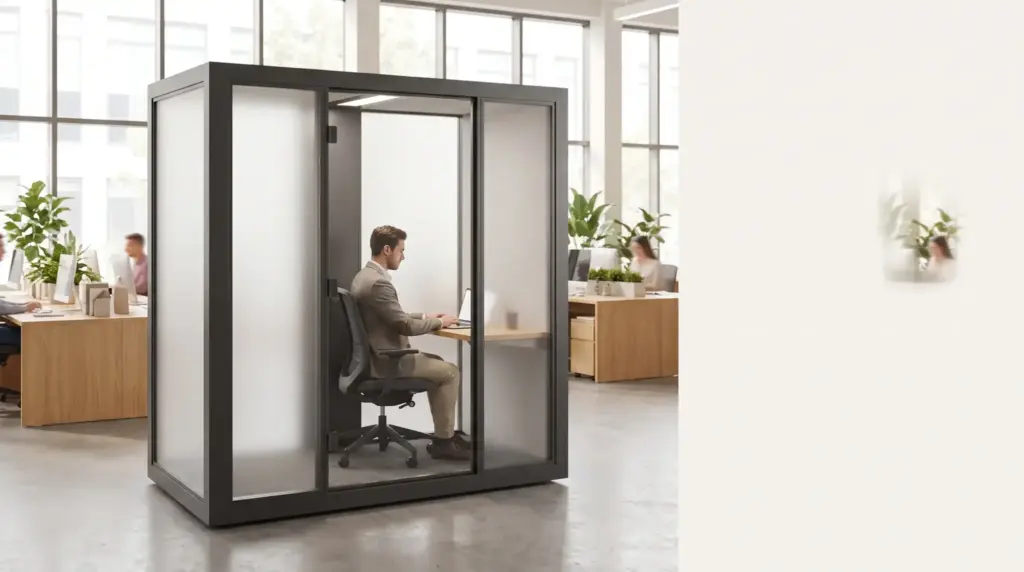
An office privacy pod is a self-contained, soundproof booth designed to give workers an immediate soundproof sanctuary on the main office floor. Built as a modular structure, a pod features integrated acoustic glass, sound-dampening wall insulation, motion-activated ventilation, internal lighting, and plug-and-play power outlets.
Unlike traditional conference rooms or drywall phone booths, privacy pods require no permanent construction, building permits, or architectural modifications. Facilities teams can assemble them in hours and easily relocate them whenever floor plans change or space requirements evolve.
Available in single-user phone booths up to large group meeting rooms, pods give companies an adaptable, cost-effective way to add quiet capacity right where employees need it most.
How to Choose the Right Pod for the Work
Choosing the right privacy pod comes down to understanding the primary tasks your team completes every day. Matching the pod size and internal furniture to specific work habits ensures high daily usage and maximizes your investment.
Private Calls and Focused Work
Single-person office pods serve as ideal focus sanctuaries for individual tasks, quiet phone conversations, and video calls. These compact booths take up minimal floor space, typically around four square feet, making them easy to place along perimeter walls or near open workstation pods.
When evaluating single-user booths, look for an integrated desk, ergonomic seating or a standing-height workspace, and accessible power modules with USB charging ports.
A well-designed individual booth isolates voice frequencies effectively, preventing private phone discussions from carrying across the open floor while giving the user a distraction-free spot for deep, analytical work.
Confidential Conversations and Team Meetings
Multi-person meeting pods accommodate collaborative group work, sensitive HR discussions, executive reviews, and four-way client calls. These larger modular units generally seat two to eight people and replace the need for permanent drywall construction.
For group pods, prioritize acoustic ratings that prevent sensitive speech from leaking into neighboring work areas. Ensure the pod features double-glazed acoustic glass, acoustic fabric wall panels, and built-in table hubs with power and data connections.
Larger pods should also support wall-mounted display monitors and video conferencing hardware to keep remote participants fully engaged during hybrid team sessions.
What to Check Before Buying
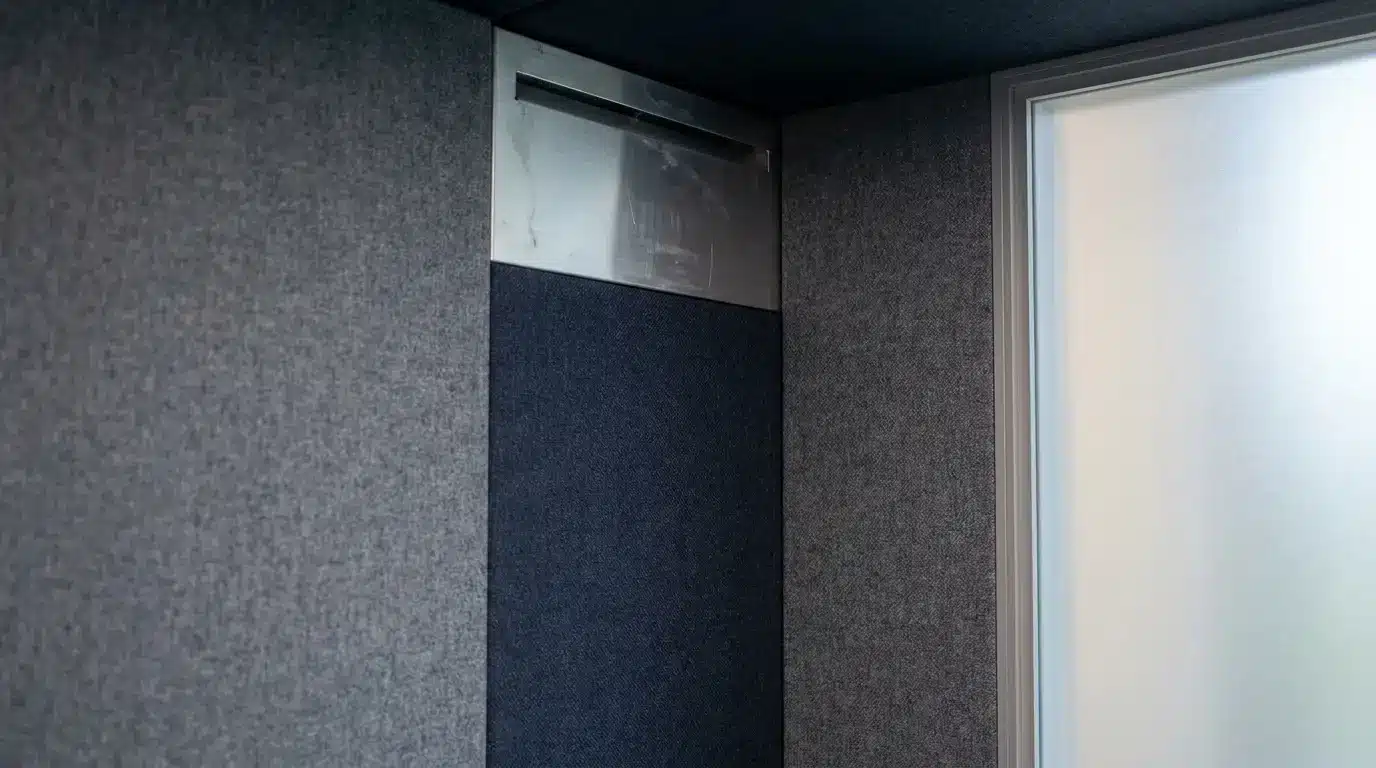
Buying an office pod requires evaluating technical specifications beyond basic exterior dimensions and style options. Reviewing verifiable acoustic ratings, interior airflow systems, technology integration, and vendor service terms guarantees that your pod meets real daily workplace demands.
Sound Reduction and Speech Privacy
Not all soundproof claims hold equal weight. Rather than relying on generic marketing terms, check whether the manufacturer provides independent laboratory test certificates. Focus specifically on the ISO 23351-1 speech level reduction rating, which measures how effectively a pod attenuates spoken voice frequencies.
A high-performance modular booth should deliver a speech reduction rating of 30 dB or higher (Class A certification).
This level of sound isolation ensures that speech inside the pod remains completely unintelligible to people standing right outside, giving employees complete privacy for confidential HR reviews, executive discussions, and sensitive client calls.
ISO 23351-1: Measures speech reduction specifically for acoustic furniture. Target performance is 30 dB or higher (Class A Speech Privacy).
NIC (Noise Isolation Class): Measures total noise reduction across all sound frequencies. Target performance is 28 dB to 32 dB.
STC (Sound Transmission Class): Measures wall assembly sound-blocking capacity. Target performance is a 30+ STC rating for wall panels.
Ventilation, Comfort, and Technology
A privacy pod must maintain a comfortable interior environment during long, back-to-back work sessions. Airflow design is critical: choose booths equipped with continuous, motion-activated ventilation fans that completely refresh the interior air volume every one to two minutes. Look for high-volume airflow systems that operate below 35 dB so fan noise doesn’t interfere with video calls or microphone pick-up.
In addition to fresh air circulation, assess internal lighting and tech connectivity. The pod should feature dimmable, neutral LED task lighting (around 4000K daylight spectrum) to prevent eye strain during screen work.
Ensure the built-in power module includes standard AC outlets, dual USB charging ports (USB-A and USB-C), and routed Ethernet pass-through channels for stable internet connections during hybrid meetings.
Delivery, Installation, and Warranty
Before finalizing an order, verify the logistics of moving the pod into your building. Check whether the pod ships flat-packed and verify that the shipping crate dimensions fit through your building’s freight elevators, stairwells, and doorways.
Confirm if the seller offers professional white-glove installation or if your facilities team can assemble the unit using basic tools in two to three hours.
How Much Does an Office Privacy Pod Cost?
Office privacy pod pricing varies based on capacity, acoustic performance, smart integrations, and material quality. While direct-to-consumer options keep upfront investments manageable, enterprise-grade units with cloud connectivity and custom finishes sit at a higher price tier.
Single-Person Phone Booths ($4,500 – $10,000): Designed for private calls and solo focus sessions. Entry-level units deliver essential power and ventilation, while high-end models offer Class A acoustic ratings, dimmable LED lighting, and adaptive motion-sensor airflow.
Two- to Four-Person Meeting Pods ($10,000 – $18,000): Built for 1-on-1 reviews, collaborative brainstorming, and small team video calls. These pods feature built-in seating, integrated worktables, and expanded power modules to support multiple devices.
Large Conference Pods ($18,000 – $35,000+): Function as fully modular, freestanding conference rooms accommodating six to eight people. They include integrated monitor mounts, high-capacity ventilation systems, and specialized acoustic wall treatments.
When calculating the total cost, account for additional expenses such as freight shipping, professional white-glove installation, and regional sales tax. Choosing pre-wired units with plug-and-play electrical setups prevents costly hardwiring fees and keeps overall procurement simple.
Is a Privacy Pod Worth It for Your Office?
Investing in an office privacy pod delivers immediate returns by protecting employee focus and solving open-plan noise friction. Traditional drywall room builds require architectural plans, landlord approvals, building permits, and weeks of messy construction that disrupt daily work. By contrast, a privacy booth arrives flat-packed, assembles in hours, and integrates smoothly into your current floor plan.
Beyond speed and convenience, privacy pods preserve long-term capital. When your company expands or relocates to a new building, modular pods disassemble easily and move right along with your team, preventing wasted renovation costs on leased real estate.
Office pods give modern organizations a scalable, flexible way to improve workplace productivity by cutting noise distractions and providing dedicated rooms for focused work and calls.