
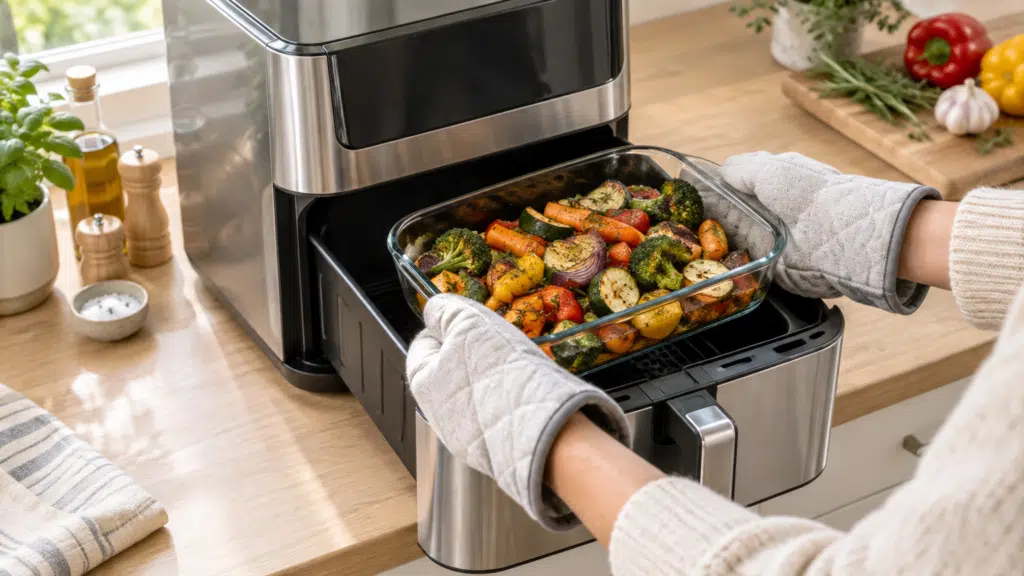
The air fryer has become a fixture in many kitchens, valued for its speed and its ability to crisp food with little oil. As its use extends beyond chips and reheating, a practical question arises: can the glass dishes already in the cupboard go into the basket? The answer is yes, under certain conditions. Understanding those conditions helps protect both the appliance and the cookware.
Why Glass Requires Particular Care
An air fryer works by circulating very hot air at high speed around the food, in a compact chamber close to the heating element. This environment is more intense than a conventional oven, and temperature changes can be rapid.
Glass is sensitive to one phenomenon in particular: thermal shock. When one part of a dish heats or cools much faster than another, the material expands unevenly, which can cause cracks or, in some cases, breakage. The risk is therefore less about high temperatures alone than about sudden variations.
Not All Glass Is Equal
The composition of the glass largely determines how it behaves under heat.
- Borosilicate glass has a low coefficient of thermal expansion, which makes it more resistant to temperature changes. It is commonly used for laboratory equipment and quality ovenware.
- Tempered soda-lime glass is treated to improve its strength and heat resistance, and is widely used for baking dishes.
- Ordinary glass, such as drinking glasses, decorative bowls or food storage containers not designed for the oven, should never be placed in an air fryer.
The simplest reference remains the manufacturer’s marking. A dish labelled oven safe is generally suitable, provided it fits the basket and the maximum temperature indicated is respected. Some ranges, such as air fryer safe glass dishes, are designed specifically for this appliance, with dimensions adapted to standard baskets.
Good Practice when Using Glass in An Air Fryer
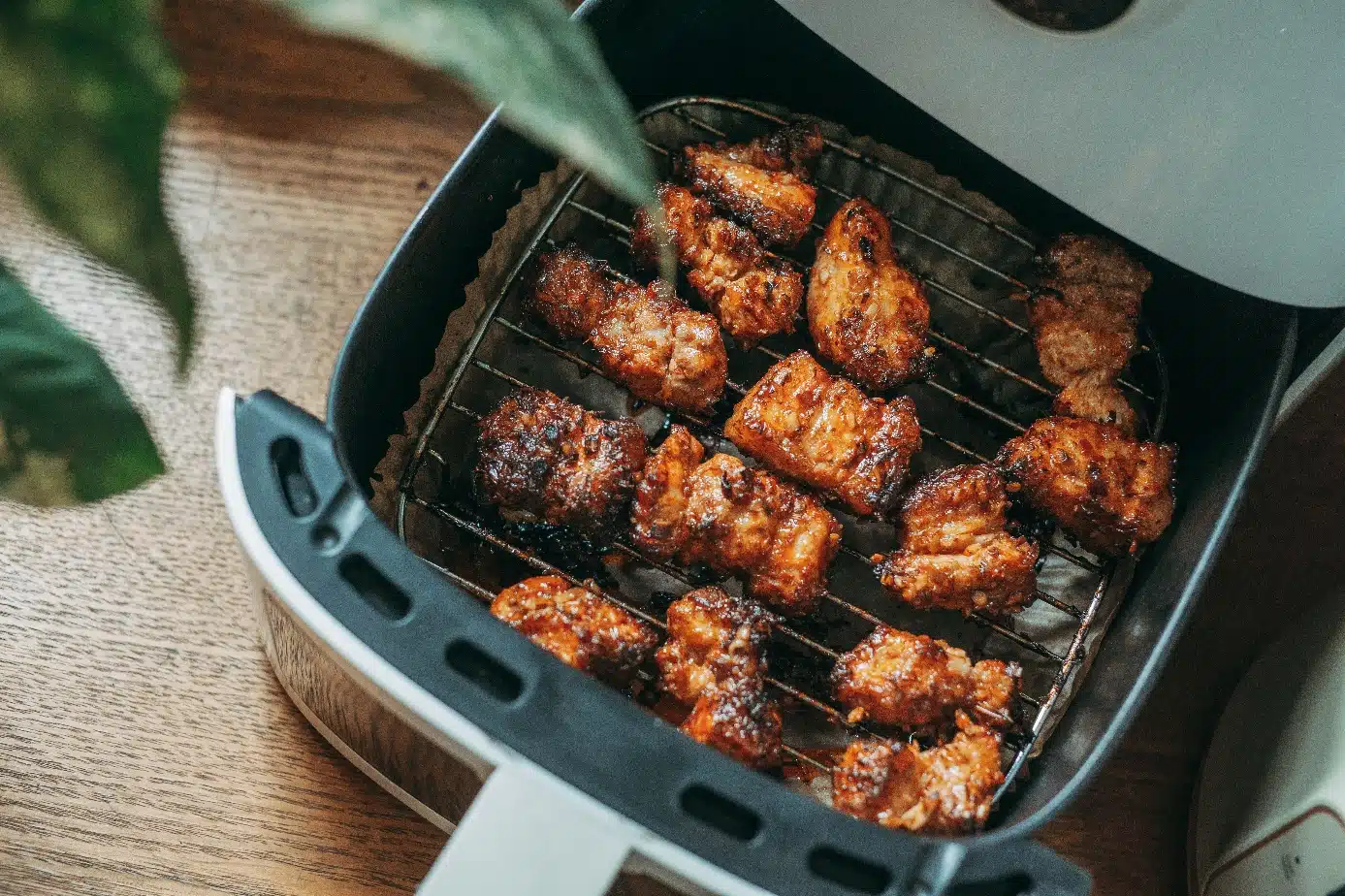
A few precautions considerably reduce the risk of damage:
- Avoid abrupt transitions. A dish taken straight from the refrigerator or freezer should be left to reach room temperature before going into a preheated appliance. Likewise, a hot dish should not be placed on a cold or wet surface.
- Check the dimensions. The dish should sit flat in the basket and leave a gap around its edges so that air can circulate. A dish that is too large hinders cooking and may come too close to the heating element.
- Inspect the dish. Chips, cracks or deep scratches weaken the structure. A damaged dish should be set aside.
- Remove unsuitable lids. Plastic lids and seals, often supplied with storage containers, are not designed for this level of heat.
- Handle with protection. Glass retains heat for a long time. Oven gloves are needed when removing the dish, and it should rest on a trivet or dry board.
Effects on Cooking
Glass heats more slowly than metal, but it also retains heat well once warm. In practice, cooking times may be slightly longer than with food placed directly in the basket, and browning on the underside may be less pronounced. Checking progress partway through and adjusting the time is advisable, particularly the first few times.
On the other hand, glass offers clear advantages. It does not react with acidic ingredients, does not retain odours and makes it possible to monitor the cooking through the sides of the dish. The same dish can also be used to prepare, cook, serve and store leftovers, which limits washing up.
In Summary
Glass dishes can be used in an air fryer, provided they are made from heat-resistant glass and labelled as oven or air fryer safe. Avoiding sudden temperature changes, choosing the right size and checking the condition of the dish are the main safeguards. Used in this way, glass becomes a practical and durable addition to everyday air fryer cooking.