Technology is so present in our lives that trying to eliminate it often means fighting an unfair battle. With this being said, using technology correctly may bring more benefits to sleep than trying to eliminate it entirely. This is important, as late-night entertainment has become part of our daily routine, as people get busier and busier during the day, but nothing is more important in this matter than a quality sleep.
Why mobile-first wind-down habits belong on a steady surface
Many nighttime activities are now mobile-first by design. They are built for a small screen, short sessions, and one-handed control. That includes reading apps, slow strategy games, word puzzles, and card games that feel more like thinking than reacting. In bed, these activities become even more “bed-shaped” because the default posture is to lie down and let the phone float above your face. It feels effortless, until your arms, neck, and eyes start paying the price.
In this sense, mobile card play stands out. A lot of digital poker is intentionally paced. You are not mashing buttons, you are watching patterns, making small choices, and waiting for the next hand. That rhythm is a big reason people like to play late.
When you play poker on mobile devices, the mind stays engaged in a light, steady way: odds, timing, and reading the table. It is not stressful for everyone, but it does keep your attention “on.” The physical setup matters even more because the game can stretch longer than you planned, especially when you are comfortable and already in bed.
A bed desk helps by changing the whole posture of the session. It also adds a soft “border.” With a small table in front of you, poker on mobile feels like a clear activity you start and finish, not just endless scrolling until your eyes get too tired to stay open.
If digital poker and similar games are part of your nightly routine, the goal is to make it physically easy, mentally contained, and simple to end, so you can close the loop and move into sleep without feeling wired or achy. One funny meme from social media teases that a player may go back to sleep while the game is still going on, so it’s all about well-balanced scheduling and comfort in late-night entertainment.
Please, embed the link:
https://www.instagram.com/reel/DTlqBAKjI8V/?igsh=MXhldzRicDU3ajBrcg%3D%3D
What the numbers say about bedtime screens, and why setup changes outcomes
If you want a quick reality check, look at what people report about screens near bedtime. Across surveys, the theme is not that screens are rare. It is that they are normal, and many adults feel the downside when the habit stretches or turns emotionally noisy.
A recent survey shared by the American Academy of Sleep Medicine found that 38% of adults say bedtime phone or tablet use to view headlines makes their sleep slightly or significantly worse, and 26% say they prioritize phone screen time over getting the recommended amount of sleep. In a separate Gallup poll reported by AP News, only 26% of Americans said they get eight or more hours of sleep per night, while 20% reported five hours or less. SleepFoundation.org also reports that adults in the U.S. spend 3 hours and 30 minutes on social media before bed each night, showing how easily “just a little time” can expand.
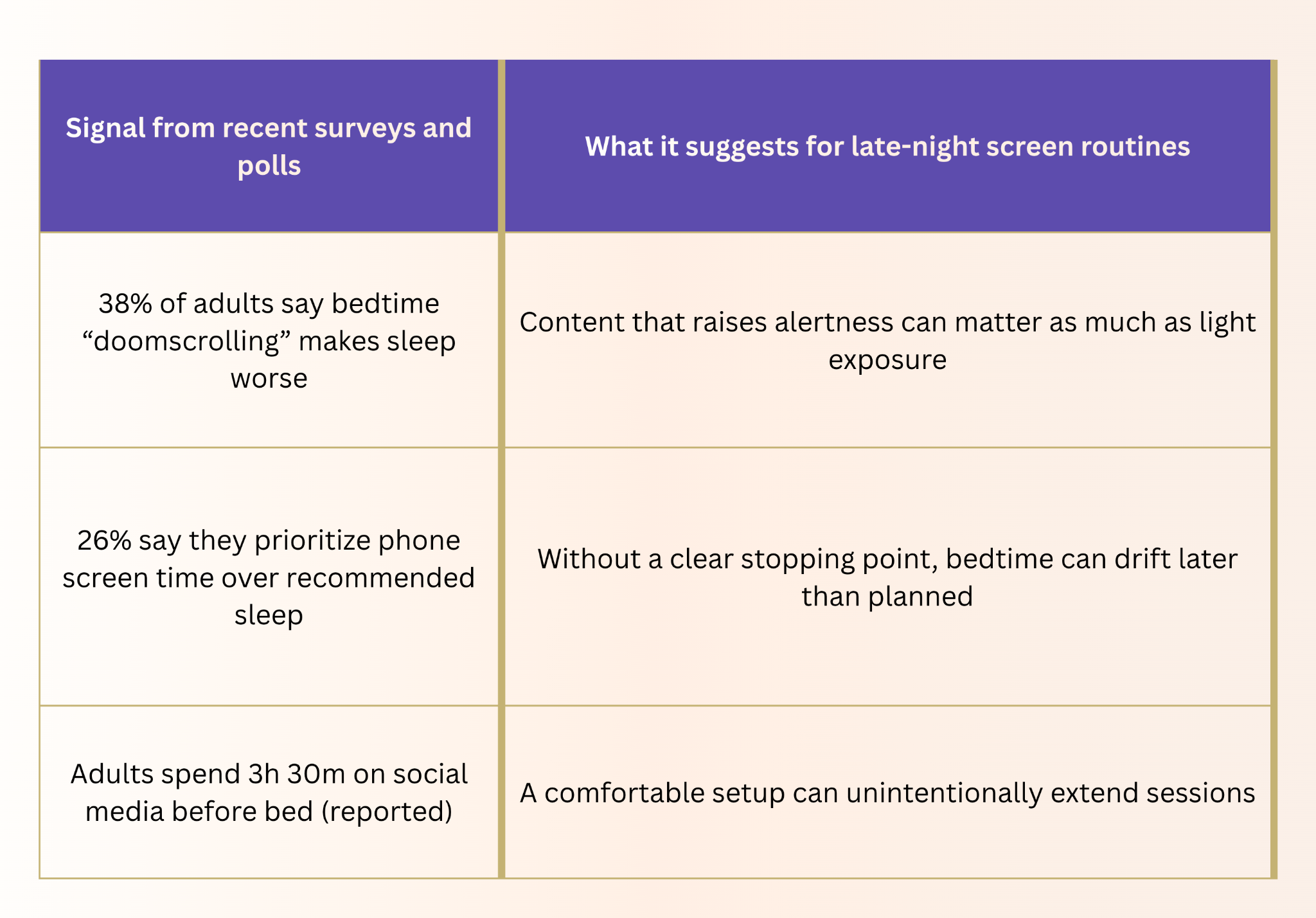
The table was created by us, specifically, for this article.
This is where a bed desk earns its keep. It does not magically remove light from a screen. But it can make your routine more intentional. A stable surface encourages a more upright, less collapsed posture, keeps the screen from constantly changing distance, and reduces the little discomforts that keep you half-awake. Just as important, it turns “bedtime screen time” into a session you can finish, rather than a posture you get stuck in.
Building a cleaner off-ramp from screens to sleep
The simplest way to sleep better after screens is to make the last part of the routine predictable. A bed desk helps because it creates a small “station” that can be reset. When the session ends, the surface can be cleared, the device can be put away, and your bed can go back to being only for rest.
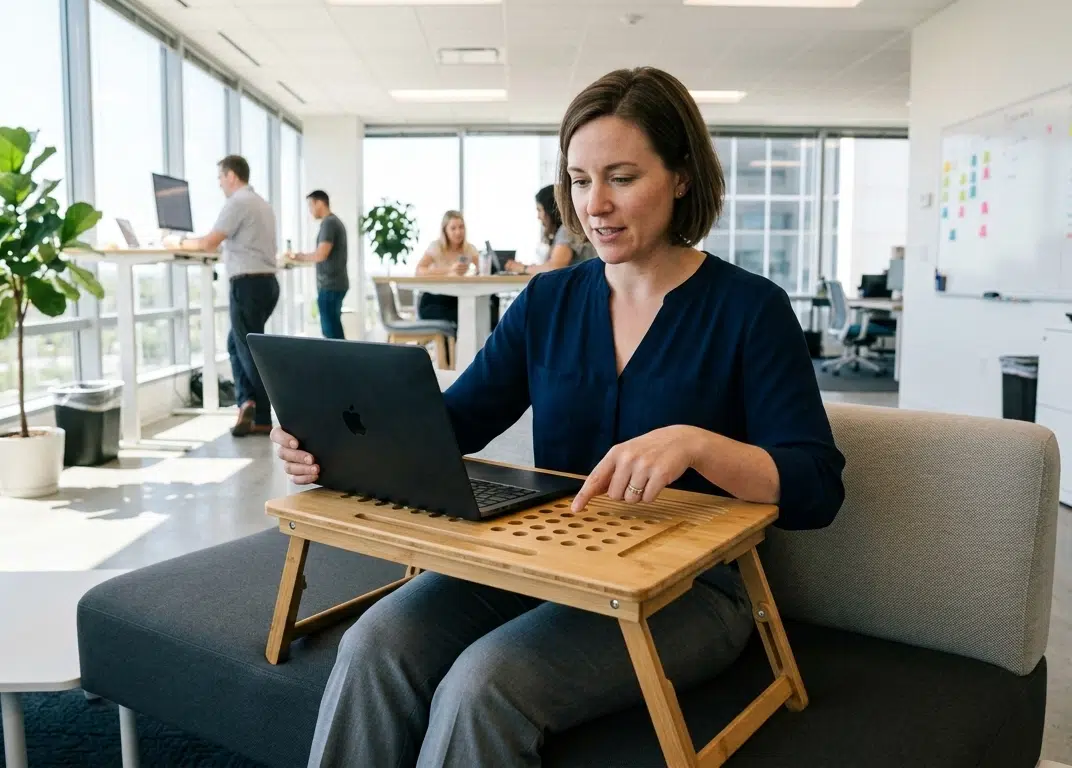
Many desks have little holes or raised parts on the surface. This is because laptops and tablets can get hot when they sit on soft blankets. The extra airflow helps your device stay cooler, work better, and feel less hot on your legs.
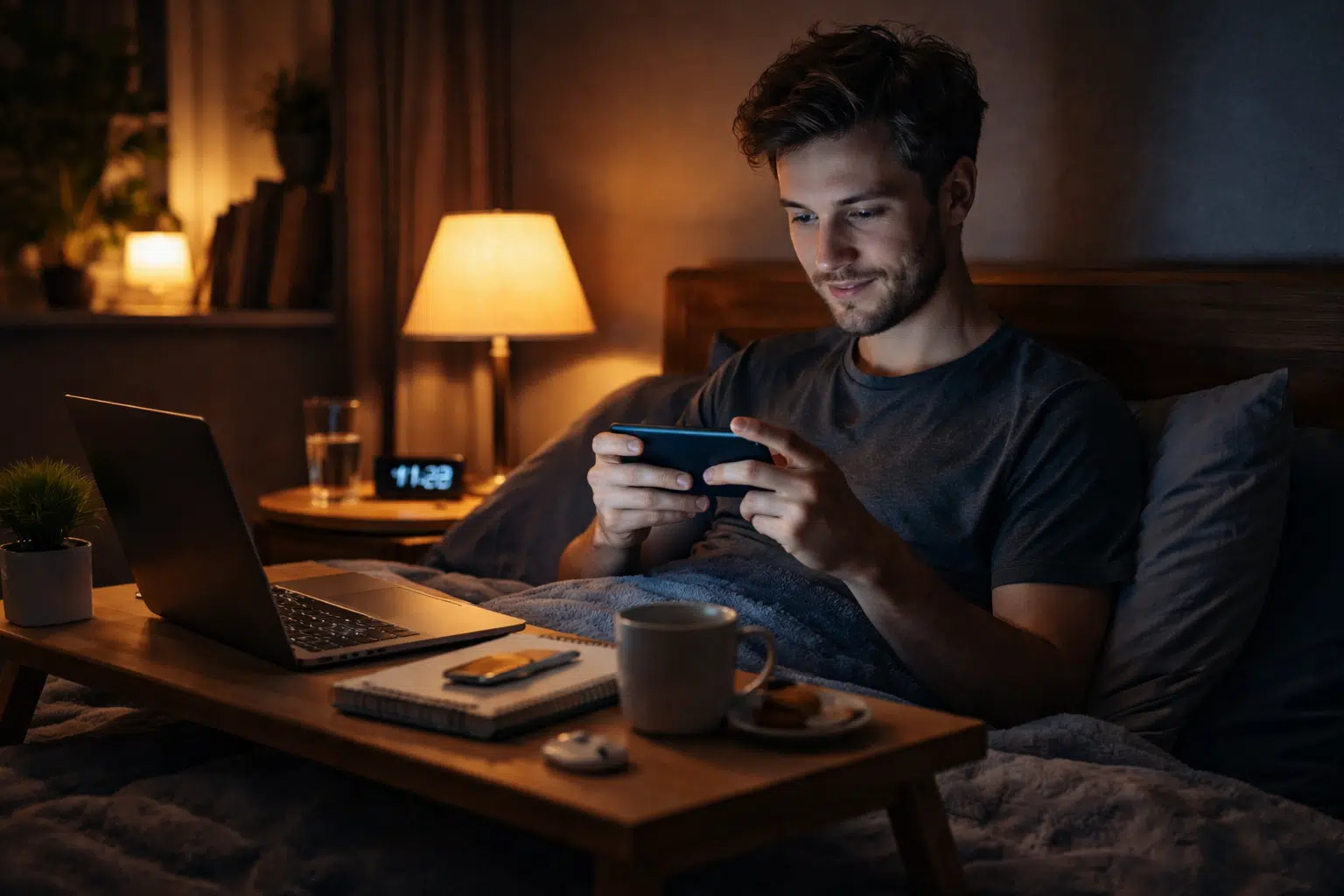
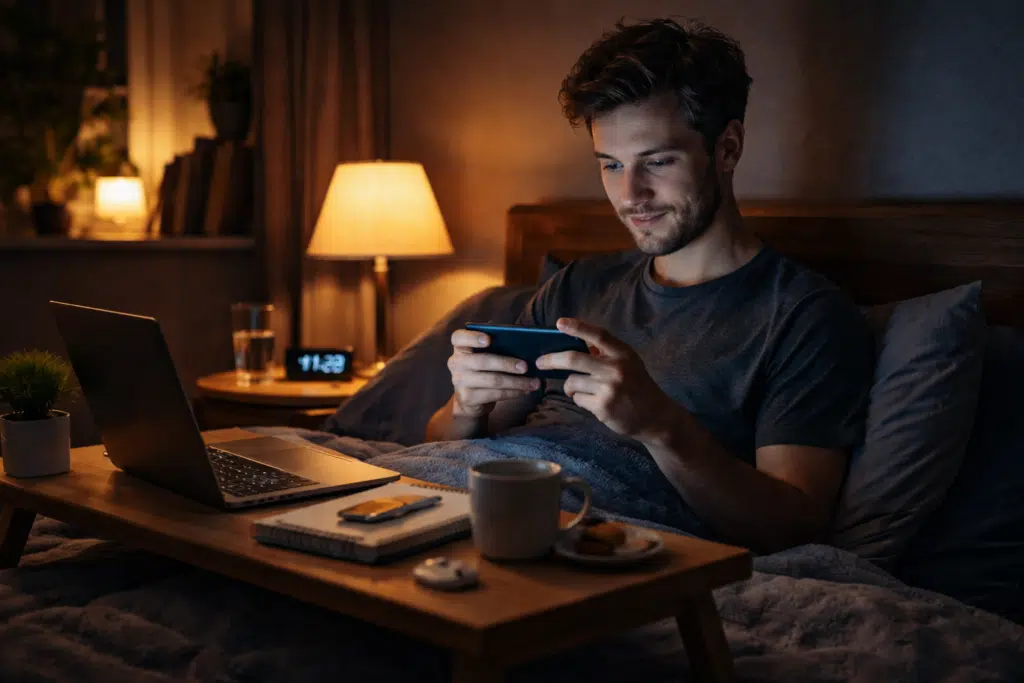
The image was created by us via AI, specifically, for this article.
It also helps to understand why screens keep you lingering. Light plays a role, but attention does too. Harvard Health Publishing states it plainly: “While light of any kind can suppress the secretion of melatonin, blue light at night does so more powerfully.” That line is useful because it points to a practical idea: you want fewer inputs that keep your body and brain in “day mode,” right when you are asking them to switch.
There is another reason the loop is hard to close: the device is often physically right there, within reach, even after you decide to stop. A 2025 paper in a medical journal archive notes that a Pew Research Center survey found 65% of smartphone users keep their phones on or near their beds while sleeping. When the phone stays in arm’s reach, it is easy to reopen it after a micro-wake, or to check “one last thing” that turns into ten more minutes.
Frequently Asked Questions
1) What is a bed desk, exactly?
A bed desk is a small table made to sit on your lap or over your legs while you’re in bed. It gives you a stable, flat surface for a phone, tablet, or laptop.
2) How can a bed desk improve sleep after screen time?
It helps you sit in a better posture and makes your screen time feel like a clear “session” with an end. That makes it easier to stop, put the device away, and transition into sleep.
3) Is a bed desk only useful for work, or also for late-night mobile activities?
It’s useful for both. For slow, mobile-first wind-down habits like reading apps or digital poker, it reduces arm and neck strain and keeps the setup more controlled.
4) Why do many bed desks have holes or raised parts on the surface?
Those features improve airflow, which helps laptops and tablets stay cooler on soft bedding. Less heat also means the device feels less hot against your legs.