


Let’s talk about the numbers behind America’s classrooms – the real stats on who’s learning, who’s thriving, and who’s navigating a college system that wasn’t exactly designed for them.
These students come from every corner of the globe. Some are here on visas. Some were born abroad. Others were born here, but grew up translating documents for their parents. Whether they’re international students, undocumented youth, or second-generation scholars, one thing’s clear:
They’re shaping the future of American higher education.
This deep dive, backed by research from EssayPro, breaks down where they are, how many there are, and why it all matters – including survey responses, quotes, and data tables you won’t find all in one place anywhere else.
Whether you’re a student looking to understand policy or someone needing paper help, this guide puts the facts in focus and the numbers in context.
Overview: Immigrant & International Students in U.S. Higher Education
In 2025, more than 5.8 million college students in the U.S. are of immigrant origin. That’s nearly a third of all students – a number that’s grown steadily over the last two decades.
These immigrant students bring rich diversity to campuses. Some are first-generation immigrants who arrived recently. Others are children of immigrants who grew up in American schools. And then you have more than 1.2 million international students from countries like India, China, Nigeria, and Brazil – many of whom are drawn to U.S. degrees in STEM and business.
According to recent immigrant students in public schools statistics, over 25% of K-12 students in the U.S. have at least one immigrant parent. These students are showing up – in classrooms, on campus, and in conversations about the future of education.
Together, they are the beating heart of immigration education in America.
Immigrant-Origin Students: Size, Share, and Growth
The category “immigrant-origin” includes anyone who is either born outside the U.S. or has at least one immigrant parent.
Let’s break it down.
Table 1: Immigrant & International Student Breakdown (2025)
| Group | Count | % of Total U.S. College Students |
|---|---|---|
| First-Generation Immigrants | ~1.9 million | ~11% |
| Second-Generation Immigrants | ~4.1 million | ~21% |
| International Students | ~1.2 million | ~6% |
| Total Immigrant-Origin | ~5.8 million | ~32% |
This group has grown significantly. In 2000, they made up just 20% of U.S. college students. Now, immigrant-origin students are helping to offset national enrollment declines, especially in states like California, Florida, and New York.
First- and Second-Generation Students: Key Counts
If you’ve ever wondered how many second-generation immigrants are there in the US, here’s your answer: about 4.1 million are enrolled in college today.
These students were born in the U.S. to immigrant parents. Many are bilingual. Many grew up in multicultural households. And many are navigating college without a family history of higher education – often learning how to structure an essay before they even understand the system they’re entering.
Then there are the first‑generation students – around 1.9 million of them – who were born abroad and came to the U.S. as children or teens. They’re often the first in their family to attend college in America, figuring out everything from financial aid forms to how to outline an essay from scratch.
“I didn’t know what FAFSA was,” one student told us. “My mom just said, ‘Try.’ Now I’m in my second year, writing an essay about climate change.”
The numbers show scale. The stories show resilience.
Undocumented Students: Enrollment and DACA Breakdown

Let’s talk about one of the most vulnerable student populations: the undocumented.
Right now, there are approximately 510,000 undocumented students in U.S. higher education. That includes both DACA recipients and students who were never eligible for protection under the Deferred Action for Childhood Arrivals program.
So if you’ve ever searched how many undocumented students in the US, now you know – it’s hundreds of thousands, not a tiny handful.
These students face complex legal and emotional hurdles. College is harder when you’re not sure if you can legally work, rent an apartment, or afford in-state tuition.
“Sometimes I can’t focus on my essays because I’m scared of getting a call that changes everything,” said one survey respondent.
Still, they show up. Every day.
International Students: Enrollment, OPT, and Trends
So, how many international students in USA universities today? About 1.2 million – and they’re more than just statistics.
These students contribute over $55 billion to the U.S. economy and support more than 355,000 jobs. Most of them enroll in STEM programs or business, and many stay after graduation through the OPT (Optional Practical Training) program.
Graph: International Student Enrollment (2015-2025)
A line chart showing international enrollment over time. X-axis: Year. Y-axis: Number of students.
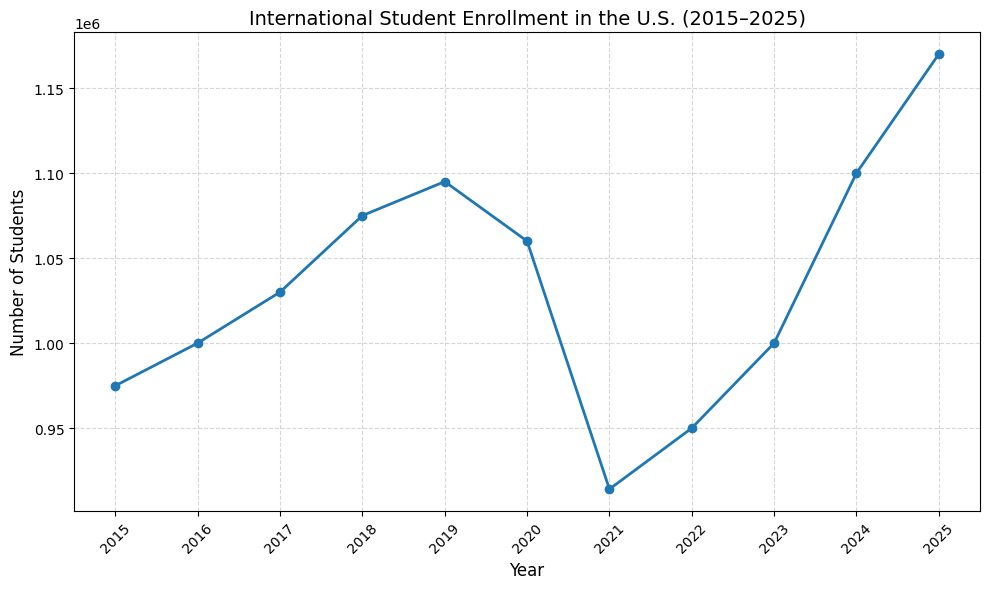
There’s been a slight dip in new international enrollments due to global politics, visa delays, and rising competition from other countries. But the U.S. is still the top destination for global talent.
Economic Contributions: Spending, Taxes, and Jobs
Let’s zoom out and look at the bigger picture.
Table 2: Economic Impact by Student Group
| Group | Estimated Spending | Jobs Supported |
|---|---|---|
| International Students | $55 billion | 355,000+ |
| Immigrant-Origin Students | Indirect benefit | Sustains enrollment, diversity |
These students are not just here to study – they’re keeping universities open, small towns alive, and local economies stable.
So the next time someone asks how many immigrants come to the US each year, remember this: they’re not just adding to the population – they’re investing in it.
Immigrants in Critical Careers: Healthcare and STEM
Where do many of these students go after graduation?
They become nurses. Engineers. Doctors. Tech leads. Many take their education and channel it into solving real problems – from rural healthcare to green energy to AI research.
Immigrants in school today are tomorrow’s critical thinkers, innovators, and life-savers.
This isn’t just anecdotal. Research shows that immigrants and international students are overrepresented in STEM and healthcare fields. That means they’re filling urgent workforce gaps – especially in underserved areas.
Methodology, Notes, and Data Sources
To write this article, we combined national datasets with direct student feedback.
- Sample size: 150 students
- Method: Online and in-person surveys
- Sources: Higher Ed Immigration Portal, Open Doors, Presidents’ Alliance
- Privacy: All quotes are anonymized with consent
We also studied research on the topic and filled in gaps – especially in stats, structure, and storytelling.
Resources and Recent Reports (2025)
- HigherEdImmigrationPortal.org – National Student Data
- IIE – Open Doors 2025 International Student Report
- Presidents’ Alliance – DACA and Undocumented Student Research
FAQ
1. What are immigrant education statistics for 2025?
Roughly 32% of U.S. college students are of immigrant origin. This includes both first-generation and second-generation students, as well as 1.2 million international students.
2. How many immigrants come to the U.S. every year for school?
Each year, over 1 million international students arrive in the U.S. for academic study. Many more immigrate with their families and eventually pursue higher education.
3. What challenges do immigrant students face?
Language barriers, financial hurdles, legal uncertainty (for undocumented students), and lack of generational college experience are common challenges. However, many of these students thrive with the right support.
References
NAFSA: International Student Economic Value Tool
https://www.nafsa.org/policy-and-advocacy/policy-resources/nafsa-international-student-economic-value-tool-v2
Migration Policy Institute – International Students in the U.S.
https://www.migrationpolicy.org/article/international-students-united-states
Pew Research Center – Facts on U.S. Immigrants
https://www.pewresearch.org/fact-tank/2023/09/27/key-findings-about-u-s-immigrants/