

Bad sleep has a way of sneaking up on you. One night you wake up stiff, the next your partner is rolling toward you on a mattress that used to feel perfectly flat.
After years of professionally testing and reviewing mattresses, I have seen this pattern recur across dozens of sleep setups. The culprit, more often than not, is a mattress that has never been rotated.
The question of how often you should rotate your mattress may sound simple, but the honest answer depends on your mattress type, body weight, sleep position, and how the bed is actually used. This piece covers it all without the guesswork.
How Often Should You Rotate Your Mattress?
Rotate your mattress every 3 months. That is the answer for most people, and it is the one I stand behind based on everything I have seen across different mattress types, sleep setups, and real bedroom conditions.
Rotating means turning the mattress 180 degrees; the head end moves to the foot, and the sleeping surface stays facing up.
This shifts where your body weight lands each night, slowing the development of soft spots and uneven dips that can form when one area bears pressure night after night.
| Some mattresses with zoned support systems are designed to stay in a fixed orientation. Rotating them moves the targeted support zones out of alignment with your body. If your mattress is marketed with any specific term, check your owner’s manual or the manufacturer’s website before rotating it. For everyone else, 3 months is your working baseline. |
That said, every mattress brand has its own care instructions. Some latex models can go 3 to 6 months between rotations. Some older innerspring beds are built to be flipped as well as rotated. Always check the label or care booklet for your specific mattress before settling on a schedule.
How Often Do People Actually Rotate Their Mattress?

In the Reddit discussion “How often do you turn your mattress over?“, the original poster admitted they had owned their mattress for a full year before turning it, and had not been rotating it at all.
The replies tell a familiar story. A good chunk of people had no idea regular rotation was even recommended. Others said they rotate every few months, and a handful follow whatever schedule their brand suggests, usually every six months.
Several people mentioned that sagging became noticeable once rotation was ignored, especially on heavier king-size beds. This tracks with what I have observed.
People remember to wash their sheets and flip their pillows, but the mattress gets skipped because it still feels acceptable, until it does not.
By then, some of the wear is already set in. The 3-month rule exists precisely because the damage is gradual and easy to miss until it is harder to reverse.
Why the Right Rotation Schedule Differs for Every Sleeper
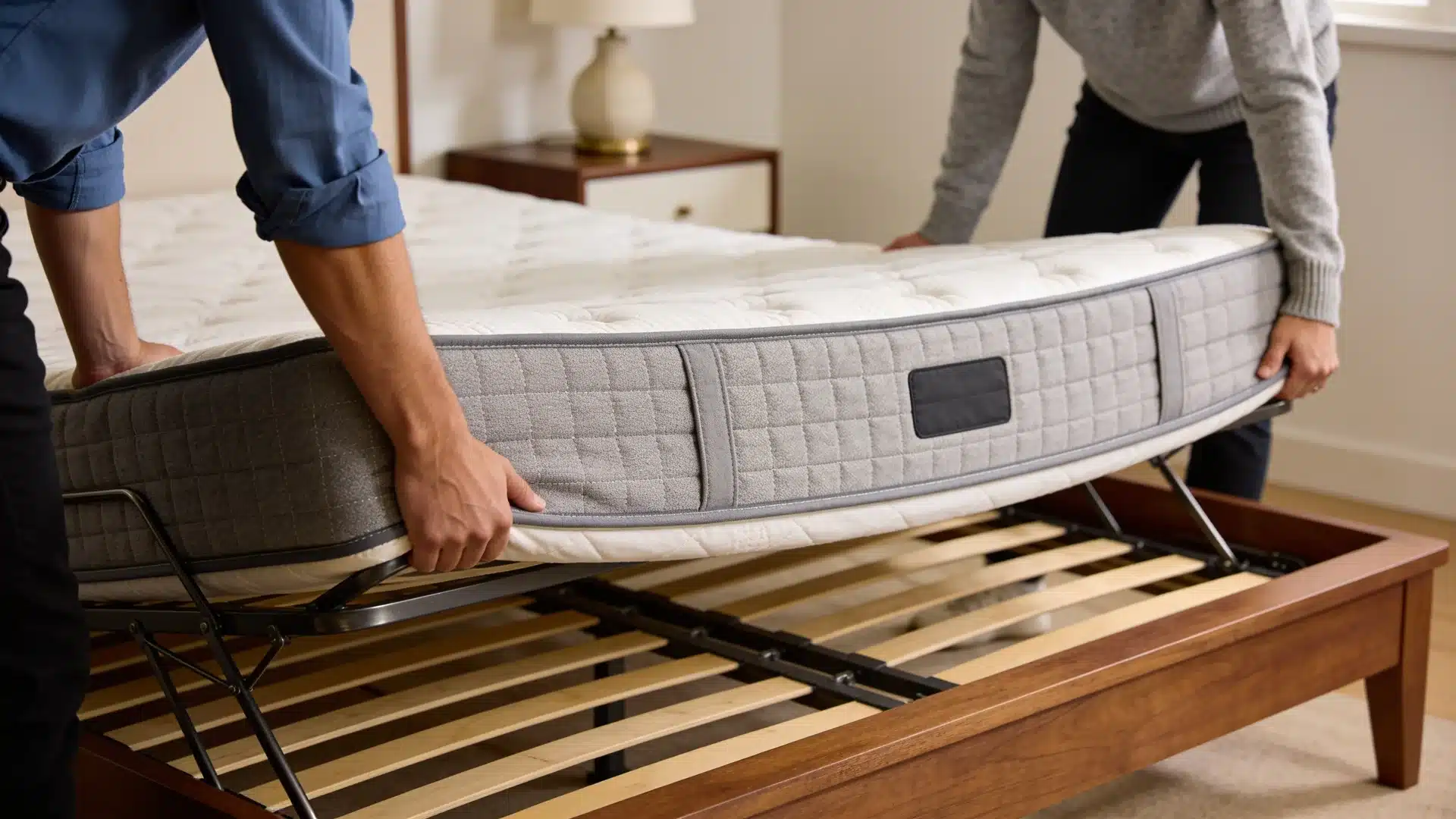
A single mattress rotation schedule does not work equally for every household. Here is what actually changes the math:
1. Your Sleep Position
Side sleepers concentrate weight on the shoulders and hips, which creates deeper impressions in those zones faster than anywhere else.
Back sleepers distribute pressure more evenly across the spine and legs, so wear tends to be slower. Stomach sleepers often load the center of the mattress heavily, which can cause the middle to soften first.
If you sleep on your side every night, every 3 months is non-negotiable. Back sleepers can sometimes stretch to 4 months without issue, though I would not push past that.
2. Body Weight and Weight Difference Between Partners
Heavier sleepers compress mattress materials more deeply with every night of use. When two partners have a significant weight difference, say one is 130 lbs, and the other is 220 lbs, the heavier side wears faster, and the mattress will start to tilt subtly toward that edge over time.
In shared beds with a notable weight gap, rotating every 2 months is worth doing. It does not fully eliminate the difference, but it slows the imbalance enough to matter over the life of the mattress.
3. How Frequently the Mattress Is Used
A primary bedroom mattress that gets used 365 nights a year needs a consistent 3-month rotation. A guest room mattress that gets slept on a few weekends a year can comfortably go 6 months between rotations, sometimes longer if it has had very little use.
A child’s mattress is worth rotating on a standard schedule too, since kids tend to sleep in fairly fixed positions and their lighter weight can still create soft spots in foam over time.
Easy Ways to Remember Mattress Rotation
The biggest reason people skip rotation is not laziness; it is that there is no natural trigger for it. Unlike laundry or dishes, the mattress gives no obvious signal until the damage is already happening. The fix is to attach rotation to something you already do.
| Method | What to Do | Why It Works |
|---|---|---|
| Seasonal rotation | Rotate at the start of each season: autumn, winter, spring, summer. | Four seasons, four rotations. Lands almost perfectly on a 3-month cycle without tracking dates. |
| Pair with bedding care | Rotate when you deep clean the mattress or swap out seasonal bedding. | The bed is already stripped bare, so the extra step costs almost no additional effort. |
| Phone reminder | Set a recurring 3-month calendar alert labeled “rotate mattress.” | Takes 10 seconds to set up and removes any need to remember on your own. |
I personally use the seasonal method. It requires zero tracking, and flipping the bedding over anyway makes rotation feel like a natural part of the same task rather than a separate chore.
What Happens When You Skip Mattress Rotation
Skipping rotation for a few months is rarely catastrophic. Skipping it for years almost always shows up in ways that affect both sleep quality and mattress lifespan.
- Uneven wear sets in early: The same body parts land in the same spots every night, and foam or springs in those areas compress faster than the rest of the surface.
- Body impressions deepen: Shallow impressions are normal and expected. The problem is that when they go deeper than an inch or so, comfort and spinal alignment both take a hit.
- You start rolling toward a dip: Once one area softens enough, the slope pulls your body toward it during the night, disrupting sleep without you always realizing why.
- Spinal support weakens on one side: An uneven surface means your spine is no longer held in a neutral position, often showing up as morning stiffness or lower back discomfort.
- The mattress ages faster overall: A mattress that wears unevenly reaches the end of its useful life sooner than one that has been maintained with regular rotation.
Rotation will not save a mattress that is already deeply sagged or structurally compromised. At that point, the conversation shifts to replacement. But used consistently from the start, it genuinely extends how long a mattress performs well.
Rotate vs. Flip: What Is Actually Right for Your Mattress
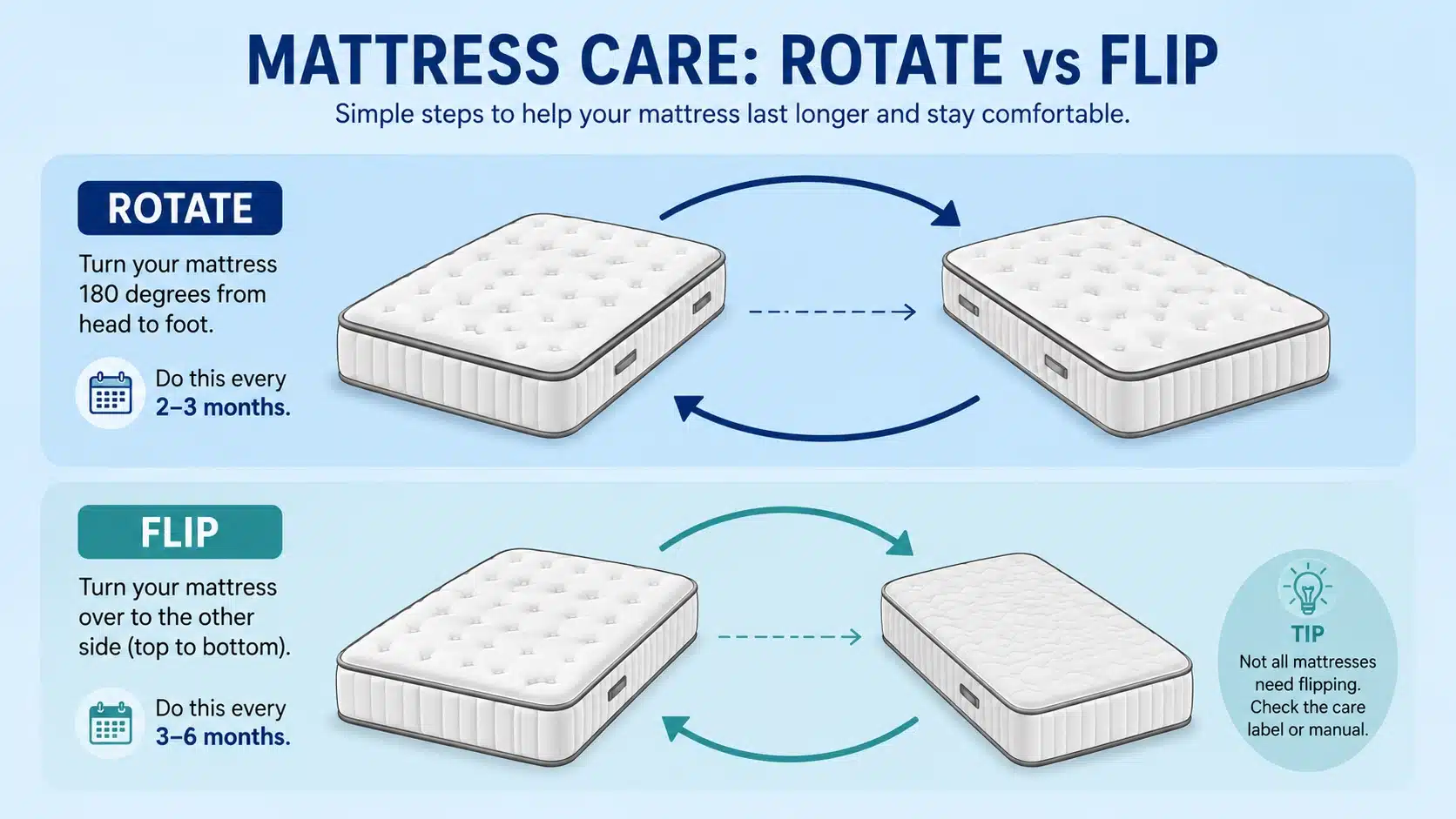
These two terms get used interchangeably, but they describe completely different actions, and confusing them can lead to sleeping on the wrong side of your mattress for months without knowing it.
| Action | What It Means | When It Applies | Key Point |
| Rotating | Turn the mattress 180 degrees on the same axis | Every 3 months for most mattresses | The sleeping surface stays on top; only the head and foot positions swap. |
| Flipping | Turn the mattress completely upside down | Only for double-sided mattresses | Both sides are designed to sleep on. Not all mattresses qualify; check the label first. |
| Flipping a single-sided mattress | Not recommended | Avoid this entirely | You end up sleeping on the support base rather than the comfort layer. The mattress will feel hard, uneven, and wear in ways it was not designed to handle. |
Worth noting: some mattress brands, particularly certain latex and older innerspring models, still manufacture double-sided designs. If you own one, flipping is not only safe but recommended alongside regular rotation. Always confirm with your specific brand rather than assuming either way.
For the vast majority of modern mattresses, rotate freely, flip never.
What About a Brand New Mattress?
Most people rotate on autopilot once a mattress is fully broken in, but the first six months are actually when rotation matters most.
New mattress materials, whether foam, latex, or pocket springs, are still settling under regular body weight. If you sleep in the same spot every night during this period, that area compresses faster than the rest of the surface and settles into a pattern that is difficult to reverse later.
For the first six months after buying a new mattress, rotate it every 6 to 8 weeks. Once the mattress has broken in evenly, you can move to the standard 3-month schedule.
I started doing this with the last two mattresses I reviewed and saw noticeably fewer early impressions at the 6-month mark compared to beds where I had skipped the break-in rotation.
Rotation Frequency Based on Mattress Type
Not every mattress wears the same way, and the rotation schedule that suits a memory foam bed is not identical to what a latex mattress needs. Here is how the main types break down:
| Mattress Type | Rotation Frequency | Should You Flip It? | Why It Matters |
|---|---|---|---|
| Memory foam | Every 3 to 6 months | No, unless specified as double-sided | Foam compresses with body heat and pressure and holds impressions longer than spring-based materials. |
| Hybrid | Every 3 months | No, for most models | The coil base and foam comfort layers are designed to work in a fixed orientation. Flipping disrupts that. |
| Innerspring | Every 3 to 6 months; more frequently for older models | Only if double-sided | Older innerspring models were routinely double-sided. Many newer ones are not; check before flipping. |
| Latex | Every 3 to 6 months | Only if the brand specifies | Latex is more resilient than foam, so it holds up longer between rotations, but it still benefits from the habit. |
| Pillow-top | Every 3 months | No | The pillow-top layer is fixed to one side. Flipping puts that layer face-down against the base, which ruins both comfort and construction. |
| Zoned support | Do not rotate unless the manufacturer explicitly permits it | No | Zoned designs target specific body areas with firm or soft support. Rotation moves those zones out of alignment with your spine, hips, and shoulders. |
Signs Your Mattress Needs Rotation Now
If you are already on a 3-month schedule and one of these shows up before your next rotation date, do not wait. Rotate immediately.
- One side is noticeably softer than the other: Lie across different sections of the mattress. If there is a clear difference in firmness, the worn side has been carrying more weight.
- You can see a visible dip or body impression: Run your hand across the surface with the sheets off. Shallow impressions under an inch are normal. Deeper ones mean the rotation schedule needs to start immediately if it has not already.
- You keep sliding toward the same spot: The mattress surface has softened enough to create a slope. Rotation shifts that area out of your primary sleep zone.
- Morning back or hip stiffness has increased: When a mattress stops supporting your spine evenly, you often feel it in the lower back or hips within the first hour of waking. This is one of the clearest signals I have seen in practice.
- Your partner’s side feels better than yours: Switch sides for a night. If theirs feels noticeably more supportive, your side has worn down, and the mattress needs to be rotated.
Frequently Asked Questions
Does mattress rotation help with motion transfer between partners?
Rotation does not change a mattress’s material or construction, so it will not directly improve motion isolation. However, when one side of a shared mattress has worn down unevenly, the softer area can amplify the transfer of movement. Keeping the surface even through regular rotation prevents that secondary problem from developing.
Should you rotate a mattress on an adjustable bed base?
Yes, but with extra care. Adjustable bases flex the mattress in ways a standard flat base does not, which means foam and hybrid materials can develop wear patterns at the flex zones, usually around the head and foot sections. Rotating every 3 months is especially important here. Make sure the mattress is rated for use on an adjustable base before rotating or flexing it repeatedly.
Can a mattress topper replace the need to rotate the mattress?
A topper protects the surface layer and can extend comfort, but it does not stop the core of the mattress from wearing unevenly underneath. The body weight still compresses the mattress materials beneath the topper in the same spots every night. Rotate the mattress on schedule regardless of whether a topper is in use, and wash or rotate the topper separately.
Does rotating a new mattress void the warranty?
The opposite is usually true. Most mattress warranties actually require evidence of reasonable care, and many brands specifically recommend rotation as part of that. Failing to rotate is more likely to be used as grounds to deny a sagging claim than rotating ever would be. Check the warranty documentation for your specific brand to confirm the care requirements.
At what point should rotation stop being the answer?
When the mattress has a persistent sag deeper than 1 to 1.5 inches, broken or protruding coils, or a surface that feels different even after rotation has moved the worn zone away from your sleep position, the mattress has reached the end of its useful life. Rotation at that stage moves the problem rather than managing it. Most quality mattresses reach this point between 7 and 10 years of consistent use.
Final Thoughts
Every 3 months is the right mattress rotation schedule for most beds; move it sooner if you are a heavier sleeper, share the bed with a partner of significantly different weight, or notice uneven wear developing between cycles.
Side sleepers and couples should treat that 3-month window as a firm deadline rather than a loose guideline. The mattress rotation schedule you actually stick to will always outperform the perfect one you forget.
Tie it to a season change, set a phone reminder, and keep the habit simple. Your mattress and your sleep will reflect the consistency over time.
Drop your mattress type and current rotation schedule in the comments; it helps others calibrate what works for different setups.