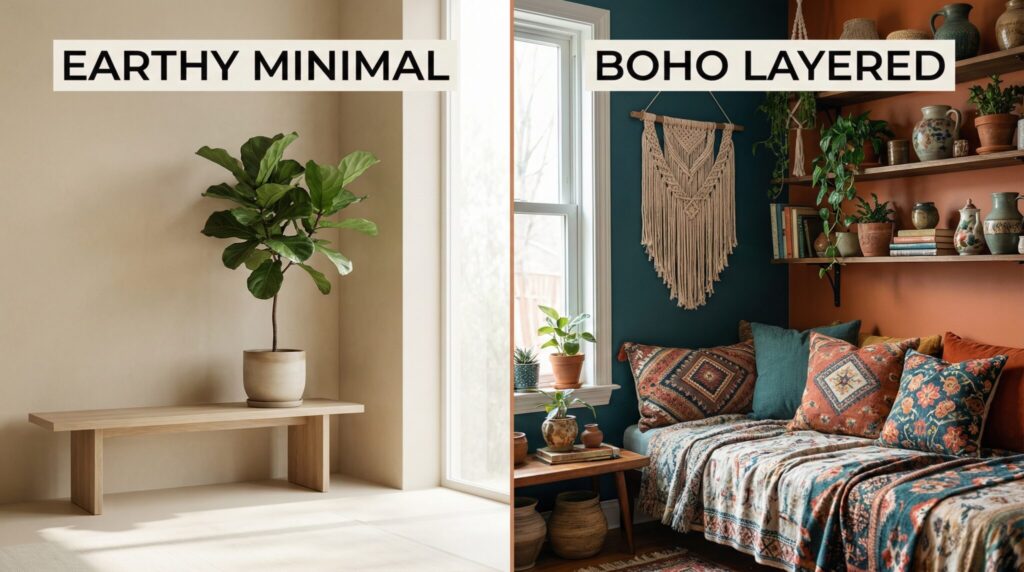
Earthy vs. Boho: The Difference Most People Get Wrong (And Why Your Room Feels “Off”)
If you’ve ever stood in the home decor aisle holding a rattan thingamabob and thought, “Is this earthy? Is this boho? Is this… just overpriced?” hi, you’re my kind of person.
Earthy and boho get confused constantly because they both love warm tones and natural textures. But they’re not the same vibe. And when you mash them together without a plan, you don’t get “effortlessly curated.” You get “I decorated in a hurry while hungry.” (Ask me how I know.)
So let’s clear it up in plain English, with zero design snob energy.
The real difference: what the style is trying to do
Here’s the simplest way I know to explain it:
Earthy style is asking: Does this connect me to nature and make my brain feel quiet?
Boho style is asking: Does this make me happy and say something about me?
Earthy is the friend who orders the same calming drink every time and owns exactly one perfect coat.
Boho is the friend who comes home with a vintage lamp, a woven basket, and an embroidered pillow “because it spoke to me.”
In an earthy room, you tend to notice the materials first the wood grain, the linen, the soft matte pottery. It’s not screaming for attention. It’s like a deep exhale.
In a boho room, you notice the objects the layered textiles, the gallery wall, the “I found this at a flea market and now it’s my personality” treasures.
Neither is better. They just scratch different itches.
Color: earthy is “calm neutrals,” boho is “neutrals + personality”
This is where people accidentally drive their room straight into the ditch.
Earthy color palette
Earthy is mostly neutrals think:
- warm whites
- beige/sand
- warm taupe
- soft clay tones
- light to medium wood
- tiny touches of black (usually as an anchor, not a party trick)
Earthy color feels like a cozy hoodie for your room. It’s there to soothe, not perform.
Boho color palette
Boho usually starts with neutrals too… but then it adds color on purpose:
- rust
- teal
- emerald
- deep plum
- mustard
- warm brass tones
Boho is like jewelry: the base outfit might be simple, but the accessories are doing the talking.
If you want a quick gut check:
If your room is mostly neutrals and you’re adding texture for interest, you’re leaning earthy.
If you’re stacking color and pattern for interest, you’re leaning boho.
Pattern: earthy whispers, boho sings karaoke
Earthy pattern is minimal. You might do one rug with a subtle design, or a simple stripe, or a quiet botanical print but the “wow” comes from texture: chunky knits, nubby linen, raw wood.
Boho pattern layers like it’s getting paid per textile:
- kilim style rugs
- tribal geometrics
- florals
- embroidery (hello, suzani vibes)
- all of it, sometimes in the same 6-foot radius
I’m not mad at it. I just need boho to be intentional or my eye starts twitching.
My personal rule if you’re pattern layering: pick 2-3 main colors and repeat them so the room feels collected, not chaotic.
Decor density: “edited calm” vs “curated treasure cave”
This is the other big giveaway.
Earthy rooms
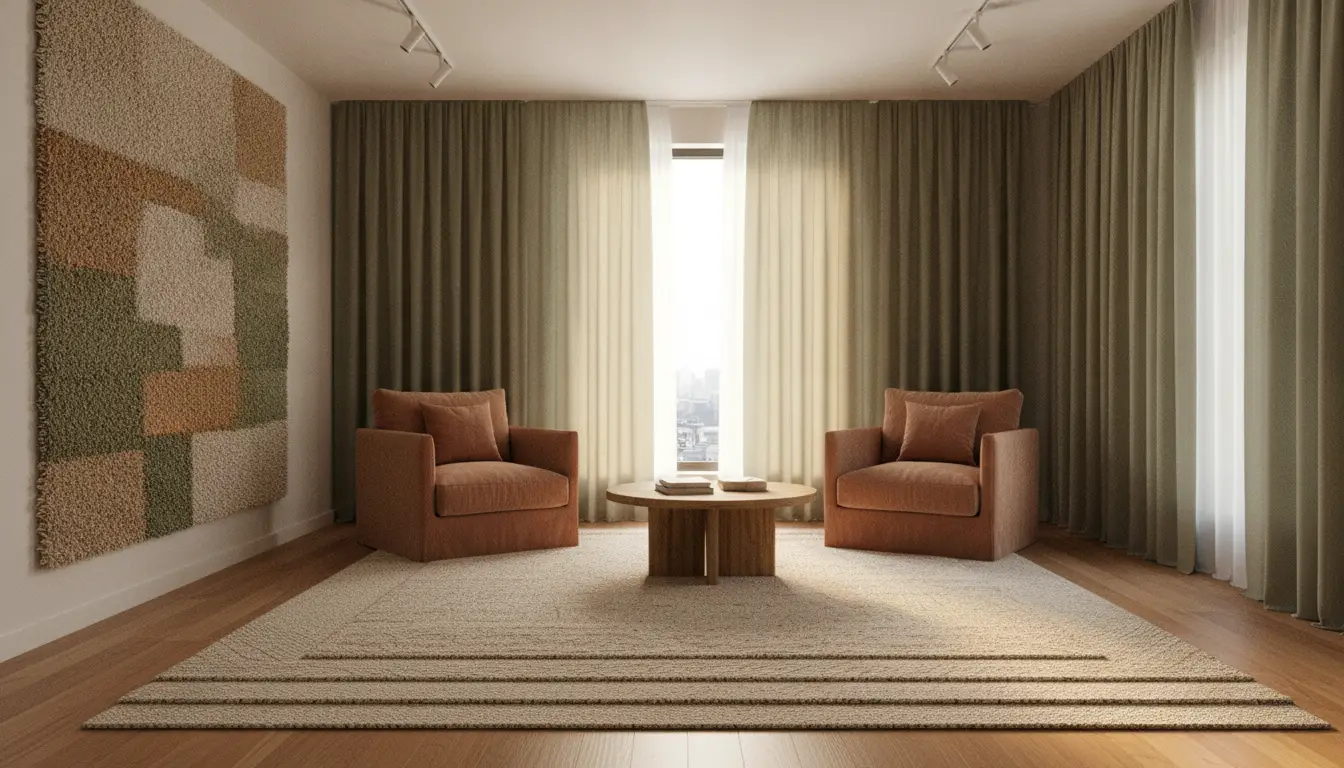
Earthy rooms usually have fewer things out a handful of objects that feel really considered in a modern natural bedroom style. Open space is part of the design. Not “empty because you haven’t finished,” but “empty on purpose because peace is the point.”
If earthy goes wrong, it starts feeling like a showroom. (You know the vibe: beautiful, but nobody’s allowed to sit down.)
Boho rooms
Boho rooms are layered: more art, more books, more baskets, more textiles, more plants. It’s a vibe. But and I say this with love boho can cross the line into clutter cosplay real fast.
Here’s a super practical test:
Stand in the doorway. If you can spot a bunch of unrelated objects all yelling for attention at once, it’s time to edit. Boho is eclectic, not random.
Materials: same ingredients, totally different recipes
Both earthy and boho use natural materials, but they use them differently.
Wood
- Earthy: cleaner lines, visible grain, more “simple and solid”
- Boho: carved/distressed/mismatched pieces that look like they’ve lived a life
Textiles
- Earthy: solid or subtle weaves (linen, cotton), mostly neutrals
- Boho: patterned, embroidered, globally inspired, happily imperfect
Rattan
- Earthy: functional and streamlined (basket that holds blankets, chair with simple shape)
- Boho: decorative and dramatic (peacock chair energy, screens, baskets as wall art)
Also: furniture mixing is the tell.
Earthy usually coordinates wood tones so everything feels calm and cohesive.
Boho mixes woods and metals on purpose because the whole point is that things were collected over time.
Plants + lighting: minimalist moment vs jungle mood
Earthy plants tend to be fewer and sculptural like one gorgeous fiddle leaf fig or snake plant that stands there looking important. Pots are usually simple: ceramic, concrete, terracotta.
Boho plants are more like, “What if my home was a greenhouse but cuter?” You’ll see plants at multiple heights, trailing vines, macramé hangers, mismatched pots… it’s lush and a little wild.
Lighting follows the same logic:
- Earthy: simpler fixtures, fewer light sources, lots of natural light if you’ve got it
- Boho: layered mood lighting lanterns, warm bulbs, interesting lampshades, maybe even string lights if you’re brave (and committed to untangling them at least once a year)
Which one fits your actual life (not your Pinterest life)?
Pick earthy if:
- you want your home to feel calming
- you hate constant rearranging and dusting (respect)
- your space is small and you want it to feel bigger
- you want “warm minimalism,” not stark minimalism
Pick boho if:
- you love thrifting, collecting, and changing things up
- you feel energized by visual richness
- you want your home to feel personal and creative
- you genuinely enjoy the hunt for weird little treasures (this is a personality type)
And yes, you can totally be both. Many of us are.
How to mix earthy + boho without your room looking confused
The easiest blend is:
Earthy base (about 70%) + boho accents (about 30%)
That usually looks like:
- neutral walls + simple furniture (earthy)
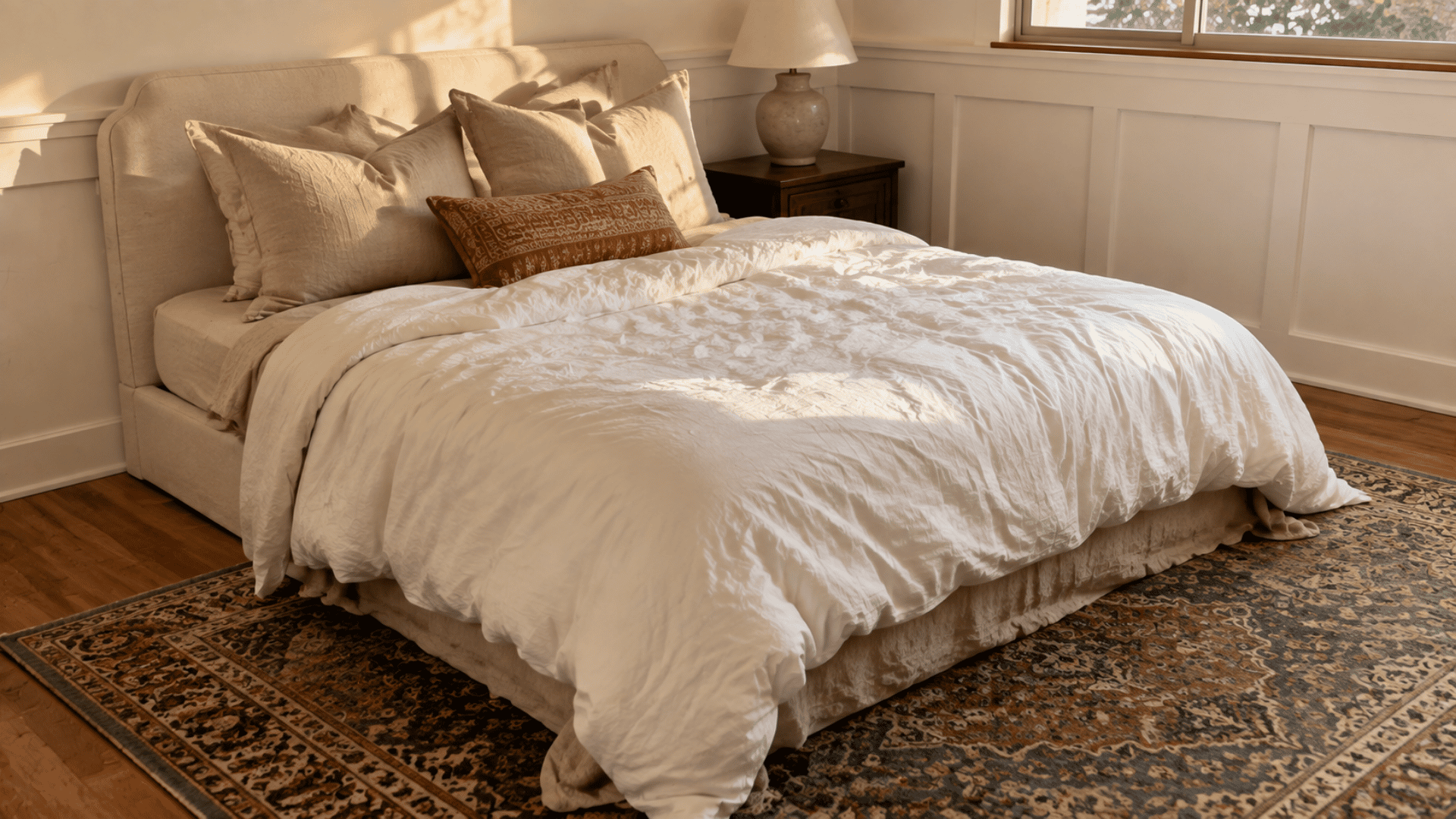
- one patterned rug and some layered pillows (boho)
- a few handmade/collected pieces that matter (boho)
- natural textures everywhere (both)
What doesn’t work:
- tossing bold boho colors around the room with nothing grounding them
- adding a ton of boho “stuff” on top of a super restrained earthy room (it reads messy, not layered)
- competing focal points (like a giant gallery wall fighting a giant earthy statement piece)
If you’re stuck, my opinion: split by room.
Do a simple calming sleep space (sleep deserves calm), and let the living room be your boho “personality playground.” Everyone wins.
The two biggest vibe killers (please don’t do this to yourself)
1) Earthy but sterile
If your earthy room feels cold, it’s not “more decor” you need it’s more texture and something personal. Add one great textile (curtain, rug, throw) and one or two objects that mean something to you. Calm isn’t supposed to feel like a hotel lobby.
2) Boho but “boho kit”
If everything looks like it came from the same aisle… it stops feeling collected and starts feeling costume-y. Mix in thrifted pieces, local maker items, anything with a little story to it.
My favorite “final decision” question
Walk through your space and ask yourself:
Do you want to add more… or does subtracting feel like relief?
If subtracting sounds like a spa day for your nervous system, go earthy.
If adding sounds fun and inspiring, go boho.
Start with your most used room, pick your direction, and commit for a minute before you start buying random things at 11:47 p.m. (Again: ask me how I know.)
Your house doesn’t need to fit a label. It just needs to feel like you live there on purpose.