
What Actually Makes a Room a Legal Bedroom? (Because a Bed Isn’t a Magic Wand)
You know that “bonus room” listing that’s clearly a glorified closet with dreams? Yeah. About that.
A surprising chunk of rooms marketed as “bedrooms” don’t actually meet code. And it’s not just a nitpicky technicality this stuff affects appraisals, loan approvals, insurance headaches, and, oh right… whether someone can get out if the house is on fire. Tiny detail.
So let’s talk about what makes a room a legal bedroom in the eyes of building code (not Aunt Linda, who thinks any room becomes a bedroom if you shove a twin bed in it).
The boring truth: a bedroom is a safety definition, not a decor choice
A bedroom isn’t defined by a bed, a dresser, or your teen’s laundry pile that’s achieved sentience. It’s defined by whether the room meets basic safety and habitability requirements: you can escape, you can breathe, you can see, and you won’t freeze.
Most places in the U.S. lean on the International Residential Code (IRC) as a baseline, but your local building department gets the final say. (Translation: the internet can’t overrule your city inspector. I’m sorry.)
The “legal bedroom” basics (aka the stuff that gets people in trouble)
I’m going to keep this focused on the big deal breakers, because nobody needs a 40 page code romance novel.
1) Size: you can’t call a hallway a bedroom (nice try)
In general, the IRC baseline is:
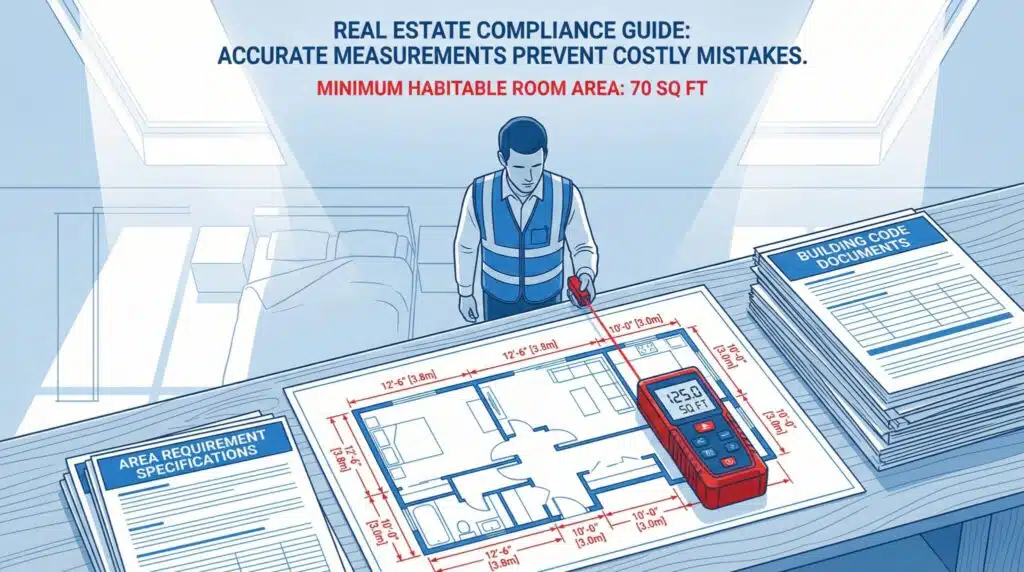
- At least 70 square feet
- At least 7 feet in one direction (this is the sneaky part)
So a room that’s technically 70 sq ft but shaped like a baguette (like 20 feet by 3.5 feet) fails because it doesn’t have 7 feet of width anywhere. A 7×10 room? That’s fine.
Also: if you’re planning for multiple occupants, codes often require more square footage per person. If you’re shopping or renovating, just know that “it’s fine, they can share” isn’t always a code approved strategy.
2) Ceiling height: sloped attic vibes can betray you
That cozy attic bedroom with the angled ceiling that makes you feel like you live in a storybook? Sometimes it’s adorable. Sometimes it’s not tall enough to count.
Baseline rule: you need 7 foot ceiling height over at least half the required floor area. And if the ceiling drops super low, that floor area may not count toward the minimum at all.
This is why people finish an attic and swear it’s a bedroom… and then an appraiser is like, “That’s a very nice storage space you’ve made.”
3) Egress: you need a real way out
This is the one that blows up listings, renovations, and DIY dreams on a regular basis.
A legal bedroom needs an egress window or exterior door a way to escape directly to the outside in an emergency.
Typical IRC requirements include:
- Net clear opening: 5.7 sq ft minimum (not the glass size what you can actually crawl through when it’s open)
- Minimum opening dimensions: at least 20″ wide and 24″ tall
- Sill height: bottom of opening no more than 44″ from the floor
- Must open from inside without keys, tools, or a secret handshake
- Must lead outside, not into another room
And yes, the “math note” matters: just because the opening is 20″ by 24″ doesn’t automatically mean it hits 5.7 sq ft. The code has multiple requirements happening at once because it enjoys chaos.
If you take one thing from this post: a room without proper egress is usually not a legal bedroom. Period.
Stuff people assume is required (but often isn’t)
Let’s clear up the myth I see repeated like it’s gospel:
No, a closet is not always required
A lot of people will tell you, very confidently, that a bedroom must have a closet. In many areas, the IRC does not require one. Buyers may expect it, real estate agents may prefer it, and appraisals may value it differently… including closet and bath sizing but code doesn’t always care.
A door isn’t always explicitly required either
In real life, bedrooms basically always have doors (because… privacy). But depending on your jurisdiction, the code language may not specifically say, “Thou shalt have a door,” in the way people think it does.
That said: if you’re creating a bedroom without a door, you’re going to have bigger problems than code like the person living in it plotting your demise.
Local code can absolutely override the “standard” rules
Here’s where I gently take your hand and tell you the truth: the IRC is a baseline, but local amendments can be stricter. A room that passes in one state can fail in another.
Some places bump up requirements like:
- minimum square footage
- minimum ceiling height
- room dimensions (not just “7 feet in one direction”)
- rules for shared bedrooms / occupant limits
So if you’re in a major city or a state known for tougher building rules, don’t assume the IRC numbers are the final answer. Your local building department is the final boss.
Basements, attics, and garage conversions: where “bedrooms” go to get complicated
If you’re thinking, “Okay, but my house has a basement bedroom…” yes, and that’s where things get spicy.
Basements
Basement bedrooms can be legal, but egress is usually the issue. You may need a proper egress window and a window well that actually lets a human body climb out (revolutionary concept).
Window wells often need:
- enough clear space to climb out
- drainage (because nobody wants a soggy emergency exit)
- grates that release easily from the inside
Attics
Attics tend to fail on ceiling height and sometimes egress, depending on window placement. Sloped ceilings are charming until you realize half the floor doesn’t count because you can’t stand up without becoming a croissant.
Garage conversions
Garages love to be troublemakers:
- floors can sit lower than the rest of the house (and can affect window sill heights)
- ceilings can dip under 7 feet after you add drywall/insulation
- electrical and HVAC are often not set up for bedroom use
Also: a converted garage can look cute and Pinterest-y and still be noncompliant. (Pinterest does not issue Certificates of Occupancy. Yet.)
Bedroom myths that need to retire immediately
Myth: “Any room with a bed is a bedroom.”
Nope. The code does not care about your bed. Or your intentions.
Myth: “The listing bedroom count is definitely accurate.”
Oh, honey. Listings are often based on what someone calls a room, not what’s legal. Sometimes it’s innocent. Sometimes it’s… optimistic marketing.
How to check if a room is actually a legal bedroom (without becoming a code detective full time)
If you’re buying a house or trying to decide if you should call something a bedroom when you sell here’s the practical way to approach it.
Ask for the paper trail
Request:
- Certificate of Occupancy (often shows original bedroom count)
- Permits for additions/finishes/conversions
- Tax assessor records (not perfect, but discrepancies can be a clue)
If the listing says 4 bedrooms and the paperwork screams 3, don’t ignore that little horror movie violin sound in your gut.
Red flags during a walkthrough
- windows that are tiny, weirdly high, or feel “basement-y”
- no obvious permanent heat source (space heaters don’t count)
- ceilings that slope hard or feel low
- finished basements/attics with no clear egress
- access that requires walking through another bedroom (awkward AND often not allowed)
Measure like you mean it
A laser measure helps, but even a tape measure is fine if you’re careful when estimating typical primary bedroom size.
Two quick notes:
- Don’t round up. If it’s short, it’s short.
- For sloped ceilings, you need to know how much floor area actually meets the height requirement. (Yes, it’s annoying. No, the inspector won’t accept “it’s basically fine.”)
“Can I fix it?” Sometimes yes. Sometimes please don’t.
Some problems are relatively fixable like upgrading an egress window or adding permanent heat.
Some problems are money pits like reworking access so you’re not entering a “bedroom” through another bedroom, or trying to magically raise a ceiling that’s too low. (If you figure out how to raise a whole roof for cheap, call me. I have projects.)
Also: if you’re converting space into a bedroom, you usually need permits. Unpermitted bedrooms can cause financing issues and value hits, and in some areas, adding a bedroom can trigger septic capacity requirements. Rural properties get extra spicy that way.
My simple “is this a real bedroom?” checklist
If you want the quick and dirty version, here you go:
- Does it meet minimum size requirements?
- Does it have adequate ceiling height where it matters?
- Does it have a code compliant egress window or exterior door?
- Does it have permanent heat?
- Can you access it from a hallway/common area (not through another bedroom)?
- Do the records and permits match what you’re being told?
If you’re unsure, the most grown up (and least dramatic) move is to call your local building department and ask what code edition and amendments apply where you live. They’ll tell you what actually counts so you don’t find out the hard way when you’re under contract, mid renovation, or trying to refinance.
And if you discover your “fourth bedroom” is really a “delightful den with aspirations”? Congratulations: you just saved yourself a future headache.