
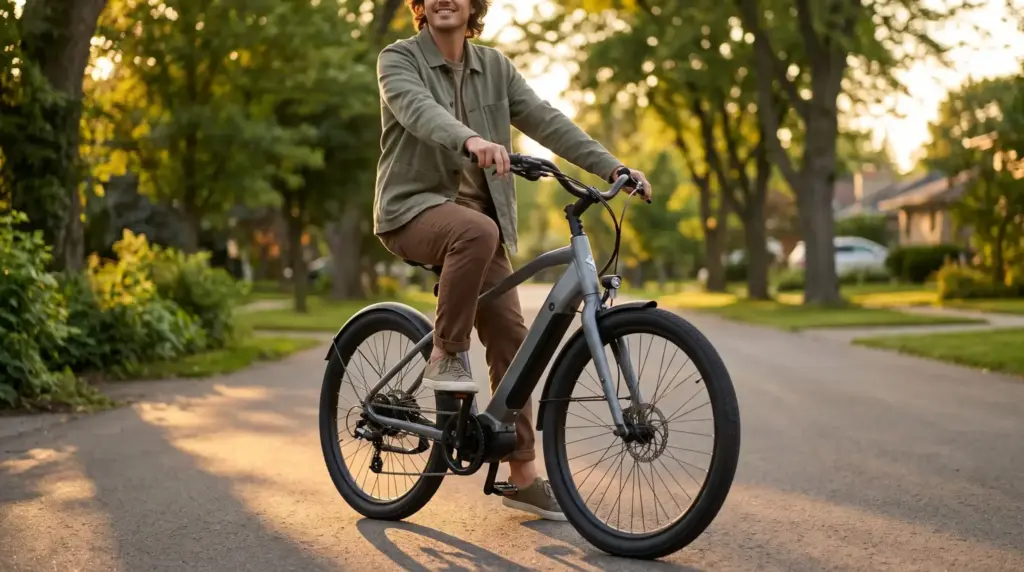
A comfortable electric bike should let you settle into the ride, not keep adjusting yourself around the machine. A soft seat may feel inviting in a showroom, but it cannot tell you whether the handlebars are within reach, your legs have room to pedal, or you can use the brakes without shifting your hands. Those are the details to explore before buying.
Think of comfort as a relationship between your body, the bike, and the roads you use. Start with fit, then consider support, vibration, and controls. That order helps you avoid paying for extra cushioning when the real problem is a riding position that does not work for you.
Start With Fit, Not a Softer Seat
With the bike supported, sit where you would naturally ride and reach for the grips. Can you keep your shoulders relaxed and operate the brake levers without stretching? Look ahead rather than down at the front wheel. A position that only feels comfortable while you are sitting still and looking at the display deserves a second look.
Check the transition to a stop as well as the seated position. Practice getting on and off and steadying the bike, with assistance where needed. A height recommendation can narrow your search, but it does not answer how the complete bike feels under your control. Do not make an unstable stop part of the test just to see whether you can manage it.
Pay attention to the seat design. A conventional saddle on a seatpost may allow height and fore-aft adjustment; a long bench-style seat should not be assumed to offer those same changes. Ask what can actually be adjusted on the model. Moving yourself along a seat also changes your reach and pedaling position, so check both rather than treating extra seat length as a complete fit solution.
Why More Cushioning Is Not Always Better

Judge the seat while pedaling, not just by pressing it with your hand. Notice whether you remain supported in a natural position or keep sliding, shifting to avoid a pressure point, or sitting awkwardly to reach the pedals. Those observations are more useful than the thickness of the padding. A good first impression should survive ordinary movement.
Discomfort is information, not an instruction to persevere. Stop if the seat causes pain or numbness and ask about fit or a suitable alternative. Do not assume a cover will fix a mismatch, or buy on the promise that a clearly uncomfortable position will become right after enough rides.
Tires and Suspension Do Different Jobs
Separate the fine vibration of rough pavement from the larger jolt of a bump. Tire construction and pressure influence how the tire absorbs road shocks; a suspension system allows controlled movement as the wheel encounters uneven ground. Both can affect what reaches your hands and seat, but neither corrects a handlebar that is too far away.
Wider tires can give room for a lower-pressure setup, but lowering pressure indiscriminately is not a comfort strategy. The setting must suit the load and remain within the tire and bike manufacturers’ limits. Insufficient pressure can damage a tire. Ask for an appropriate setup before judging a test bike on its harshness or softness.
Apply the same discipline to suspension. Ask which end of the bike is suspended and what adjustments the manufacturer permits. Compare the bike on surfaces similar to your normal rides, not by bouncing on it while parked. The useful result is a ride that feels composed, rather than the greatest amount of movement.
Controls Should Not Make You Change Your Grip
Check the brake levers and throttle together. Your hands should be able to reach the controls from a comfortable grip. When comparing electric bikes with throttle, a thumb-operated control avoids the twisting action of a twist grip. It still needs to be within easy reach, and you still need to learn how to apply power gradually.
During a controlled start and stop, notice whether you have to reposition your hand before braking or tense your wrist to reach the throttle. Have the shop explain any permitted adjustment. A control that feels natural to someone else is not proof that its location suits your hand.
What a Short Test Ride Can Tell You
Use an ordinary ride rather than a speed demonstration: a gentle start, a normal turn, a stop, and a change in pavement. After each, ask what made you adjust your body. Was it the seat, the reach, the road, or uncertainty about a control? Change one permitted setting at a time so you can understand what helped.
For everyday riders considering the Macfox X7 ebike, its long seat and thumb throttle are best evaluated together. Sit where pedaling feels natural, then check whether the grips, brake levers, and throttle remain easy to reach. That turns two product features into a useful fit test: can you stay supported without changing position whenever you need to control the bike?
Choose the bike that stays comfortable while you do the things riding actually requires. Fit should come first, cushioning should serve it, and the controls should not interrupt it. A short test cannot predict every long ride, but it can reveal problems that a soft seat and a specification sheet cannot answer.