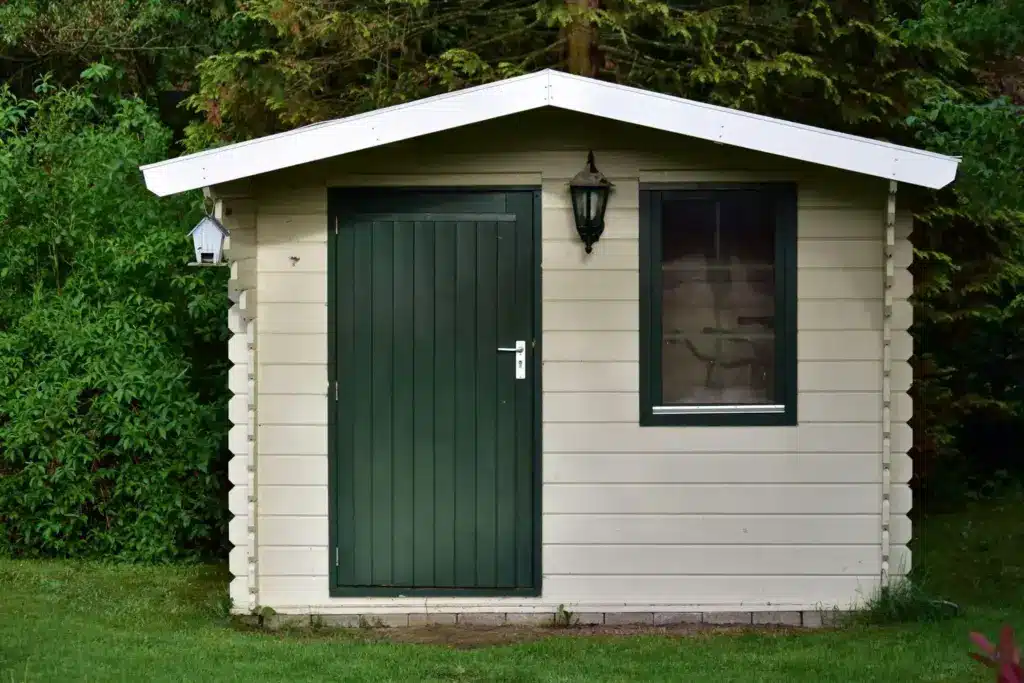
I did not set out to build a bedroom. I set out to stop sleeping in one.
The house we moved into outside Brisbane had a main bedroom on the western side, which sounded fine in July and turned out to be a serious mistake by November. By two in the morning the room still held the heat of the afternoon, and I was doing that thing where you flip the pillow over every twenty minutes hoping the other side will save you.
So we built a separate sleeping room in the backyard. It arrived on a truck, in pieces, with a manual.
Two years later it is the best room on the property, and almost everything I learned came from getting the boring parts right rather than the pretty ones.
The Number That Started It
I only understood how badly I was sleeping once I put a thermometer beside the bed.
The readings sat in the high twenties most nights through summer. That turned out to matter more than I expected.
One longitudinal study of adults sleeping in their own homes found sleep was most efficient and most restful when nighttime ambient temperature sat between 20 and 25 °C, with a clinically relevant 5 to 10 percent drop in sleep efficiency once the room climbed from 25 °C toward 30 °C.
Five to ten percent does not sound dramatic on paper. Across a whole summer it is the difference between waking up functional and waking up already tired.
Humidity compounds it, and southeast Queensland has plenty. Brisbane’s climate data shows relative humidity running between 65 and 70 percent through January, February and March, with roughly 426 millimeters of rain across those three months.
Warm air you cannot sweat into is the whole problem. Your body cools itself by evaporation, and humid air refuses to cooperate.
What a Steel Kit Home Does in a Queensland Summer
Once I started looking properly, the choice came down to timber framing or steel, and in that climate it was not much of a contest.
Wide Span Homes supplies kit homes Brisbane owners put on everything from suburban blocks to acreage, built from Australian TRUECORE steel with an up-to-20-year BlueScope warranty, and the detail that decided it for me was termite resistance, steel simply does not give them anything to eat.
Their range runs from compact cabins and backyard studios through to four and five bedroom homes, with pricing published from around $27,300 at the small end.
That number is the kit, not the finished room. Site preparation, slab, plumbing, electrical, internal fit-out, delivery and a licensed builder all sit on top of it, and their own site is upfront about that, which I appreciated.
The other structural advantage was the frame staying square. A steel frame does not swell and shrink with humidity the way timber does, which matters for a room where you want doors and windows to seal properly for the next twenty years.
The Four Decisions That Actually Changed the Sleeping
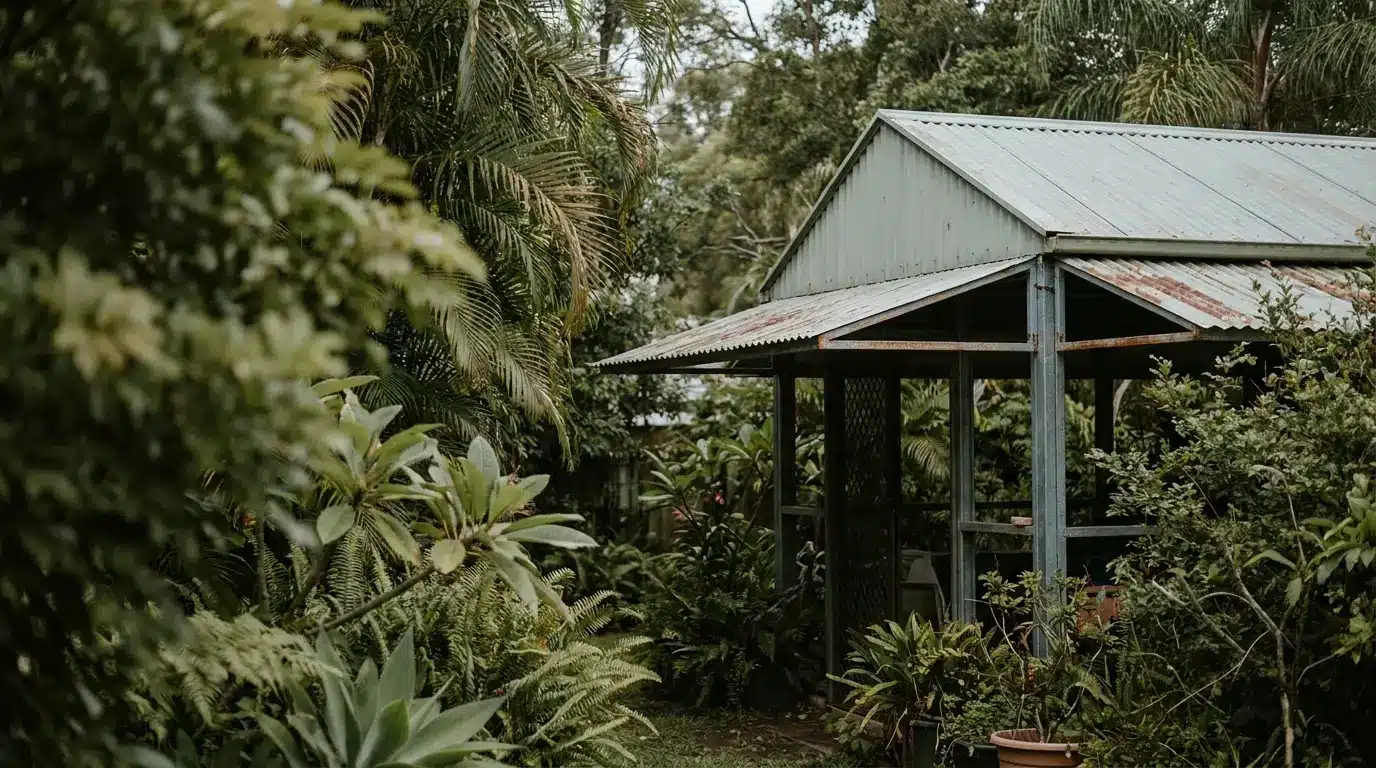
Looking back, the comfort came from four choices, none of which cost much extra at the design stage:
- A pale roof. This was the single biggest one.
- Roof ventilation. Hot air needs somewhere to go, and it will not leave on its own.
- Cross-flow windows. Two openings on opposite walls, not one on a single wall.
- A wider eave on the western side. Shade before insulation, always.
The roof color surprised me most. According to the Department of Energy, a conventional roof can reach 150 °F or more on a sunny summer afternoon, while a reflective surface can stay upward of 50 degrees cooler under the same conditions.
Fifty degrees of difference sits directly above your head while you are trying to sleep. Colorbond comes in a wide palette, and I picked from the pale end for exactly this reason rather than for how it looked from the driveway.
Questions People Keep Asking Me
Is it noisy in the rain?
Less than you would think, with insulation and a ceiling lining. Bare sheeting over an unlined room is a different story, and it is worth budgeting for the lining rather than discovering this in a February storm.
Did you build it yourself?
No. I project-managed and used a licensed builder for the structural work. The kit includes a construction manual and engineering documentation, but “flat pack” does not mean “amateur.”
Is it cold in winter?
Occasionally, and I would add more ceiling insulation if I did it again. Brisbane winters are mild, but a small well-sealed room loses heat faster than a house does.
Was council approval difficult?
Ours was straightforward, but requirements vary by council and by what you are building. Check before you order, not after.
What I’d Do Differently
Two things.
I would run the power and data conduit before the slab went down. Doing it afterward is possible and irritating and more expensive than it should be.
And I would have spent more on window quality. The frames are the weakest thermal point in any small building, and mine are adequate rather than good.
I would not change the size. It is a modest room with a bed, a wardrobe, a chair and a fan, and there is something genuinely restful about a space that cannot accumulate clutter because there is nowhere to put it.
The Part I Didn’t Expect
Building a room specifically for sleeping changed how I treat sleeping.
There is no desk in it. No television. It exists for one purpose, and my brain worked that out within about a fortnight.
That matters more than I would have guessed, given how much time we spend inside these spaces. The EPA notes that on average people spend around 90 percent of their time indoors, and a decent slice of that is spent horizontal, in one room, with the lights off.
If you are considering something similar, my advice is to design for the worst night of the year rather than the average one. Pick the roof color for February. Put the windows where the breeze actually comes from, not where they look balanced.
Everything else you can fix later with a fan and better sheets.