The calculus of moving versus improving has shifted significantly in 2026. With mortgage rates sitting around 6.23% and millions of homeowners locked into pandemic-era rates below 4%, the financial math of selling, buying something larger, and taking on a new loan at current rates looks very different than it did a few years ago. For families who need more space, adding a bedroom to the home they already own, and the mortgage they already have, has become a more attractive option than it was when rates were low and moving was cheap.
The average cost of a bedroom addition in 2026 is around $50,000, though that number sits in the middle of a wide range that spans from $15,000 for a simple conversion of existing space to $100,000 or more for a primary suite with an attached bathroom and high-end finishes. Where your project falls within that range depends on several variables: whether you’re building a new addition or converting space that already exists, whether you’re building out on the ground floor or building up, and what your specific market’s labor rates and permitting costs look like.
This guide breaks down what a bedroom addition actually costs in 2026, what the cost difference is between building new and converting existing space, what the biggest cost factors are, what kind of value a bedroom addition adds to your home, and how to get a reliable estimate before committing to a project. ACON Engineering is a construction cost estimation and preconstruction consulting firm that helps homeowners get accurate, project-specific cost estimates for bedroom additions and home renovations of any scope.
How Much Does a Bedroom Addition Cost on Average in 2026?
The $50,000 average covers a lot of ground. To use that number practically, it helps to break it down by square footage and by what the addition actually includes.
On a per-square-foot basis, bedroom additions built as new construction on the ground floor typically run $80 to $160 per square foot, while new additions built as true room additions with new foundation, framing, and roof run $150 to $250 per square foot. A standard bedroom of around 150 to 200 square feet at the lower end of that range comes in at $12,000 to $40,000. Add a walk-in closet, a higher ceiling, custom windows, or a dedicated HVAC zone, and that number climbs.
Primary suite additions, which include both a bedroom and an attached bathroom, fall into a different price category entirely: $30,000 to $100,000 for a typical project, and over $100,000 for larger suites with luxury finishes like custom cabinetry, heated floors, or high-end tile. The bathroom component alone adds substantially to the cost, since plumbing work for a new bathroom typically runs $1,500 to $4,000 in rough-in work alone, before fixtures or finishes are factored in.
Labor accounts for 40% to 60% of the total project cost for a bedroom addition. That means on a $50,000 project, somewhere between $20,000 and $30,000 is going to the professionals doing the work, including the general contractor who coordinates the trades, the architect or designer who prepares plans, and the electricians, carpenters, and finishers who execute them.
Is It Cheaper to Build Out or Build Up?
One of the first decisions in any bedroom addition project is whether to extend the house’s footprint on the ground level or to add square footage above existing space, and this choice has a significant effect on total cost.
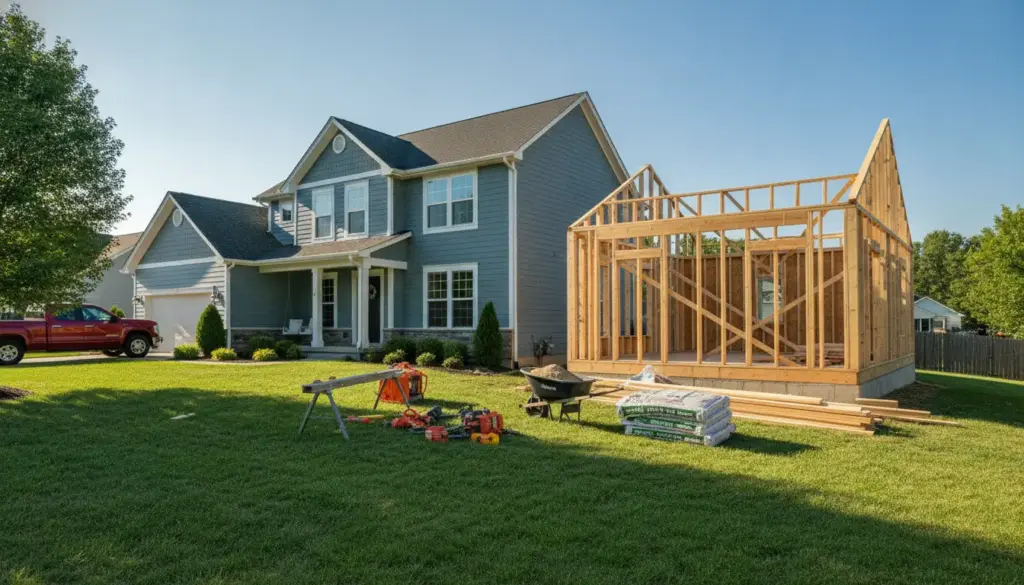
Building out on the ground floor is generally the more affordable option. A standard first-floor addition with a new foundation, framing, and roof costs $150 to $250 per square foot, and the structural requirements are relatively straightforward since the new addition sits on its own foundation.
Building up, adding a full second story or a partial second-story addition, costs significantly more: typically $300 to $500 per square foot. The reason is structural. Adding a second story requires the existing first-floor structure to carry additional load, which often means reinforcing or replacing parts of the existing framing to support the new weight. A new staircase must be integrated into the existing floor plan. The existing roof must be removed and replaced. And all of this has to happen while the house remains occupied, or the family has to relocate during construction.
Adding a bedroom above an existing garage sits in its own category, typically $60,000 to $80,000 for the project. This is essentially a second-story addition over a specific footprint. The existing garage roof comes off, the second story gets framed above it, and the new bedroom needs to connect either through the interior of the house or via an exterior staircase. Understanding how the overall height of a two-story home works, and what structural changes are involved in going from one story to two, can help in planning whether a second-story addition fits the scale of your specific property, something our guide to how tall a 2-story house is and why it varies covers in useful detail.
What Is the Cost Difference Between a Bedroom Addition and a Bedroom Conversion?
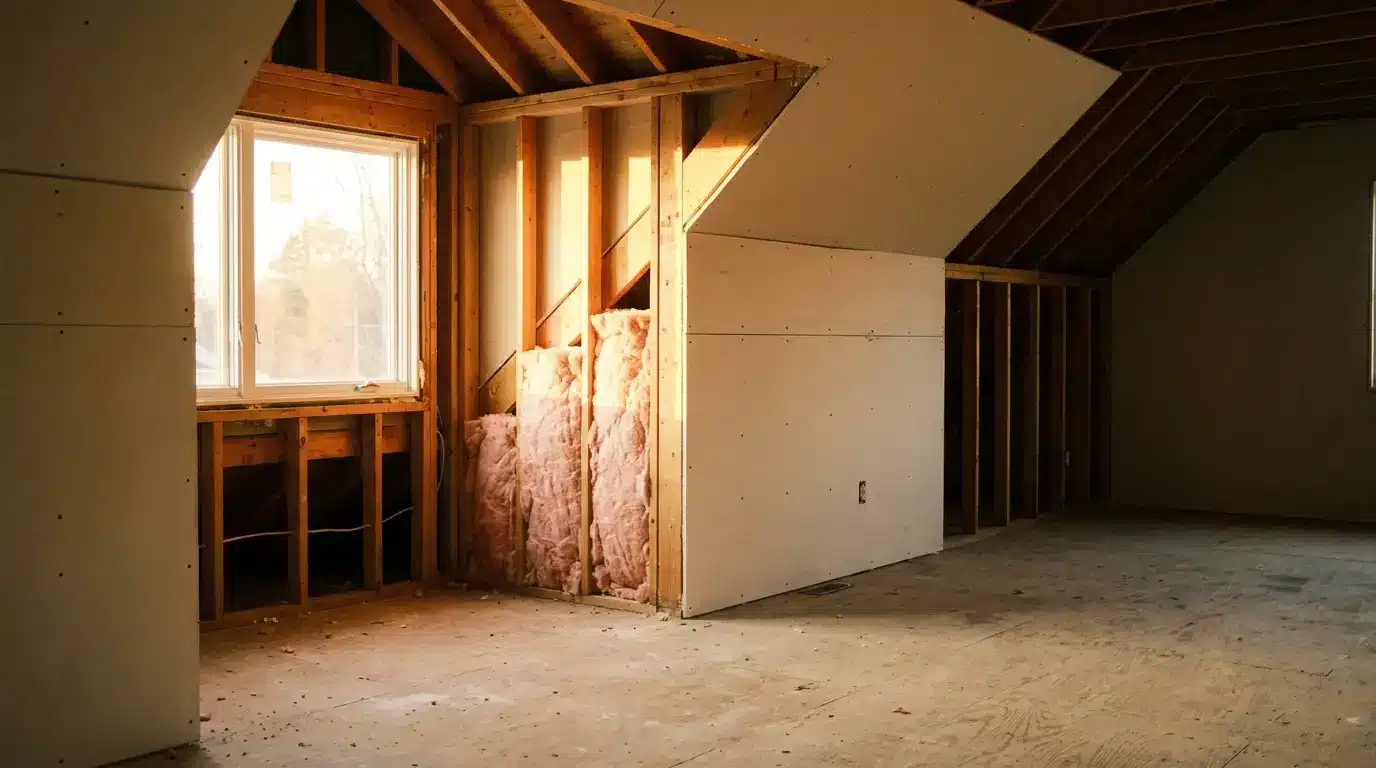
Building a new room addition from scratch is not the only way to add a bedroom. Converting existing but underused space into a legal bedroom is typically cheaper, and for some homeowners it is also faster.
Attic conversions typically cost $10,000 to $50,000, depending on how much of the attic has usable headroom, whether dormers need to be added to create ceiling height, and how complex the HVAC and electrical work is. Converting an attic to a primary suite with a bathroom pushes toward the higher end of that range.
Basement bedroom conversions are among the most affordable options, typically $3,000 to $12,000 for finishing one bedroom in a basement that already has adequate ceiling height. The main requirements for a basement bedroom are egress, meaning a window large enough to meet code requirements for emergency exit, adequate ceiling height (generally 7 feet minimum), and proper insulation and moisture management.
Garage conversions run $5,000 to $50,000, with the wide range reflecting how much work the garage needs. A garage that simply needs drywall, insulation, a window, and a coat of paint sits at the lower end. One that needs HVAC added, the garage door replaced with a solid wall and exterior siding, and significant electrical upgrades sits toward the upper end.
The tradeoff with conversions is that you gain a bedroom but lose the original function of that space. Finishing a basement for a bedroom means losing basement storage. Converting a garage means losing covered parking.
What Are the Biggest Cost Factors in a Bedroom Addition?
Beyond the base per-square-foot construction cost, several additional cost categories belong in any realistic bedroom addition budget.
Permits typically cost $500 to $2,000 for a bedroom addition, depending on location and project scope. Some high-cost markets charge more. Permits are non-negotiable for any structural addition, and unpermitted additions create problems at resale and refinancing.
Property surveys are often required before a bedroom addition can be permitted, confirming that the planned addition respects setback requirements and property lines. These typically cost $300 to $600.
Design and architecture fees range from $4 to $12 per square foot, or $100 to $250 per hour, for the plans required to permit and build a bedroom addition. Simple additions need less design work; additions that involve structural changes, custom elements, or second-story work need more.
HVAC extension is a cost that frequently surprises homeowners. A new bedroom needs to be connected to the home’s heating and cooling system, or served by a standalone unit. Extending existing ductwork into a new addition or installing a mini-split system for the new space adds real cost to the project that a basic per-square-foot estimate does not always capture.
Does Adding a Bedroom Increase Home Value?
The answer is yes, but the relationship between cost and value is more nuanced in 2026 than it was during the peak renovation market of 2020 to 2022.
A basic bedroom addition typically returns 50% to 75% or more of its cost in increased home value, meaning a $50,000 bedroom addition might add $25,000 to $37,500 to what the home would sell for. The specific return depends heavily on what the neighborhood comps look like. If comparable homes in your area have three or four bedrooms and yours has two, adding a bedroom closes a meaningful gap and can return close to 100% of its cost. If your home already matches the neighborhood in bedroom count, the marginal return on an additional bedroom is lower.
Primary suite additions return a lower percentage than simple bedroom additions, typically 32% to 50% of cost nationally according to the 2025 Cost vs. Value report, partly because the cost of a high-end suite often exceeds what the local market will recognize in resale value. This does not mean a primary suite addition is a bad decision, the daily-use value of a well-designed primary suite can be substantial. But homeowners planning primarily for resale ROI should calibrate expectations accordingly.
The 2026 interest rate environment also factors into this calculation in a way it did not in prior years. With rates at 6.23% and many homeowners sitting on sub-4% mortgages, the estimated 1.7 million transactions prevented by the rate lock-in effect between 2022 and 2024 represents real demand that has been redirected into improving existing homes rather than buying new ones. Annual homeowner spending on improvements is expected to reach $518 billion by end of 2026 according to Harvard’s Joint Center for Housing Studies, and bedroom additions are among the most common large-ticket projects driving that spending.
How Do You Get an Accurate Bedroom Addition Estimate Before Hiring a Contractor?
Every number in this article is a national average built from thousands of different projects, properties, and markets. Your specific bedroom addition sits on one specific property with its own structural conditions, its own local labor market, its own permit fees, and its own HVAC configuration, all of which push your actual cost toward one end of these ranges or meaningfully outside them.
Renovation Estimating Services from ACON Engineering produce a project-specific cost breakdown for your bedroom addition from your actual drawings and scope, rather than applying a national average to your square footage and hoping it holds. This covers the framing, electrical, drywall, flooring, HVAC extension, and finish scope as designed for your specific addition, priced at current market rates for your location. For homeowners comparing contractor bids, a renovation estimate from ACON Engineering provides the independent, scope-based benchmark that makes it possible to evaluate whether each bid reflects the actual project, rather than accepting the lowest number without knowing what it includes or excludes.
What If Your Bedroom Addition Is Part of a Larger Construction Scope?
Bedroom additions do not always stay the scope they started as. A homeowner who starts planning a simple ground-floor bedroom addition discovers the existing structure needs foundation reinforcement to support the new load. A project that begins as a single bedroom expands to include a bathroom, a hallway reconfiguration, and exterior improvements. Or the bedroom addition becomes the anchor of a broader multi-room renovation that was always in the plan but gets scoped out once the contractor is on site.
When a bedroom addition grows into a multi-trade, structural, or multi-room construction project, the estimate that covers a single bedroom is no longer the right document for the actual scope of work.Construction estimating services from ACON Engineering cover this expanded scenario, producing cost breakdowns for projects that span multiple trades and multiple scopes, from the bedroom itself through any structural, plumbing, electrical, or exterior scope that becomes part of the same project. For homeowners whose bedroom addition has grown beyond its original scope, having one coherent estimate covering the full project is meaningfully more useful than a patchwork of separate numbers that were never reconciled against each other.
Conclusion
Adding a bedroom to your house in 2026 costs $50,000 on average, with simple conversions starting as low as $15,000 and primary suite additions with bathrooms reaching $100,000 or more. Building out on the ground floor costs less per square foot than building up, conversions of existing space cost less than new additions but require sacrificing the original function of that space, and labor accounts for 40% to 60% of the total regardless of which approach you take.
In a market where mortgage rates make moving expensive and homeowner spending on improvements is at historic highs, a bedroom addition represents a genuine option for families who need more space and want to stay where they are. Getting a number based on your actual project rather than a national average is what separates a budget you can rely on from one that surprises you once the contractor shows up. ACON Engineering’s renovation and construction estimating services exist to provide exactly that for bedroom additions and home projects of any scope.