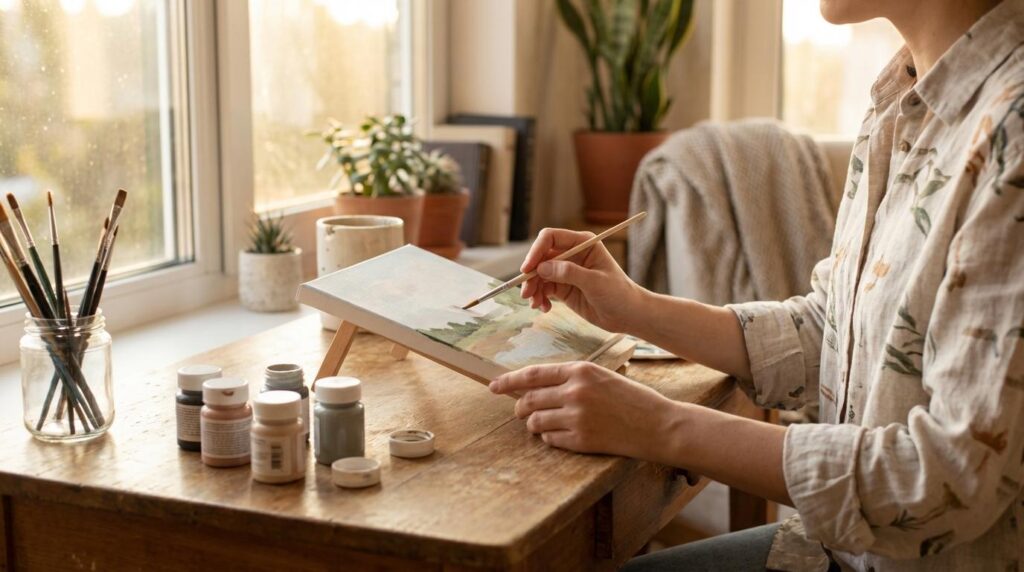
Most people redecorate when they want to feel better at home. A new throw, a different lamp, maybe some fresh plants. What almost no one considers is picking up a paintbrush — and using the act of creating art as the upgrade itself. The twist? You walk away with something beautiful for your wall, too.
That dual benefit is what makes painting such an underrated home wellness tool. The process calms your nervous system while you’re doing it. The finished piece keeps working for you every time you look at it. This article unpacks both sides: the science of why painting sessions help you decompress, how to start without any artistic experience, and how the art you make (or choose) can genuinely improve the quality of your rest.
Why Mindful Painting Activities Are More Than Just a Hobby
“Mindful painting” doesn’t mean sitting cross-legged and chanting. It simply means engaging with a creative activity with your full attention on the process — not worrying about the outcome, not checking your phone, not replaying the day’s anxieties.
When you do that, something measurable happens in your body. Research reviewed by Drexel University professor Girija Kaimal found that even brief creative sessions can reduce cortisol — your primary stress hormone — by 15 to 20%. That’s not a vague “feel better” claim. That’s a biochemical shift happening in real time while you’re mixing paint.
A 2005 study by Curry and Kasser found that engaging in structured art activities — particularly complex, repetitive patterns — can induce a state comparable to meditation, reducing anxiety markers in participants. A 2025 systematic review published in the Australian & New Zealand Journal of Psychiatry further confirmed statistically significant reductions in anxiety and depression through art-based interventions. And a meta-analysis in JAMA Network Open found broad positive health outcomes associated with active participation in visual art.
Painting also activates the brain’s reward pathways — releasing dopamine and serotonin, the same neurotransmitters connected to mood stability and, crucially, better sleep. The creative flow state silences mental noise in a way that scrolling through your phone simply cannot replicate.
If you’re already looking for screen-free hobbies for relaxation to build into your evenings, painting fits that gap particularly well — it’s absorbing enough to pull your attention away from a busy mind, but calming enough to leave you ready for rest rather than wired.
How to Start: Paint by Numbers as Your Gateway to Mindful Painting
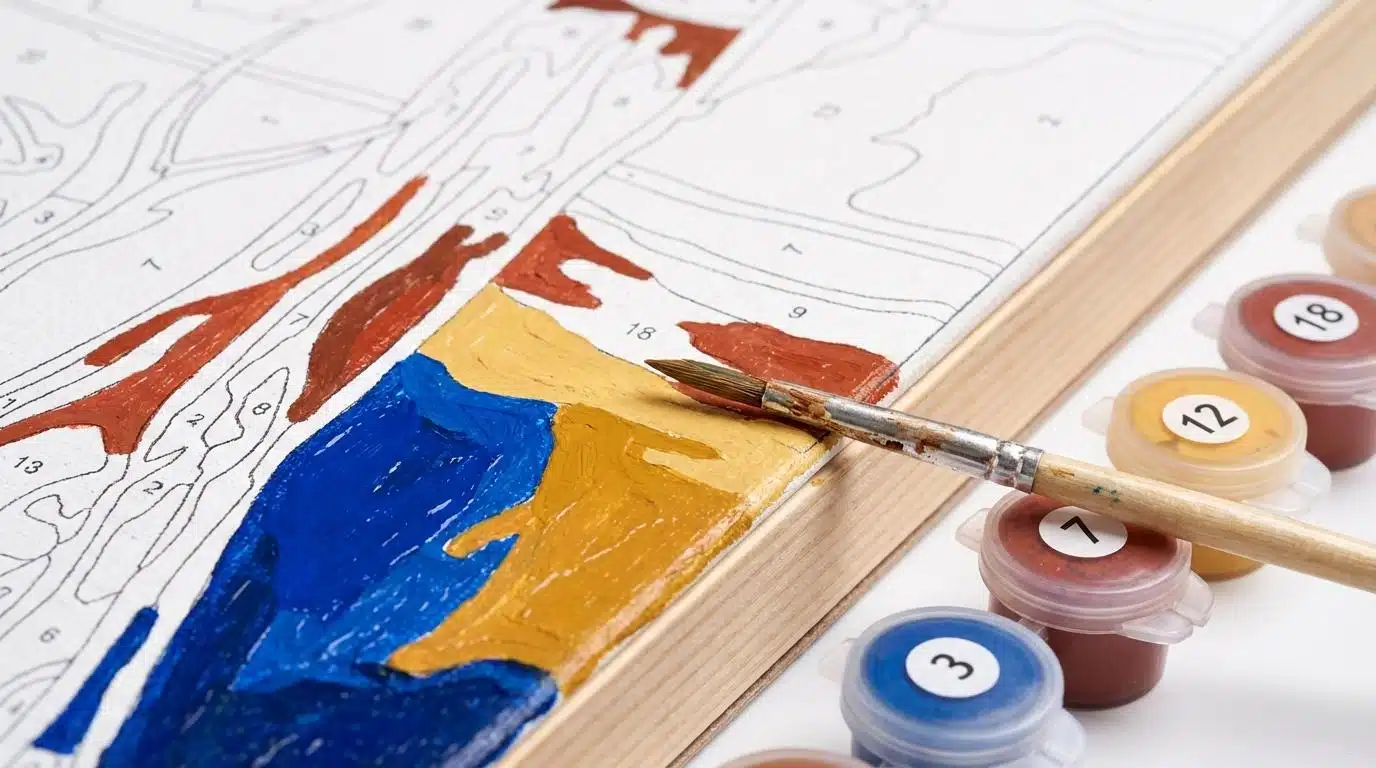
The biggest barrier most people name is some version of “I’m not artistic.” That concern is understandable — and entirely irrelevant to how painting actually makes you feel.
The therapeutic benefit of painting doesn’t come from producing a masterpiece. It comes from the act itself: the repetitive, focused, sensory experience of applying color to canvas. Which is exactly why structured formats work so well. When a canvas is pre-divided and numbered, you don’t face the blank-canvas anxiety that stops most beginners cold. You just pick up the correct color and start.
This is also precisely what Curry and Kasser identified as the active ingredient in their anxiety-reduction research: structured, repetitive creative tasks engage the brain enough to quiet rumination while remaining low-stakes enough to allow genuine relaxation.
For those looking to explore mindful painting activities without the pressure of a blank canvas, structured kits — where each section of the canvas is pre-numbered and matched to specific paint colors — offer a surprisingly meditative starting point. Abstract kits in particular are worth seeking out: because there’s no “correct” rendition of a recognizable subject, the result looks genuinely like modern art regardless of your skill level.
A few practical tips to make it work as a wind-down ritual:
- Set up a dedicated corner. Even a small table with good lighting signals to your brain that this is your creative space.
- Put your phone in another room for the session. This is non-negotiable if you want the cortisol benefits.
- Paint in the evening rather than first thing in the morning. The focused-but-calm activity is ideal for transitioning from work mode to rest mode.
- Start with shorter sessions — 20 to 30 minutes is enough to feel the shift. You’re building a habit, not racing to finish a canvas.
From Canvas to Wall: Turning Your Finished Painting Into Home Decor
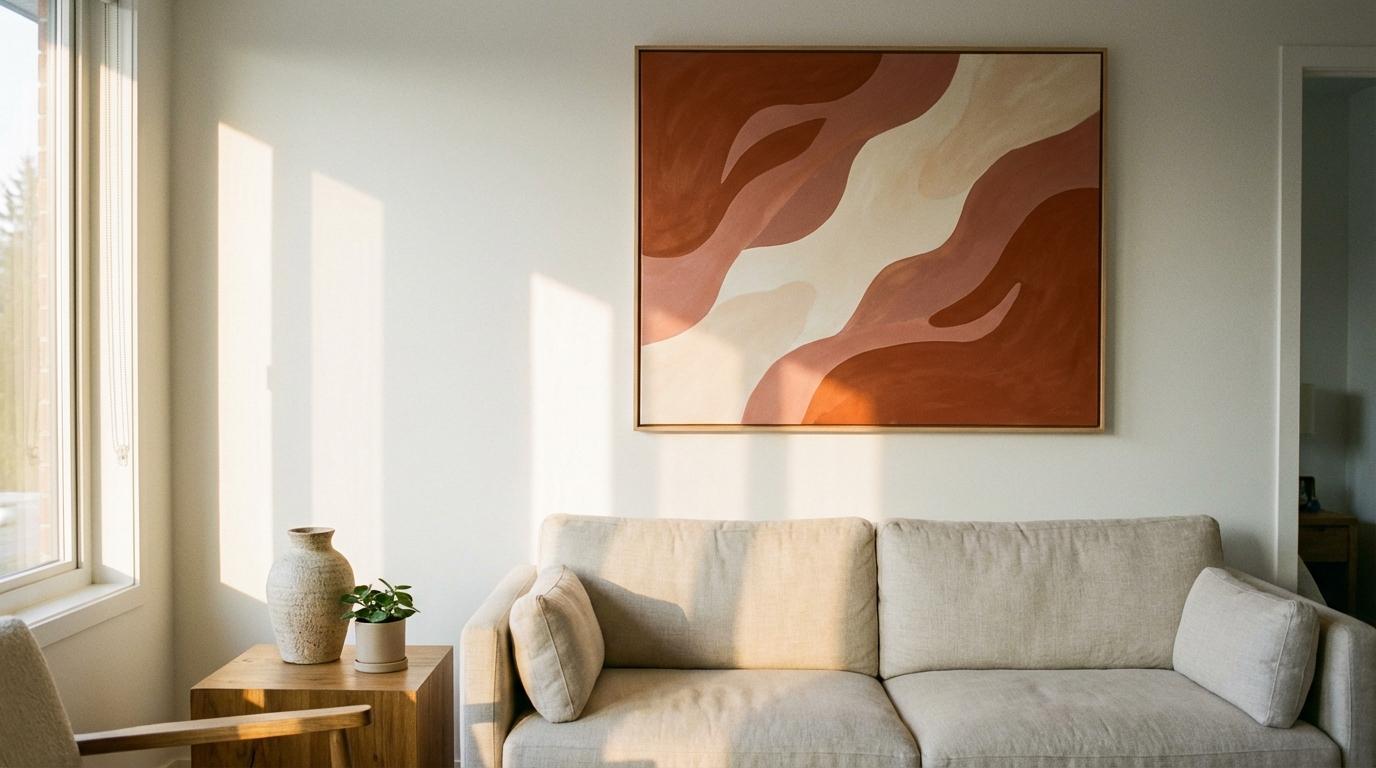
Here’s where the second layer of benefit kicks in. You’ve spent several sessions in a calm, focused creative state. Now you have an original piece of art — one that no one else owns, that carries your personal effort, and that fits your home’s specific color palette because you chose those colors yourself.
Handmade art hits differently than a mass-produced print. Visitors ask about it. You feel a small lift every time you notice it. That emotional connection to objects in your home is a documented component of what designers call “restorative environments” — spaces that actively help you recover from the demands of the day.
Abstract work is particularly versatile for home display:
- In a living room, a large abstract canvas above the sofa creates a focal point without dictating a rigid color scheme. Warm ochres and terracottas add energy; soft blues and grays pull the room toward calm.
- In a bedroom, the color science becomes more specific. Research has found that art featuring calm, water-adjacent compositions can reduce heart rate variability by 12%, supporting the physical relaxation needed for sleep. Blues, muted greens, and soft lavenders are the colors to lean toward.
If you want to explore what abstract modern art looks like across different color families before committing to a painting project — or simply want to add a professional piece alongside your own work — browsing curated collections is a useful way to develop your eye and narrow down your palette before you start.
On framing: floating frames give finished paintings a gallery-quality look without overpowering them. Natural wood frames suit earthy, organic room aesthetics. If the canvas is wrapped (painted around the edges), it can hang unframed entirely for a contemporary look.
For more ideas on how art and intentional objects work together in a room, updating your bedroom decor with a few carefully chosen pieces is often more effective than a full redesign.
Choosing Art That Helps You Rest — Not Just Impress
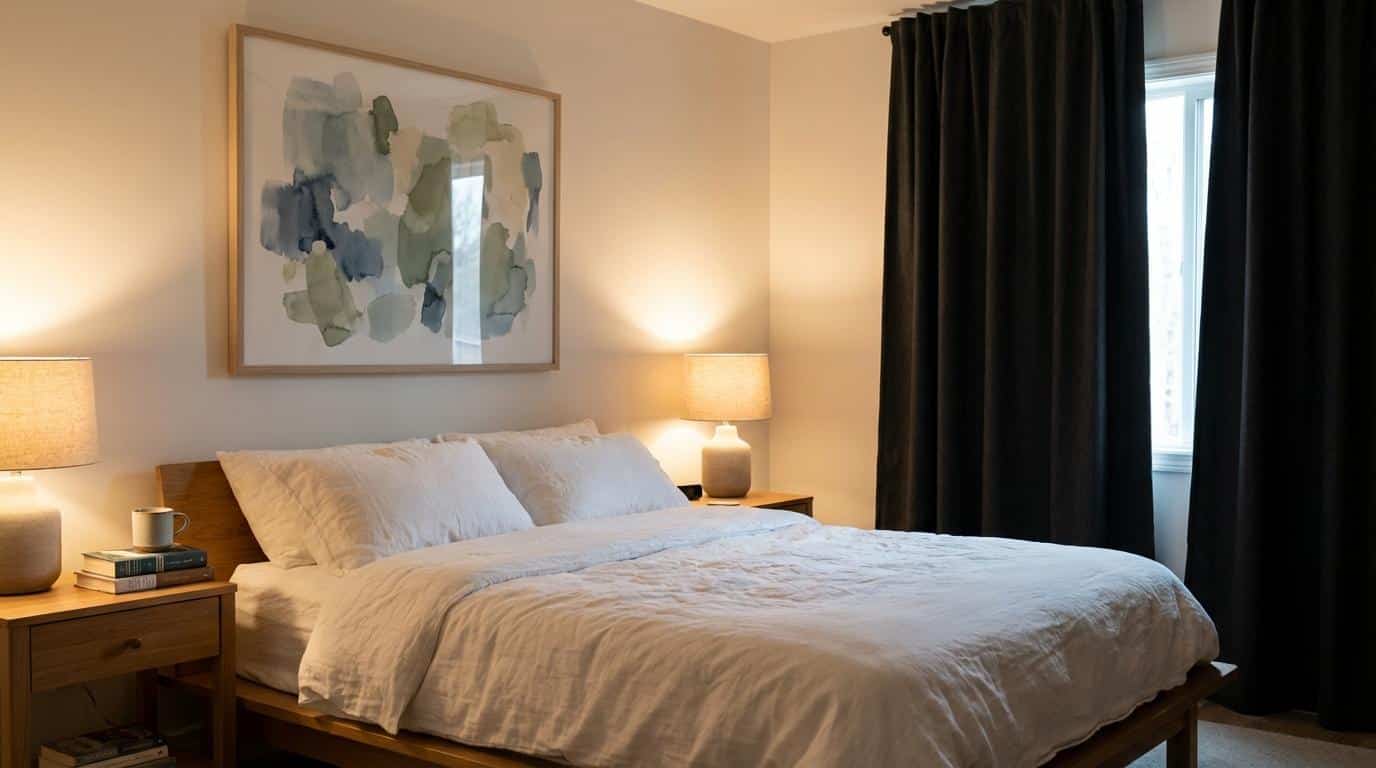
Most people choose bedroom art the same way they choose art anywhere: does it look good? That’s a reasonable starting point, but specifically in a bedroom, the question worth asking is: Does it make me feel calm?
The visual content of art in your sleep environment sends constant low-level cues to your nervous system. Research on the psychology of wall art confirms that artwork sends visual signals that directly shift the energy and feeling of a room — and those signals don’t stop when you’re trying to fall asleep.
Practical guidance for bedroom art selection:
- Stick to soft, desaturated palettes. Blues, muted greens, dusty pinks, and warm grays support the nervous system’s transition into rest. Avoid bright reds, sharp oranges, or high-contrast geometric designs near the bed.
- Lean into abstract. The open-endedness of abstract art is actually a sleep advantage. A landscape or portrait invites your brain to “read” it and interpret it — a subtle form of cognitive engagement. Abstract forms don’t make that demand. They exist. Your mind doesn’t need to decode them.
- Position thoughtfully. The wall you see first when you wake up and last before you close your eyes has disproportionate influence. A piece placed there should be genuinely soothing, not just beautiful.
- Size matters. A piece that’s too small looks timid and gets visually lost. For a standard double or queen bed, art between 24 and 36 inches wide tends to read well. Go larger for a real statement — oversized abstract art above a bed is one of 2025’s strongest interior trends.
If you’re building out the full atmosphere of a room that supports sleep and recovery, creating a chill aesthetic space goes well beyond art — but art is often the fastest single change that shifts how a room feels.
The Full Circle: Create, Display, Rest
The loop is worth spelling out, because it’s genuinely different from most home upgrades.
You sit down for a painting session and your cortisol drops. Your brain shifts into a quieter mode. You finish your evening more settled than you started it. Over several sessions, you produce a piece of art that goes on your wall — in your bedroom, your living room, wherever you most need a sense of calm. That art then continues to do the work: softening the room’s energy, giving your eyes somewhere restful to land, and building the kind of environment that makes sleep easier rather than harder.
Start small: one session this week, even 20 minutes. A structured kit removes every barrier between you and the act of painting. If you’d rather skip the process and go straight to the display, a carefully chosen abstract piece can achieve the same environmental effect. Either way, the most restful homes aren’t just decorated well — they’re designed with intention.