


I know how frustrating it feels when your body is tired, but your mind refuses to slow down. You lie there, hoping sleep will come, and instead your thoughts keep rolling.
Racing thoughts at night can feel confusing and draining, especially when daytime feels manageable, but bedtime does not. Understanding why this happens matters because it helps you respond with less stress and more control.
In this blog, I break down what is really going on, what others experience, and what actually helps in the moment and over time.
You will also see how anxiety, sleep patterns, and daily habits connect to racing thoughts at night in practical, real-life ways.
Racing Thoughts At Night You’re Not Alone
Lying in bed while the body feels worn out and the mind stays busy is a common nightly pattern. Many online discussions describe this exact nighttime struggle.
On Reddit threads about sleep and anxiety, people often say their thoughts start talking nonstop as soon as the room gets quiet.
Some mention replaying conversations, while others describe their mind jumping between random topics without pause. A common theme in these posts is feeling fine during the day, then feeling overwhelmed once lying in bed.
Several users point out that silence makes the mental noise stronger, especially after stressful days. Others share frustration about watching the clock while thoughts keep speeding up.
Reading these discussions shows a clear pattern across many experiences. The same complaints appear again and again, shared by people of different ages and backgrounds.
That repetition helps ease fear and isolation, since the experience follows a familiar and widely discussed pattern rather than a rare or unusual one.
What Racing Thoughts Actually Feel Like

Racing thoughts at night often feel like the mind cannot stay on one track. For many people, this mind racing at night shows up as jumping between unfinished tasks, plans, or memories.
Random ideas may appear without warning, even when the day feels calm. Another common experience is anxiety tied directly to sleep itself. Thoughts turn toward counting hours, fearing tiredness, or stressing about how tomorrow will feel.
A familiar example shared in discussions is lying still while mentally drafting conversations or problem-solving at midnight. These patterns feel exhausting because rest feels close but unreachable.
“I want to sleep, but my brain won’t stop talking to itself.” That line appears again and again in online discussions and captures the experience many people struggle to explain.
What People Say Helps When Thoughts Won’t Stop
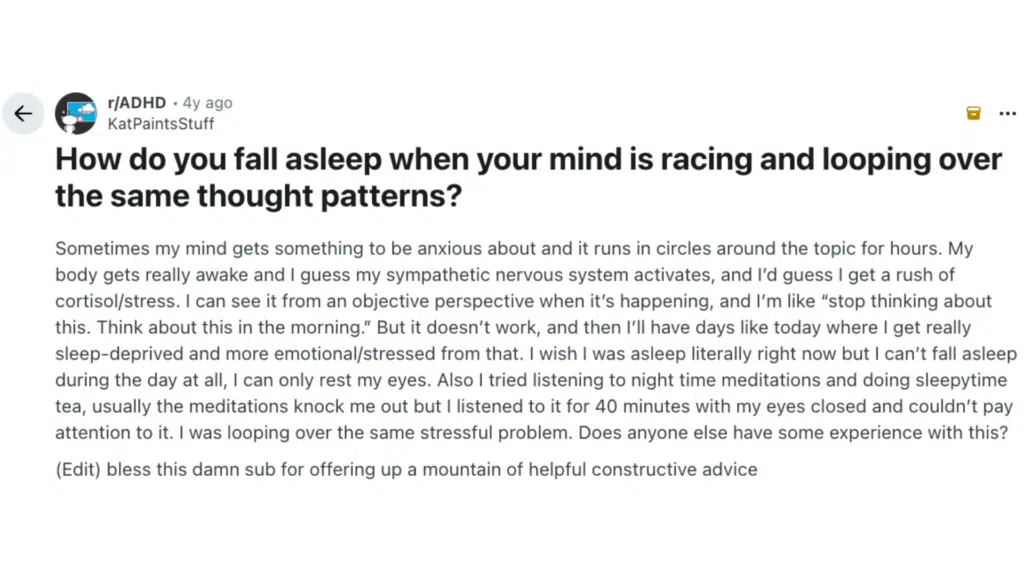
Late-night online discussions often focus on simple actions people use when sleep feels distant. These ideas aim to lower mental pressure and help the body settle, even when rest does not arrive quickly.
Online forums show detailed shared experiences around racing thoughts and sleep trouble. Reddit users in the r/ADHD community at
https://www.reddit.com/r/ADHD/ frequently describe nights where the mind loops around the same stressful topic for hours, even when the body feels exhausted. Many posts mention feeling physically alert, with stress responses making rest difficult.
Users share a range of coping methods. Some report intense late-night exercise to release built-up energy before bed. Others rely on low-volume music, white noise, or podcasts through sleep-friendly headphones to give the mind something steady to focus on.
Writing thoughts down before bed, often called a brain dump, appears often as a way to reduce mental pressure. A few users describe using simple games or familiar videos until drowsiness sets in.
These discussions show how people test practical, low-effort strategies during difficult nights. Personal stories highlight patterns, but experiences vary and should not replace professional guidance when sleep problems persist.
Why Racing Thoughts Often Come With Anxiety
At night, anxiety often shows up through racing thoughts because the mind finally has space to react. During the day, tasks, noise, and movement keep worries pushed aside.
Once the room gets quiet, those concerns return and start looping. A common pattern is worrying about not sleeping, then becoming more alert because of that worry.
The body may feel worn out, but the mind stays watchful, scanning for problems or unfinished thoughts. This creates a cycle where stress keeps the brain active, even when rest feels needed.
Many people notice their heart rate rise or their muscles tense while lying still. That contrast between physical tiredness and mental activity can feel confusing and frustrating. This response does not mean something is wrong.
It reflects how stress and nighttime conditions interact, allowing anxious thinking to surface more easily when external distractions fade.
Scientific And Research Insights
Recent research from 2021 through 2024 offers clearer insight into why racing thoughts interfere with sleep, though gaps still exist.
A 2021 study titled “Investigating Racing Thoughts in Insomnia,” published in the Journal of Psychiatric Research, explains that racing thoughts increase before sleep and directly relate to trouble falling asleep and staying asleep.
A 2022 paper, “Pre-Sleep Cognitive Arousal and Insomnia Severity,” found that heightened mental activity at night keeps the brain alert even when the body feels tired, linking this pattern to anxiety symptoms.
Research from 2023 titled “Sleep Reactivity and Cognitive Arousal” shows that people with higher stress sensitivity experience stronger nighttime thought activity after daily stressors.
A 2024 review in Sleep Medicine Reviews notes that quiet nighttime conditions reduce distractions, allowing unresolved thoughts to surface more easily.
Ongoing studies continue to examine how stress hormones, mental alertness, and sleep timing interact, with future research expected to improve sleep-focused treatments.
Comparing Thoughts, Insomnia, & Anxiety
These terms often overlap and cause confusion. The table below shows how each one differs, while also explaining why many people experience more than one at the same time, especially during nighttime rest periods.
| Aspect | Racing Thoughts | Insomnia | Anxiety |
|---|---|---|---|
| Main feature | Fast, nonstop thinking | Trouble falling or staying asleep | Ongoing worry or fear |
| Core issue | Mental speed | Sleep disruption | Emotional tension |
| Night impact | Thoughts speed up in bed | Sleep feels delayed or broken | Worry increases at night |
| Day impact | Mental fatigue | Low energy | Restlessness or tension |
| Overlap | Can cause poor sleep | Can increase anxiety | Can trigger racing thoughts |
Understanding these differences helps explain why symptoms often blend together. Racing thoughts can lead to insomnia, anxiety can fuel both, and poor sleep can make all three feel stronger over time.
Why Nighttime Makes Everything Louder?

At night, thoughts often feel louder because the body and brain follow different timing. Cortisol, a stress hormone, can rise in the late evening, especially after long or tense days. This increase keeps the brain alert even when the body feels ready for rest.
At the same time, melatonin, the hormone that supports sleep, may be released later than expected, delaying mental slowing.
Distractions also fade at night. Work, movement, noise, and conversation drop away, leaving fewer external anchors for attention. Without those anchors, the mind turns inward.
The nervous system may still remain active, especially after stress, sending signals to stay watchful. This combination creates a contrast between physical tiredness and mental activity, making thoughts seem sharper, faster, and harder to quiet during nighttime hours.
What Helps Calm Racing Thoughts Right Now
These steps focus on settling physical tension first, since the mind often follows once the body feels safer and less alert.
- Body First, Thoughts Second: Slow breathing, relaxed muscles, or gentle movement help lower alert signals before trying to change thinking.
- Sensory Grounding: Soft sounds, steady textures, or temperature changes give attention a neutral focus and reduce internal noise.
- Removing Sleep Pressure: Letting go of forcing sleep often reduces stress, which makes rest more likely to arrive naturally.
Habits That Reduce Nighttime Racing Thoughts
Small, steady habits during the evening can lower mental build-up over time and make it easier for the mind to slow down once the day winds down.
Evening Routines: Repeating the same low-energy steps each night helps signal that active thinking is no longer needed.
Thought Parking: Writing worries or next-day tasks earlier helps clear mental clutter before getting into bed.
Screen Timing: Limiting late screen use reduces stimulation that can keep the brain alert after lights go out.
When to Consider Extra Support for the Racing Thoughts?
Extra support may help when racing thoughts and sleep trouble continue for several weeks or begin affecting daytime focus, mood, or energy.
Therapy can help address thinking patterns that stay active at night and offer tools to manage stress responses. Sleep-focused support may also help reset rest habits and reduce nighttime alertness.
In some cases, a healthcare provider may discuss medication options, especially when anxiety or sleep disruption becomes persistent. These conversations usually focus on benefits, limits, and timing rather than quick fixes.
Seeking support does not mean something is wrong. It can provide guidance when personal strategies no longer bring relief or consistent rest.
Conclusion
By now, you have seen how racing thoughts connect with anxiety, sleep timing, and daily stress.
I walked through what these thoughts feel like, why nighttime makes them stronger, and which steps people use to calm their mind and body. One helpful reminder is to focus on easing physical tension first instead of forcing sleep.
Small changes often work better than big efforts. Racing thoughts at night do not have one single cause, but they do have patterns you can work with.
Try one or two ideas shared here and see how your nights respond. If this topic helped, take a moment to check out other related posts for more sleep and mental health support.