Most homes are not prepared to lose grid power for more than a few hours.
This guide walks you through a practical, scalable solar and battery storage system that can keep your household running for a full 72 hours, starting with what you need to know and ending with an actionable checklist you can use today.
Why 72 Hours Is the Standard You Should Plan For
FEMA recommends that every household be prepared to be self-sufficient for at least 72 hours following a major emergency. That benchmark exists because large-scale power outages caused by hurricanes, ice storms, wildfires, and grid failures routinely take three or more days to resolve, even with emergency crews working around the clock.
The average U.S. power outage lasts between 1.5 and 8 hours under normal conditions. But when extreme weather is involved, the numbers change dramatically. After Hurricane Ida in 2021, hundreds of thousands of Louisiana residents went without power for two to four weeks. After the 2021 Texas winter storm, outages stretched across the state for days during record-low temperatures.
Traditional backup options have real limitations. Portable gasoline generators are loud, require stored fuel that degrades over time, produce carbon monoxide, and cannot be operated indoors or in garages. Standard UPS units are designed for minutes of runtime, not days. Neither option is sustainable for a 72-hour scenario.
A solar panel and battery storage system addresses each of these limitations. It generates power continuously from sunlight, stores that energy in a high-capacity battery, and delivers clean, quiet electricity to your home with no fuel required. When the grid goes down, a well-sized system continues operating without interruption.
How a Home Solar Backup System Actually Works
Before sizing or purchasing anything, it helps to understand the four core components and how they interact.
Solar panels capture energy from sunlight through the photovoltaic effect and convert it into direct current (DC) electricity. The amount of energy produced depends on the panel wattage, the number of panels, and the hours of usable sunlight at your location.
The charge controller manages the flow of electricity from the panels to the battery. Modern systems use Maximum Power Point Tracking (MPPT) technology, which continuously adjusts the electrical operating point of the panels to extract the maximum available power under changing light conditions. This matters because real-world conditions are never as clean as laboratory test conditions.
The battery storage unit holds the energy generated during daylight hours so it can be used at night or during extended cloudy periods. Battery capacity is measured in watt-hours (Wh) or kilowatt-hours (kWh). Lithium iron phosphate (LFP) batteries are the current standard for home backup due to their long cycle life, thermal stability, and depth of discharge.
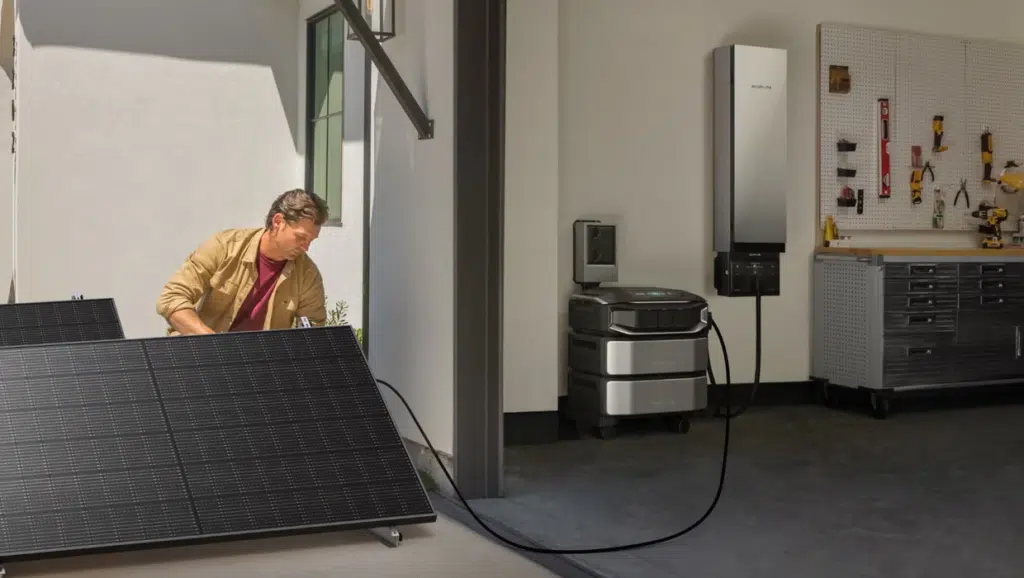
The inverter converts the DC electricity stored in the battery into alternating current (AC) electricity that your appliances and devices run on. In integrated systems like EcoFlow’s DELTA Pro series, the charge controller and inverter are built into the same unit, which simplifies setup significantly.
Understanding the difference between watt-hours and watts is critical before you make any purchasing decisions. Watt-hours measure capacity, meaning how much total energy a battery can store. Watts measure power, meaning how much energy a device draws at any given moment. A battery with 3,600 Wh can theoretically run a 100W device for 36 hours, or a 1,200W device for 3 hours. Matching both dimensions to your actual load is where most buyers make mistakes.
How to Size a Solar and Battery System for 72 Hours
The following five steps take you from a blank page to a complete system specification. Working through each step before purchasing will save you from the most common and expensive sizing errors.
Step 1: Calculate Your Essential Load
Start by listing only the appliances you need to keep running during an outage. This is not the time to plan for your full household consumption. Focus on the essentials that protect health, food safety, and basic communications.
Common essential loads for a typical American household include a refrigerator (150 to 200W), LED lighting for key rooms (10 to 20W per fixture), phone and laptop charging (60 to 100W combined), a Wi-Fi router (10 to 20W), and any medical devices such as a CPAP machine (30 to 60W).
For each item on your list, multiply the wattage by the number of hours per day you expect to use it. A refrigerator running at 150W for 24 hours consumes 3,600 Wh per day. LED lights at 15W running for 6 hours consume 90 Wh per day. Add up the daily totals for every item on your list to get your essential daily load in watt-hours.
Step 2: Calculate Your 72-Hour Energy Requirement
Multiply your daily essential load by three to get the total energy you need to store or generate over the 72-hour window.
If your daily essential load is 4,000 Wh, your 72-hour requirement is 12,000 Wh or 12 kWh. Add a 20 percent safety margin to account for battery efficiency losses, temperature effects on battery performance, and the likelihood that actual usage will run slightly higher than estimated. That brings your target to approximately 14.4 kWh.
For context, a typical American home consuming all appliances without restriction uses 28 to 30 kWh per day. A disciplined essential-load approach typically falls between 3,000 and 6,000 Wh per day, which is a manageable and affordable range to design around.
Step 3: Choose the Right Battery Storage Capacity

Your battery capacity should meet or exceed your 72-hour energy requirement, with the understanding that solar panels will continue replenishing the battery during daylight hours. If your location receives a reasonable amount of sunlight during the outage, the battery does not need to cover the full 72 hours in isolation.
A practical approach is to size the battery to cover at least 36 hours of essential load independently, then rely on solar generation to cover the remainder. This protects you during the first night and a full day before solar begins restoring the battery.
EcoFlow’s DELTA Pro starts at 3,600 Wh and can be expanded with additional smart extra batteries to reach over 25,000 Wh. For a household with a 4,000 Wh daily essential load, a two-unit configuration with expansion batteries covering 10 to 14 kWh of total storage provides a comfortable buffer. LFP batteries in this product line are rated for 6,000 charge cycles before degrading to 80 percent capacity, which translates to more than a decade of regular use.
Step 4: Size Your Solar Panels
Solar panels replenish the battery during daylight hours and determine how quickly the system can recover after a night of discharge. To calculate the panel capacity you need, divide your daily essential load by the number of peak sun hours your location receives each day.
Peak sun hours measure the equivalent number of hours of full-strength sunlight a location receives on an average day. In the Southwest United States, this figure is typically 5 to 6 hours. In the Southeast, it averages 4 to 5 hours. In the Northeast and Pacific Northwest, it can drop to 3 to 4 hours, especially in winter.
For a daily essential load of 4,000 Wh in a location with 4 peak sun hours, you would need panels capable of generating at least 1,000W to fully replenish the battery each day. Two EcoFlow 400W rigid solar panels connected in parallel would meet this requirement, delivering up to 800W under good conditions. Adding a third panel provides additional buffer for cloudy days and faster recharge when sunlight is strong.
For homes where rooftop installation is not practical during an emergency, EcoFlow’s portable 400W folding panel provides the same wattage in a self-supporting, deployable format. Multiple panels can be connected in parallel to increase total output up to 4,800W when paired with the DELTA Pro’s solar input capacity.
Step 5: Plan Your Installation and Connection Method
Rigid solar panels mounted on a roof provide the most efficient long-term energy generation but require professional installation and are not a same-day solution during an emergency. If you are setting up a permanent home backup system, rooftop installation of 400W all-black rigid panels is the right approach. EcoFlow’s rigid panels carry an IP68 waterproof rating and a 10-year warranty, making them a durable long-term investment.
Portable and folding panels offer a plug-and-play alternative with no installation required. They can be deployed in minutes on a south-facing lawn, deck, or driveway and adjusted using the integrated angle stand. The universal solar connector on EcoFlow panels is compatible with most major portable power stations, so you are not locked into a single ecosystem.
For a hybrid approach, a rooftop rigid panel array can handle baseline charging during normal operation, with portable panels available as supplemental input during high-demand outage scenarios.
Six Mistakes That Undermine Most Home Backup Systems
Knowing what to avoid is as important as knowing what to build. These are the errors that most frequently lead to undersized systems, unexpected failures, and buyer frustration.
Confusing capacity with output power. A battery rated at 3,600 Wh sounds large until you realize it can only deliver 1,800W at a time on lower-tier units. If your refrigerator compressor, sump pump, and lighting all run simultaneously, the peak draw can easily exceed that limit and trigger a shutdown. Always verify the maximum continuous output wattage of any battery system, not just the storage capacity.
Using panel wattage as a reliable output figure. Manufacturers rate solar panel output under Standard Test Conditions, which assume direct noon sunlight at 25 degrees Celsius with no shading or soiling. In real-world conditions, panels typically produce 70 to 80 percent of their rated wattage. A 400W panel should be planned around 280 to 320W of actual average output, not 400W.
Designing only for clear weather. A three-day outage can and often does coincide with storm conditions that reduce solar generation significantly. Systems designed to rely entirely on daily solar replenishment fail on day two of cloudy weather. Your battery storage should be sized to cover at least one full day of essential load without any solar input.
Underestimating startup power for motor-driven appliances. Refrigerators, air conditioners, sump pumps, and well pumps all draw two to three times their rated running wattage for the first few seconds at startup. A refrigerator rated at 150W running power may require a 450W surge at startup. Your inverter must be rated to handle these surge loads, or it will shut down under the initial load spike.
Skipping a transfer switch for hardwired integration. If you intend to power circuits in your home directly from the battery system rather than through extension cords, a manual or automatic transfer switch is necessary to safely disconnect the home from the grid. Without one, restoring grid power while the backup system is still connected can damage equipment and create a safety hazard.
Purchasing solar panels without a storage solution. Solar panels without a battery only produce power when the sun is shining. An outage that begins at sundown leaves a panel-only system with nothing to deliver until morning. Storage is the component that makes solar backup useful around the clock.
72-Hour Home Backup Readiness Checklist
Use the following checklist to confirm your system is properly designed, installed, and maintained.
Before You Purchase
- Confirm you have calculated your household essential load in watt-hours per day.
- Confirm your 72-hour energy requirement including a 20 percent safety margin.
- Confirm your battery storage capacity meets or exceeds 36 hours of essential load independently.
- Confirm your solar panel wattage is sized to fully replenish the battery within one day of typical sunlight for your region.
- Confirm your inverter’s continuous output wattage can handle peak simultaneous loads including startup surges.
- Confirm whether a transfer switch is required for your intended installation method.
After Installation
- Verify solar panels are producing expected output by monitoring the input reading on your storage unit.
- Verify all essential appliances are connected and operational through the battery system.
- Verify the battery reaches full charge within a single day of normal sunlight.
- Confirm the transfer switch (if installed) operates correctly by running a brief disconnection test.
- Set up app-based monitoring if your storage system supports remote visibility.
Ongoing Maintenance (Quarterly)
- Clean solar panel surfaces to remove dust and debris. Soiling can reduce output by 5 to 25 percent.
- Check battery state of health and cycle count through the system app or display.
- Inspect all cable connections and solar connectors for signs of wear or corrosion.
- Run a full discharge and recharge cycle to verify actual usable capacity has not degraded.
Start With the Load Calculation
A 72-hour solar and battery backup system is not a luxury purchase for early adopters. It is a practical investment in household resilience that becomes more accessible and cost-effective each year as panel efficiency improves and battery costs decline.
The most important first step is not deciding which products to buy. It is sitting down with a list of your essential appliances and calculating what your household actually needs to sustain operations for three days. That number drives every other decision in the system design process.
For households looking for a complete starting point, EcoFlow’s 400W Solar Panel paired with the DELTA Pro offers a scalable combination that covers the needs of most American homes, with the flexibility to expand storage capacity as requirements grow. The plug-and-play connection approach means the system can be operational in under an hour without professional installation.
The next power outage in your area is not a matter of if. It is a matter of when, and how prepared you are when it arrives.