
Lat Strain Keeping You Awake? Here’s How to Sleep Better Tonight
If you’ve ever rolled over in bed and gotten that rude little stab in your side like your body is personally offended you tried to get comfortable hi. Welcome. A lat strain can turn “early bedtime” into a nightly event where you rearrange pillows like you’re building a nest on a reality show.
The good news: you can usually make sleep way less awful with the right position, a couple strategically placed pillows, and one simple rule no twisting around like a rotisserie chicken.
Let’s get you through tonight.
Why it always feels worse at night (because of course it does)
Your latissimus dorsi is that big, fan shaped muscle that runs from your lower back/hip area up into your upper arm. It’s involved in things like pulling, reaching, stabilizing… and apparently ruining your sleep.
At night, a few things gang up on you:
- Lying down lets fluid settle into irritated tissue, which is why you can wake up feeling stiffer than when you went to bed.
- Breathing moves your ribcage, and your lats help with that. So deep breaths + irritated fibers = tiny pain jolts that keep waking you up.
- Where you’re sore matters. Pain closer to your lower back often hates curling up or twisting. Pain up near your armpit/upper arm usually hates arms overhead stretching.
So if one position feels “fine” and another feels like a personal attack… you’re not imagining it.
The “pick a position” cheat code (start here)
If you want the simplest plan:
- Try back sleeping first (unless reflux/sleep apnea makes that a no-go).
- If you can’t do back sleeping, sleep on your uninjured side with pillows to keep you from rolling.
- If lying flat makes breathing painful or the pain is intense, go semi-reclined for a short stretch (think: temporary, not your new personality).
Two things to avoid early on:
- Sleeping on your injured side
- Stomach sleeping (I know some people love it. Your lat does not.)
Position #1: On your back (the “least drama” option)
Back sleeping keeps your torso untwisted and spreads your weight evenly aka it gives your lat fewer reasons to complain.
Set it up like this:
- Put a pillow under your knees so they’re slightly bent (roughly 20-30 degrees).
- Use a head pillow that keeps your neck neutral (not crananked up like you’re watching TV in bed).
- If your lower back feels like it’s floating, slide a rolled towel under it for light support.
- Let your arms rest by your sides or lightly on your stomach.
Green flag: you can take a full breath without that sharp “catch.”
If back sleeping makes you feel like a flipped over turtle, go to the next option.
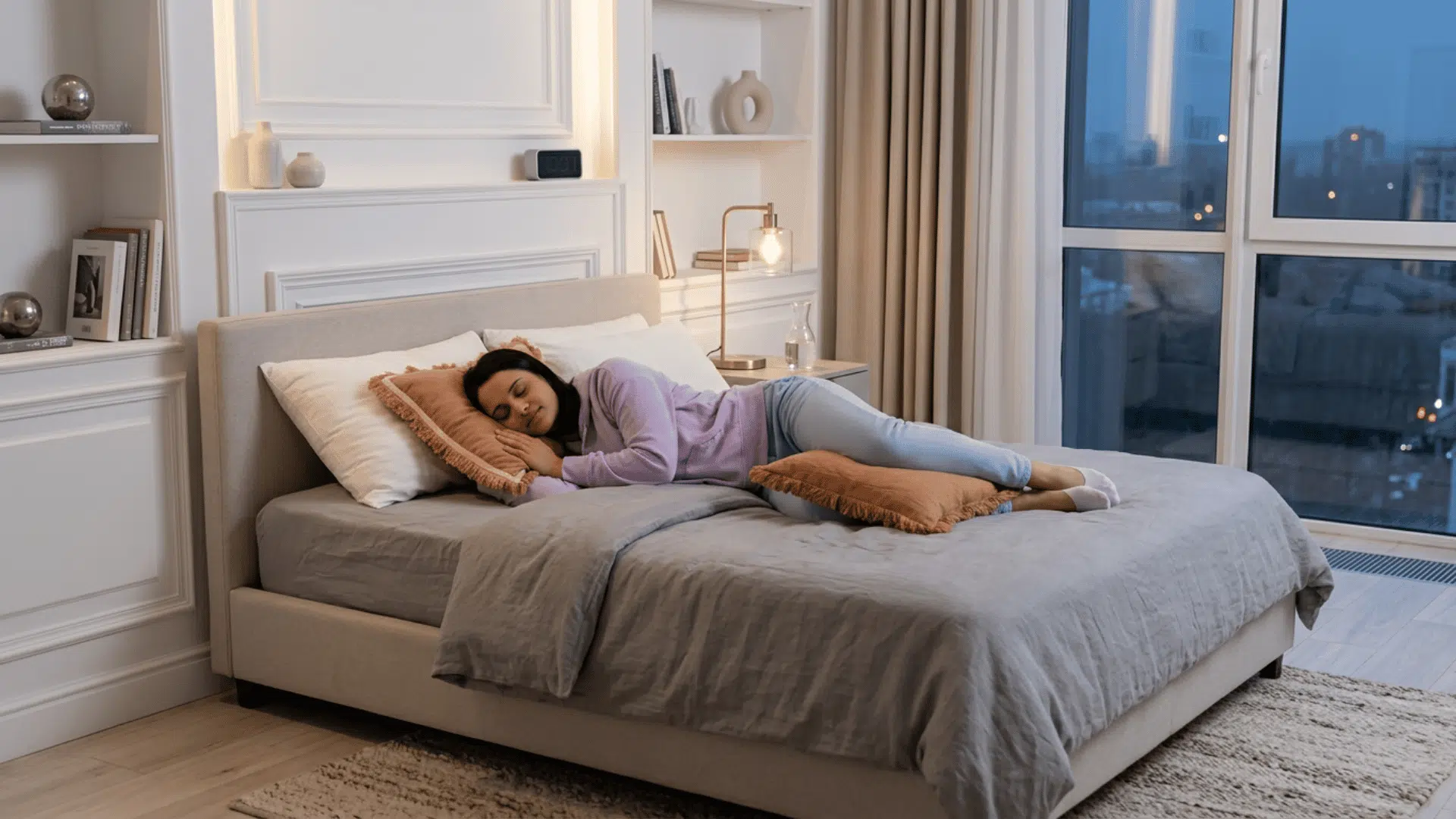
Position #2: On your uninjured side (a very solid Plan B)
Side sleeping can work beautifully with a stacked and supported sleep setup as long as you keep everything stacked and supported.
Set it up like this:
- Lie on your good side.
- Put a pillow between your knees so your hips stay level (this matters more than people think).
- Hug a pillow or body pillow so your top arm has somewhere to rest (otherwise it can tug on that sore lat/shoulder attachment).
- Optional but helpful: put a body pillow in front of you to block the midnight roll onto your injured side.
Yes, some people do the “tennis ball trick” (making it uncomfortable to roll). Personally, I’d rather build a pillow barricade like I’m defending my castle, but you do you.
Position #3: Semi-reclined (for the “everything hurts” phase)
If the first few nights are spicy especially if lying flat makes breathing painful sleeping at an angle can take the edge off.
Set it up like this:
- Prop yourself to about 30-45 degrees using a wedge pillow or a stack of firm pillows.
- Add a small pillow/rolled towel behind your lower back if you need it.
- Keep your arms supported (a pillow under each forearm can feel amazing).
Important: treat this like a short term survival strategy. After a week or two, start lowering the angle gradually so you don’t end up with a stiff shoulder on top of everything else.
The only “gear” I actually care about (no weird specialty products)
You don’t need a shopping spree. You need normal pillows doing their job.
My short list:
- Knee pillow (or any pillow) for back sleeping
- Pillow between knees for side sleeping
- Hug pillow/body pillow to support your top arm and stop rolling
- Rolled towel for lower back support
Also: if your bed is super soft and you’re sinking like a marshmallow in a hot tub, it can make everything worse. If you’re suspicious, try this quick test one night: lie on the floor (I know, glamorous) with a pillow under your knees. If that feels noticeably better, your mattress might be part of the problem.
How to get in and out of bed without re-injuring yourself (please read this)
This is where people accidentally turn “mild strain” into “why am I like this?”
Do not sit straight up by pushing through your arms and twisting. Your lat will file a complaint.
Do the log roll instead:
- Roll your whole body onto your side as one unit (shoulders and hips together).
- Swing your legs off the bed to help you sit up no twisting.
- To lie back down, reverse it: sit → lower onto side → roll to back.
It feels a little robotic at first, but it prevents so many flare ups.
The sneaky sleep mistakes that keep poking the bear
If you keep waking up mad at your own body, check these:
- Stomach sleeping: twists your spine/neck and torques everything.
- Tight fetal curl: can increase tension at the lower lat attachments (especially if your pain is lower back-ish).
- Arms overhead or arm tucked under your head: stretches the muscle near the shoulder attachment and can also irritate nerves (hello, tingling).
- Any twisted, pretzeled position: if you wake up like this, don’t panic just reset gently.
A simple pre-bed routine (takes 10 minutes, doesn’t require enlightenment)
1) Ice vs heat
- First 48-72 hours: ice (wrapped in cloth) for 15-20 minutes, about an hour before bed.
- After that: switch to heat for 15-20 minutes, 1-2 hours before sleep.
If heat makes you feel worse, go back to ice you’re probably still in that early inflammatory stage.
2) Gentle stretching (only after the first few days)
From around day 3 and beyond, a couple gentle stretches can help with morning stiffness:
- Wall lat stretch
- Modified child’s pose with your hands walked slightly to one side
Hold 20-30 seconds, and keep it mild. If it’s sharp pain, your body is saying “absolutely not.”
3) Set your pillow situation before you’re half asleep
Do yourself a favor and build your pillow setup while you’re still awake enough to make decisions. Trying to engineer a knee pillow at 1:12 a.m. is a dark place.
What healing usually looks like (so you don’t spiral after one bad night)
Everyone’s different, but here’s a realistic vibe check:
- Week 1-2: you’ll probably wake up a few times a night. Many people start improving around nights 5-7 if they stop aggravating it.
- Week 3-4: you should notice clear progress often a big pain drop by around the two week mark. You can test your normal sleep position in short blocks (15-30 minutes) and switch back if it bites.
- Week 5+: the goal is getting 6+ uninterrupted hours with minimal morning stiffness for a few nights in a row.
Mild strains often settle on a healing timeline by severity in 4-6 weeks. Moderate ones can take 8+ weeks.
When this needs actual medical attention (not just more pillows)
Go to the ER if you have:
- Shortness of breath or dizziness with the pain
- Extreme weakness affecting daily tasks
- High fever with a stiff neck
- A clear “pop” sensation when it happened
Book a visit within a day or two if:
- It’s not improving at all after 2-3 days
- You have numbness/tingling down the arm
- Over the counter meds (taken as directed) aren’t touching it
Get seen within the week if:
- Pain lasts past 7 days despite doing the basics
- New bruising/swelling shows up
- Sleep is still a wreck even after fixing positions
And if you reposition and the tingling doesn’t fade within about 30 minutes, that’s a “call someone” situation.
If you do one thing tonight, do this
Pick one best position (back with a knee pillow is my first vote), set your pillows like you mean it, and use the log roll so you don’t tweak it getting in and out of bed. Then stick with that setup for a full week before you declare it “not working” (your body hates constant experimenting).
You don’t need perfect sleep tonight. You just need less pain and fewer wake ups. That’s a win and your lat will eventually stop acting like a grumpy gremlin at bedtime.