


Four nights. That is how long the average new bedtime routine lasts before someone checks their phone in bed, remembers an unpaid bill, and quietly abandons the whole plan. I have done this at least six times.
The problem is rarely motivation. It is design. Most routines get built in a burst of Sunday optimism and fall apart the first time you work late, fight traffic, or eat dinner at nine. If yours keeps collapsing, you do not need more discipline.
You need a structure that bends instead of breaking. I have landed on what I call the Working Clock method: ninety minutes, four short blocks, one job each. It is built for people who eat at nine some nights and leave the office seven hours earlier than they meant to. It also works better when you set the room up so the routine does half the work for you.
My setup got easier once I added a red light therapy machine to the last block, because it gives me a reason to stay in one spot for fifteen minutes instead of drifting toward the kitchen or the laptop on the counter.
Here is the case for the method, the blocks themselves, and a few changes that make the whole thing survive a bad week.
Why most bedtime routines die by Thursday
Ask people what wrecked their routine and you get the same three answers: they got home late, they lost track of time, or the routine was too long to face.
All three are design failures. If your wind-down starts the moment you decide to be calm, it is hostage to your schedule. If every step is optional, the routine dissolves the first night you are tired, and tired is exactly the night you need it.
The fix is giving each block a job you can finish even at half effort. You are not chasing a perfect evening. You are building a runway long enough that your body gets the signal before your head hits the pillow.
One more thing worth naming: consistency beats intensity here. A short routine you run five nights a week does more for you than an elaborate one you run twice.
According to sleep guidance from the Centers for Disease Control and Prevention, keeping a consistent sleep schedule matters more than most of the extras people bolt onto a routine, which is a relief if your evenings are unpredictable.
What is the Working Clock method, exactly?
The Working Clock is a ninety minute window split into four blocks that move in one direction: from bright and busy to dark, still, and uninteresting.
The name matters. A clock only works if its hands move forward one step at a time. Your routine should do the same thing, in the same order, roughly the same length. The sequence is the message.
Order your blocks by how much energy each one drains:
- Block one, 30 minutes: finish everything that needs a screen, a decision, or a conversation. Texts, dishes, tomorrow’s calendar, that email you keep reopening.
- Block two, 20 minutes: shut things down and reset the room. Dim the overheads, close the curtains, set out tomorrow’s clothes, turn the thermostat down.
- Block three, 15 minutes: one low-effort reset for your body. A shower, a stretch, a few slow pages of a book.
- Block four, 25 minutes: something quiet that holds your attention without asking anything of you.
Notice what is not here. No meditation app you have to learn, no journal prompts, no supplement stack. If a step needs special equipment or a tutorial, it will not survive a tired Tuesday.
The block where most people get stuck
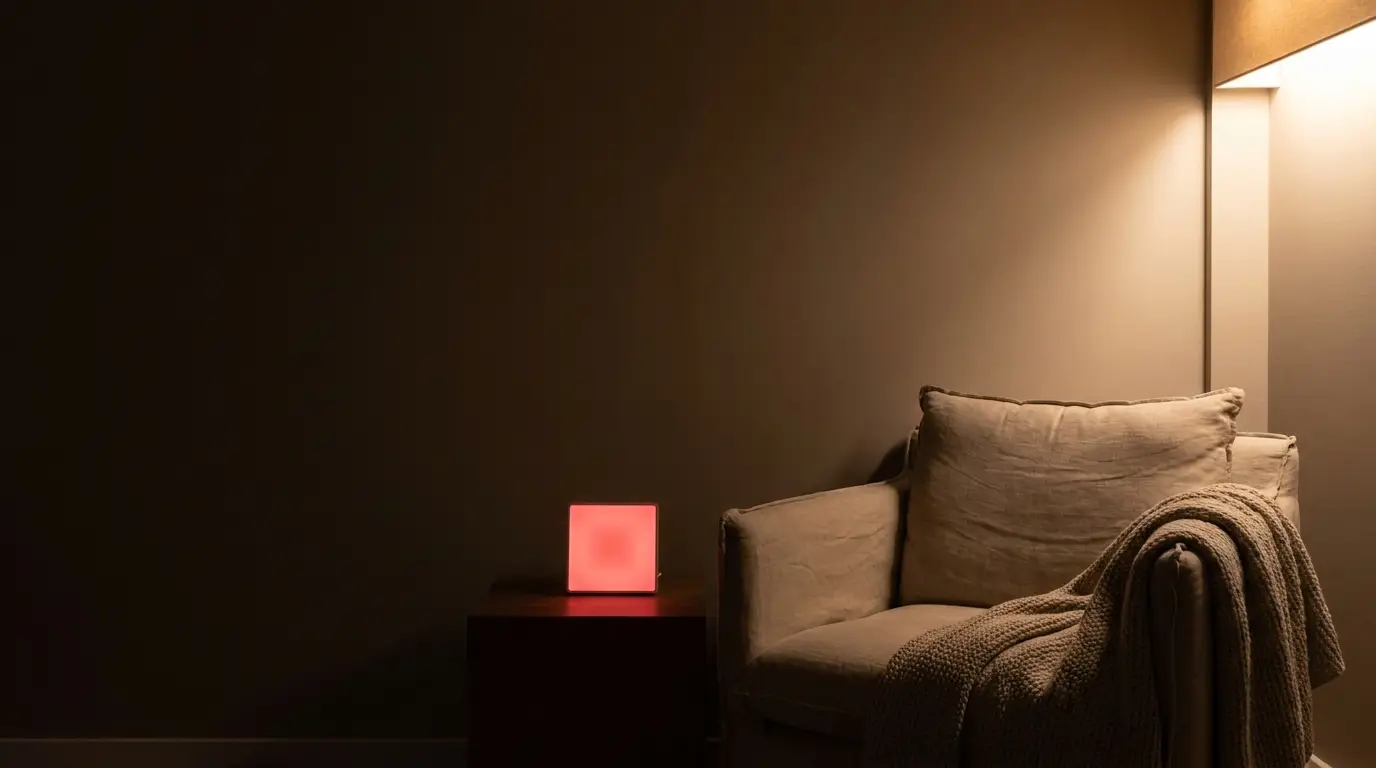
Block four is where routines quietly fall apart, because it is the block with no obvious task.
You have shut down the house. You have stretched. Now what? If the answer is “whatever feels calm,” you will end up scrolling. Your brain needs a container, not a vibe. Pick one activity and let it be boring. A paper book. A low-volume rerun. Sitting with a light device for a set number of minutes.
The activity does not need to be special. It needs to have a start and an end so your body can learn where the evening stops.
This is where light-based devices help, and not because of any magic. Warm, dim light in the last hour keeps your bedroom in the range your brain reads as nighttime. Bright overhead light does the opposite. If you are already sitting still for fifteen minutes with a device on your lap, you have replaced the hardest part of the routine with something that runs on its own timer.
Do not shop for results in week one. The goal in the first two weeks is not feeling different. It is finishing the sequence most nights.
Three changes that make it survive a bad week
The routine that works on an easy Thursday is not the one that matters. The one that matters is the version you can run when you get home at ten, you have not eaten, and you have a call at seven the next morning. Keep a short version ready. Blocks one and two, then straight to bed. Call it the half routine and use it without guilt. A cut-down sequence still tells your body what is coming.
Anchor the start to an event, not a clock time. “After I lock the front door” travels with you. “At 9:30” does not, and it breaks the moment your evening shifts.
Protect block one hardest. Everything that needs a screen belongs there. Every routine I have watched fall apart fell apart because a screen wandered into block four. One more habit that pays off: keep the room cool and dark and treat it as part of the routine, not decoration.
Research summarized by the Sleep Foundation points to bedroom temperature and light as two of the more reliable levers you have over sleep quality, and both are things you can set once and forget.
Start with tonight, not Monday
You do not need a new mattress, a blackout curtain set, or a fresh start on the first of the month. You need four blocks in a fixed order and a willingness to run the short version when life gets loud. Do this tonight: write your four blocks on a sticky note, put it where you charge your phone, and run it once.
Tomorrow, run it again. The nights you skip are not failures. They are data about which block is too heavy for your actual life, and that is the most useful thing you can learn in week one. Which block is most likely to fall apart for you: the screen shutdown, or the quiet one at the end?