

Nobody warns you about the part that comes after the crying stops. Your baby is fed, your eyes are half shut, and you climb back into bed expecting sleep to just take over. Instead, you lie there wired, heart still a little fast, mind replaying the last twenty minutes. Falling back asleep after a night feeding is its own separate skill, and it’s one most sleep advice skips entirely because it’s written for people who don’t have a nine-pound alarm clock going off every three hours.
Most of the friction isn’t the feeding itself. It’s everything wrapped around it — fumbling with a baby bottle warmer in the dark, second-guessing the water level, standing in a bright kitchen at 2 a.m. waiting for a beep. Each of those small interruptions nudges your body further from the sleepy state it was in a few minutes earlier, and getting back to that state takes longer than most people realize — often ten to twenty minutes of additional wakefulness, even after you’re physically back in bed.
If you’re going to shorten that window, the fix isn’t a new bedtime routine for yourself. It’s shortening and quieting the routine around the feeding. That’s a big part of why some parents switch to something like the Momcozy Night Pro Baby Bottle Warmer, which is built around a low-glow display and a see-through tank, so there’s no need to flip on an overhead light or squint at markings in the dark. Less light exposure at 2 a.m. isn’t a small detail — it’s one of the more reliable ways to keep your own circadian rhythm from getting knocked off course.
The Light Problem Nobody Talks About
Sleep researchers have been fairly consistent on this point for years: even brief exposure to bright light in the middle of the night suppresses melatonin production, and that suppression doesn’t reverse the moment the light goes off. It lingers. So when a parent flips on a hallway light or a kitchen light to warm a bottle, check a water line, or read numbers on a screen, they’re not just losing the two minutes it takes to warm the milk. They’re pushing their own sleep pressure backward by more than that.
A few adjustments make a real difference here:
- Keep any light source dim and low to the ground rather than overhead.
- Warm-toned light (amber or red-leaning) disrupts melatonin less than white or blue light.
- Prep as much as possible before bed — bottles measured, warmer positioned — so there’s less to figure out in the moment.
- If you have a choice, warm milk somewhere the light won’t spill into the room where you’ll be trying to fall back asleep.
None of this eliminates the feeding. But it narrows the gap between “awake and alert” and “back in bed, drifting off,” which is really the whole game when you’re stringing together broken sleep across a night.
Predictability Matters More Than People Expect
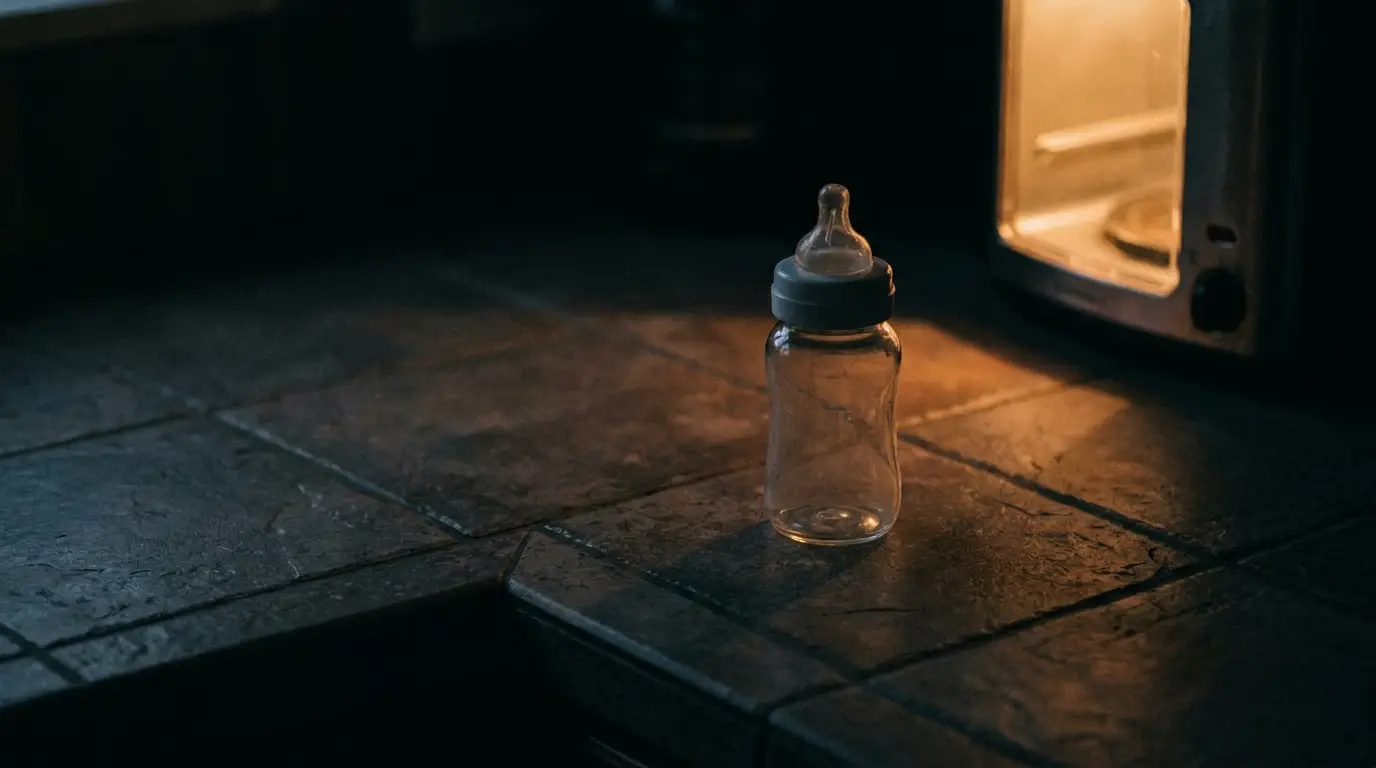
There’s a psychological piece here too, separate from the light. Uncertainty keeps the brain mildly activated. If you’re standing in the kitchen not knowing whether the bottle needs another ninety seconds or five more minutes, that low hum of “waiting and checking” is itself a small stressor, and small stressors compound at 3 a.m. in a way they wouldn’t at 3 p.m.
This is where a countdown display or an auto-shutoff feature earns its keep, less because of the minutes saved and more because it removes a decision point. You’re not standing there guessing. You know when it’s done, so your attention can start shifting toward getting back to bed rather than lingering on a task. Some parents also lean on features like temperature memory, so the warmer just repeats the last setting instead of asking them to reconfigure anything while half asleep — one less choice to make when decision fatigue is already running high.
A Simple Comparison: What Slows You Down vs. What Speeds You Up
Step in the routine | Common friction point | What tends to help |
|---|---|---|
Locating and measuring water | Guessing water levels in the dark | A visible fill line, ideally lit softly |
Setting the temperature | Reconfiguring settings each time | A warmer that recalls the last-used setting |
Waiting for the bottle | Repeated checking, uncertain timing | A visible countdown or progress indicator |
Returning to bed | Bright light still active in your system | Dim, warm-toned lighting throughout |
Falling back asleep | Residual alertness from the above | Shortening every step above |
The pattern is consistent: it’s rarely one big obstacle keeping parents up longer than necessary. It’s four or five small ones stacked together, each adding a minute or two of wakefulness that didn’t need to happen.
Protecting Your Own Sleep Doesn’t Require an Overhaul
It’s tempting to think better nighttime sleep, as a parent, means a bigger intervention — supplements, a new mattress, a sleep coach. Sometimes those help. But in the newborn and infant stage specifically, a lot of the gain comes from removing friction from the two or three things you’re doing every single night anyway. If feeding, warming, and settling back down take twelve minutes instead of twenty-five, that’s not a minor improvement stretched across a month of broken nights. It adds up to real, measurable rest.
The same logic applies beyond bottle warming, honestly. Anywhere your nighttime routine involves bright light, decision-making, or standing around waiting, there’s usually a way to simplify it. Sleep isn’t only about what happens when you close your eyes — it’s about how quickly and calmly you can get back to that point after something wakes you up. For new parents, that’s most nights, more than once. Small changes to the routine surrounding those wake-ups tend to matter more than anything else you’ll try.
<p>Nobody warns you about the part that comes <em>after</em> the crying stops. Your baby is fed, your eyes are half shut, and you climb back into bed expecting sleep to just take over. Instead, you lie there wired, heart still a little fast, mind replaying the last twenty minutes. Falling back asleep after a night feeding is its own separate skill, and it’s one most sleep advice skips entirely because it’s written for people who don’t have a nine-pound alarm clock going off every three hours.</p>
<p>Sleep researchers have been fairly consistent on this point for years: even brief exposure to bright light in the middle of the night suppresses melatonin production, and that suppression doesn’t reverse the moment the light goes off. It lingers. So when a parent flips on a hallway light or a kitchen light to warm a bottle, check a water line, or read numbers on a screen, they’re not just losing the two minutes it takes to warm the milk. They’re pushing their own sleep pressure backward by more than that.</p>
<p>None of this eliminates the feeding. But it narrows the gap between “awake and alert” and “back in bed, drifting off,” which is really the whole game when you’re stringing together broken sleep across a night.</p>
<p>There’s a psychological piece here too, separate from the light. Uncertainty keeps the brain mildly activated. If you’re standing in the kitchen not knowing whether the bottle needs another ninety seconds or five more minutes, that low hum of “waiting and checking” is itself a small stressor, and small stressors compound at 3 a.m. in a way they wouldn’t at 3 p.m.</p>