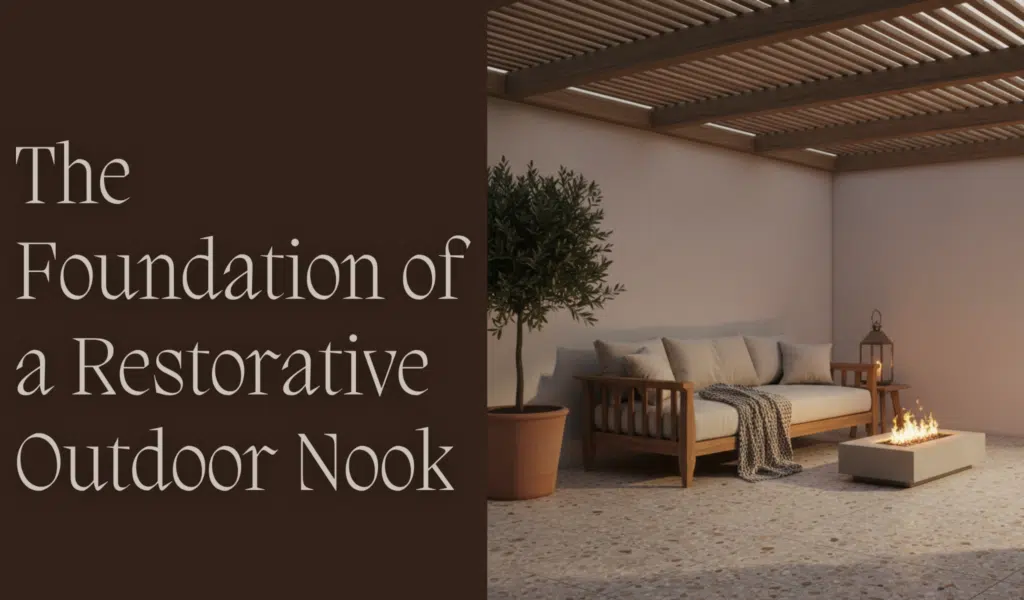
A calm outdoor nook is about designing a small corner that helps your body exhale. The kind of space where your shoulders drop the moment you step outside, where morning tea tastes slower, and evenings feel like a gentle reset.
The easiest way to get that feeling right is to build from the ground up. Tile sets the tone: cool underfoot, clean-lined, and naturally “finished,” so the space feels intentional instead of temporary.
Pair it with shade that softens the light (not just blocks it) and seating that actually supports you; a chair you can sink into, a bench that invites a pause, a spot where you don’t need to fidget to get comfortable.
In this guide, we’ll break down the best outdoor tile options for patios and porches, what to look for so it stays safe and slip-resistant in real weather, and simple shade + seating combinations that turn even a small outdoor area into a quiet, restorative retreat.
1. Start with the surface: Tile as right foundation
The outdoor nook floor is the design decision with the longest lifespan and the most consequential impact on the overall feel of the space. It also tends to be the most under-considered, defaulting to concrete pavers or pressure-treated decking by habit rather than intent.
Tile changes that calculus.
The right exterior tile brings material depth, color range, and surface character that no poured or modular surface can replicate, and it does so while meeting the performance criteria that outdoor applications demand: freeze-thaw resistance, UV stability, slip resistance in wet conditions, and structural compatibility with the substrate beneath.
For homeowners who won’t compromise on material quality, the collection’s weatherproof exterior wall tiles translate beautifully to patio use, offering an exterior-grade surface that’s as considered as any interior finish.
The lineup spans ceramic, cement, terrazzo, terracotta, stone, glass, and brick in a wide range of colorways and formats, with specifications geared for outdoor realities like moisture exposure, sun, and temperature swings. In other words, these aren’t “outdoor-looking” tiles—they’re weather-ready materials designed to perform on patios while still delivering a design-forward, curated finish.
It is organized around design intent, with the material intelligence to support it. A few tile directions particularly well-suited to outdoor nook applications:
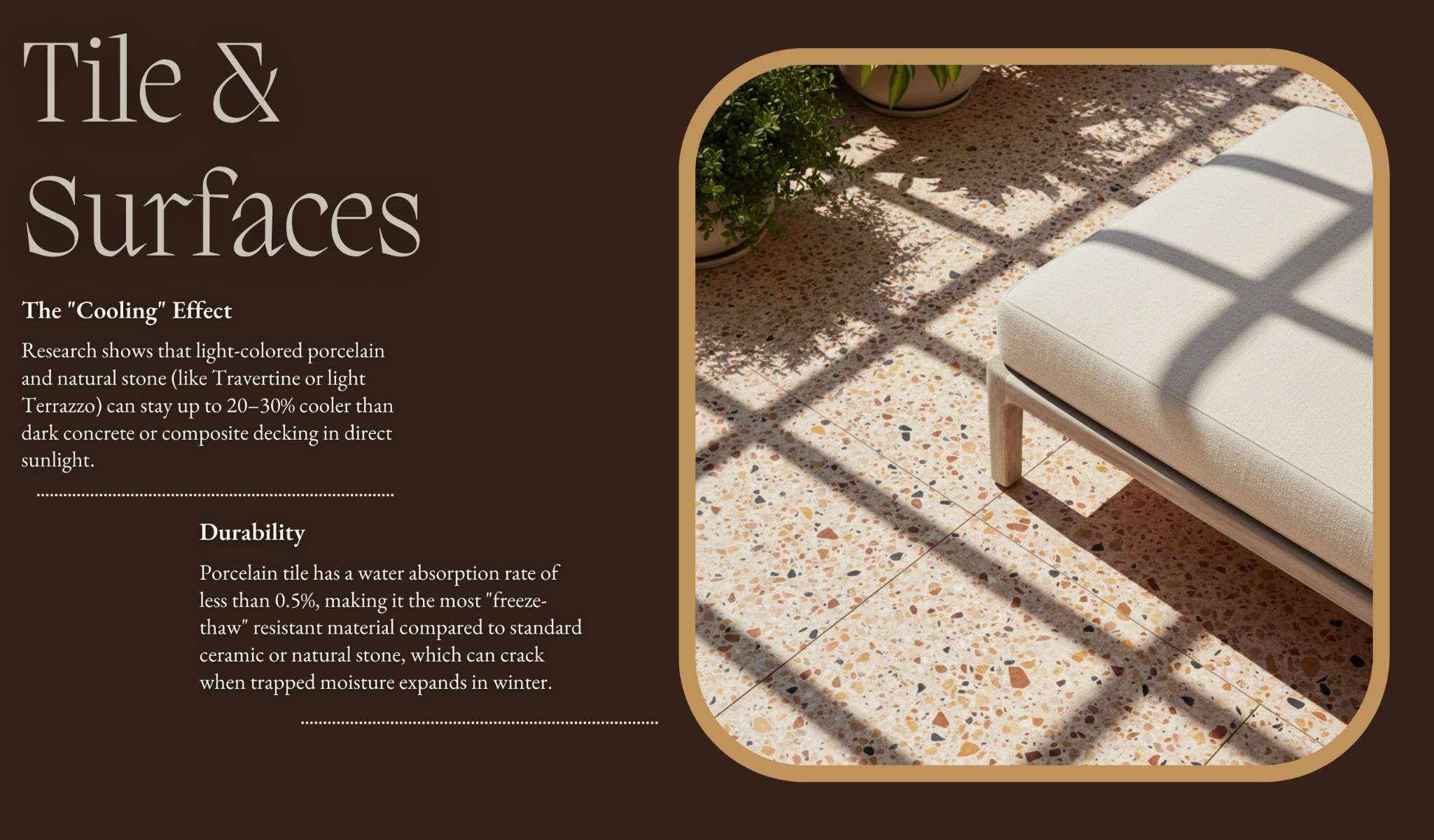
- Terrazzo for a calm, continuous surface. The Dolce Vita Terrazzo tiles in the Gather collection bring warmth and aggregated depth to a patio floor without visual noise.
In honed finishes, they read as quietly sophisticated, anchoring the space without competing with the seating or planting above. Terrazzo’s thermal mass also means the surface retains warmth into the evening, extending the usable hours of a shaded nook.
- Cement tile for pattern and handcraft character. The Cement Origami range introduces dimensional relief, including the Pleats format, which creates shadow variation as natural light shifts through the day. For a nook with direct afternoon sun, this surface quality can make the floor itself a design element, rather than a background.
- Ceramic in matte flooring or matte grip finishes for wet-zone patios. OUTERclé’s Colorwerks ceramic line offers slip-resistance finishes calibrated specifically for exterior use, in a palette range from Grasmere Grey and Biscotti Beige through to Satsuma Peel and Amber Waves. These finishes allow a color story to continue from interior to exterior without sacrificing the traction required in a space that will catch rain.
One practical note on format selection: smaller-format tiles, such as the 2×2-inch Pixies or the 2×8-inch Cigar, can work particularly well in compact nook spaces where large-format slabs might read as overwhelming.
The format should be proportional to the footprint. A 24×24-inch Petit Slab carries a terrace; a 4×4-inch Petite carries a corner.
2. Shade: the structure that determines the use
A beautiful patio nook with no overhead protection is a surface waiting for weather to cooperate. In most climates, it will not cooperate reliably. Shade is not a luxury addition; it is the structural prerequisite for a nook that functions across the seasons.
The quality of shade also shapes the quality of the space beneath it. Flat, hard overhead cover, a solid pergola roof, a cantilevered awning, creates a room-like enclosure that supports focused use, reading, conversation, dining.
Filtered shade, through a slatted pergola, a mature vine trained over an open frame, or a tensile sail, creates a softer, more atmospheric quality of light that suits spaces designed primarily for rest and sensory calm. This mirrors the logic explored in creating positive energy in a restorative space: when a space is arranged to support the body rather than merely fill an area, the experience of being in it changes entirely.
A few principles for choosing shade structures for a nook setting:
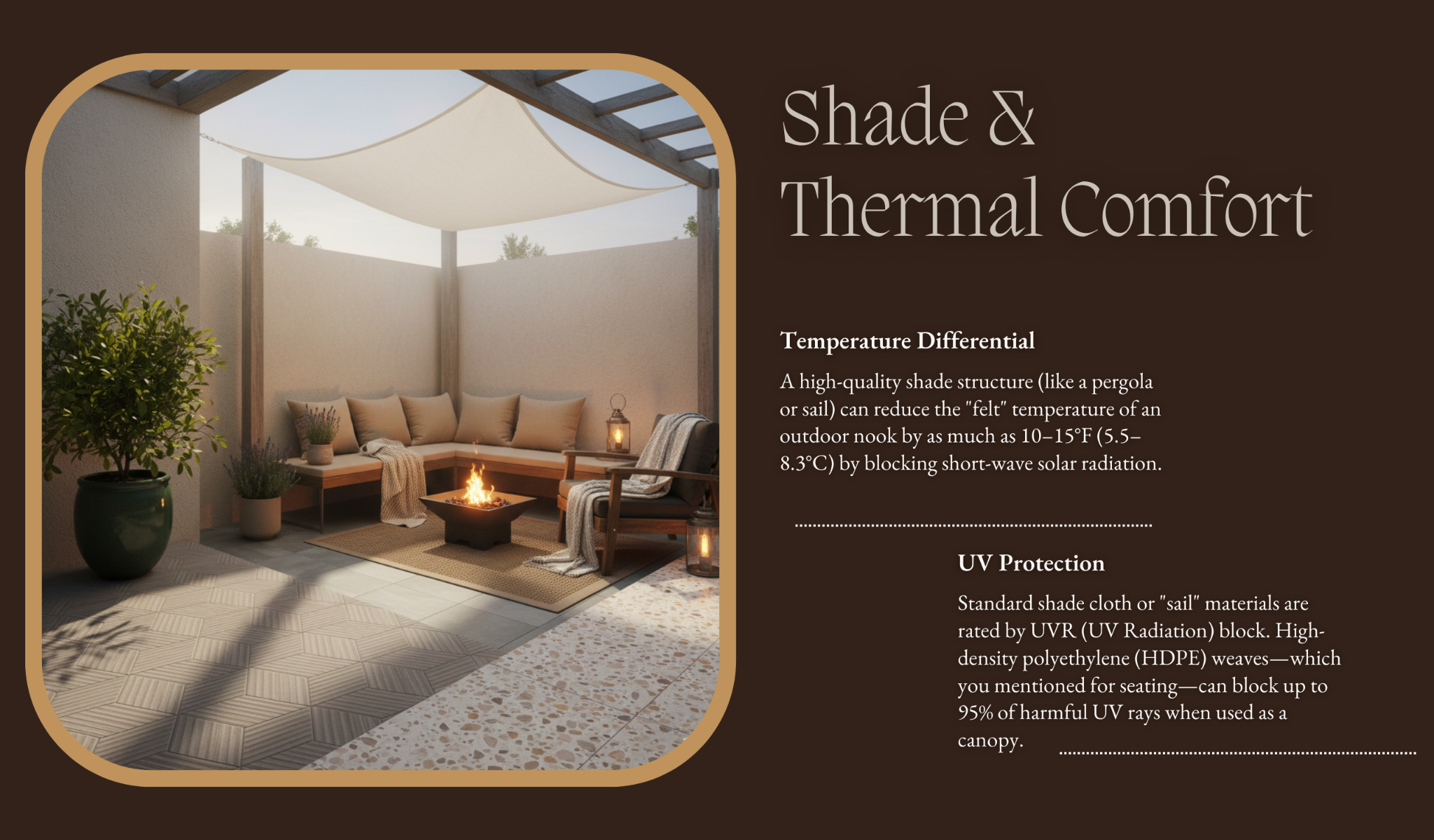
- Match overhead coverage to nook scale. An oversized pergola attached to a small corner space creates visual imbalance and may block light from adjacent interior rooms. A scaled sail shade or a simple cantilevered wall-mounted awning can provide precise coverage without architectural dominance.
- Consider the light quality, not just the quantity. A louvred pergola allows direct control over how much sun filters through at different times of day, which is particularly valuable in east-facing or west-facing nooks where morning or afternoon sun angle is steep. Fixed coverage works best in south-facing exposures where light is more consistent throughout the day.
- Account for drainage in the design. Any solid overhead structure in a nook requires a clear drainage path to prevent water pooling against the house structure. This is a coordination point that matters especially when the nook is positioned against an exterior wall.
The shade structure also frames what the eye sees from within the nook.
A well-positioned overhead element creates a defined field of view, often toward planting, a garden edge, or a borrowed landscape beyond the property, that turns the act of sitting there into something closer to a considered experience.
This is the principle behind the cloister, the veranda, and the Japanese engawa: architecture that frames the relationship between the sheltered body and the world just beyond the threshold.
3. Seating: Difference between a nook that photographs well and one that works
Outdoor seating selection follows the same logic as any other upholstered or structural furniture choice: it needs to fit the body, fit the space, and weather its conditions without looking or feeling diminished by them.
For a nook setting specifically, a few considerations are worth prioritising:
- Seat depth and recline angle over visual profile. The nook is a place for rest, not display. A seating piece with a deep seat, a reclined backrest, and adequate lumbar support will actually get used. A sculptural piece with a shallow seat and an upright angle will not, regardless of how well it photographs.
- Scale relative to the tile and shade structure. Low-profile seating, such as a deep-cushioned daybed or a wide lounge chair, reads differently under a high pergola than under a sail shade at human scale. The proportional relationship between seating height, overhead clearance, and tile expanse affects whether the nook feels like a room or a waiting area.
- Material durability without compromise on tactile quality. Powder-coated aluminium, teak, and high-density polyethylene weave are the three materials with the most proven exterior performance track records. Teak develops a silver-grey patina over time that can read well against terrazzo or stone tile.
Woven HDPE in warm or neutral tones sits well against ceramic and cement surfaces. The tactile quality of the cushion fabric, specifically its breathability and resistance to moisture retention, matters as much as the frame: a cushion that retains heat or stays damp after rain will not invite use.
Built-in seating as a spatial strategy. In compact nooks, built-in bench seating along one or two walls maximizes usable floor area, integrates the tile surface into the overall composition, and often allows storage beneath. The logic of choosing an aesthetic that fits real life applies as much outdoors as in: choose surfaces and furniture for how you actually use a space, not how it might appear in a product photograph.
When a built-in bench is tiled to match the floor, or clad in a complementary material, the nook achieves a visual coherence that free-standing furniture rarely reaches.
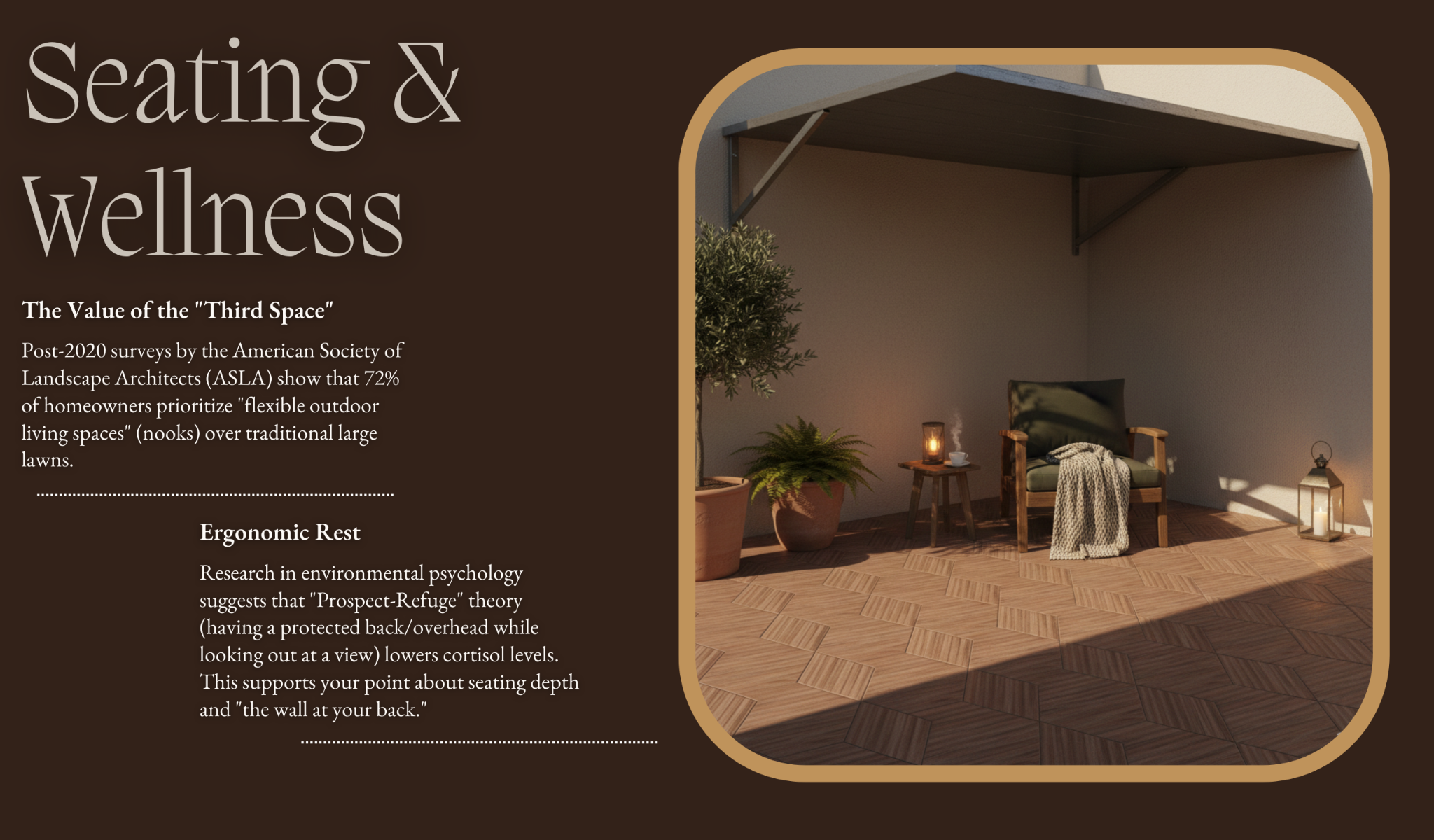
Bringing the three elements together
The calm outdoor nook is ultimately a study in material coherence and proportional thinking.
A terrazzo floor with warm aggregate tones, a scaled pergola overhead with a slatted roof that dapples afternoon light, and a deep-cushioned teak daybed: these three elements, chosen in relation to each other rather than independently, produce a space that reads as resolved.
The same principle that applies to creating a calm interior aesthetic applies here. As the approach to designing a chill aesthetic room illustrates, layered textures and a considered material palette, rather than individual statement pieces, are what make a space feel genuinely restful rather than merely decorated.
The outdoor nook does not require a large footprint. It requires a floor that grounds it, a roof that defines it, and a seat that holds you in it. The rest follows from those three decisions, made well.