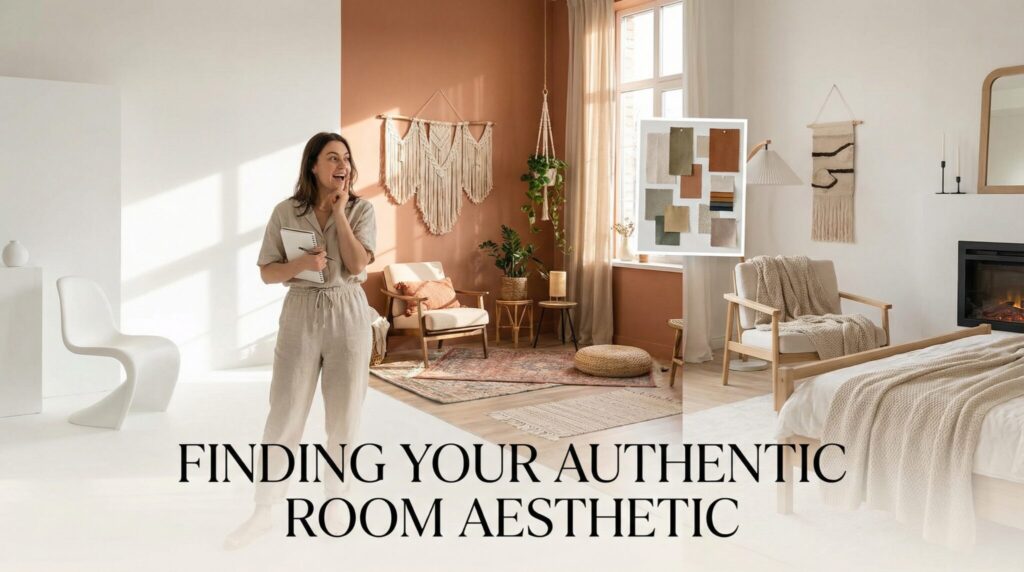
The Hidden Clues That Reveal Your True Design Style (Spoiler: It’s Already in Your House)
You know that thing where you’ve got 847 saved Pinterest photos and somehow they include: a moody black bedroom, a white and wood Scandinavian living room, and a maximalist rainbow library that looks like it belongs to a whimsical witch with a trust fund?
Same.
And then you go to actually buy a rug and your brain just… powers down. Because what even is your “style” if you like everything?
Here’s the secret I wish someone had told me way sooner: your design style is already showing itself in a bunch of tiny ways. It’s in what you wear on repeat, what you refuse to get rid of, the mug you grab every morning like it’s emotionally supporting you. You don’t need to “find” your style—you need to notice it.
So let’s do that, without turning this into a personality test that tells you you’re “83% Coastal Grandmother.” (No shade. Coastal Grandmother has great snacks.)
First: A Pretty Room That Annoys You Is Not Actually Pretty
I’ve had clients (and yes, I’ve done this myself) create a gorgeous space that looked like a magazine… and then they hated being in it. Because it didn’t match how they live.
Example: decorative pillows. If you love a bed that looks like a cloud of 37 pillows? Bless you. If you’re the kind of person who throws one pillow on the floor and calls it a day (hi), then buying six fussy pillows is just purchasing a daily argument with your own personality.
And trends? Trends are fun. But if you chase them without anchoring them to what you genuinely like, your house gets an expiration date. Suddenly you’re repainting every two years because TikTok decided beige is “out” and mauve is “in.” (Mauve has been “in” since 1997. It’s fine.)
What you actually want is a filter—something that makes purchases a clear “yes” or a polite “no thanks” so you’re not sweating in a HomeGoods aisle whispering, “Will I hate this in three months?”
Here’s the simple roadmap I use:
- Notice your real preferences (and your real life: pets, kids, renting, allergies, your tolerance for dusting).
- Pick 2-ish style directions you’re drawn to (not as strict rules—more like bumpers at a bowling alley).
- Set a few “house rules” (color palette, finishes, vibe).
- Start with low regret choices before you commit to expensive stuff.
Okay. Now let’s talk styles—without memorizing a design dictionary.
Styles, But Make It Practical (Not a Boring Lecture)
Instead of trying to label yourself with one perfect aesthetic, ask a few questions:
- Do you like clear surfaces or do you like layers?
- Are you drawn to warm tones (creamy, woodsy, cozy) or cool tones (crisp, airy, icy)?
- Do you want your room to feel like a spa, a hug, or a party?
A few style “families” to help you put words to what you’re already liking:
If you crave calm and clean
- Minimalist: fewer things, cleaner lines. But you still need texture or it starts to feel like a dentist office waiting room.
- Scandinavian: like minimalism, but friendlier—warm wood, cozy textiles, soft shapes. This one has my heart for real life living.
- Japandi: gorgeous, grounded, simple… but it only works if you’re okay keeping surfaces pretty clear. (If your counters are a “drop zone,” just know you’ll be fighting your room daily.)
If you love layers and personality
- Bohemian: warm colors, natural textures, collected vibe. The key is “curated,” not “I bought everything I saw at the flea market while dehydrated.”
- Eclectic/Maximalist: bold and fun, but it still needs one thread to hold it together—usually color, a repeated material, or a consistent vintage era.
- Vintage: the thrill of the hunt! Also the fastest way to accidentally create clutter if you buy stuff just because it’s $12 and “could work somewhere.” (Ask me how I know.)
If you’re into a specific mood
- Cottagecore: soft, romantic, florals and charm. I’d keep this one in the “easy to swap” category (bedding, art, pillows) so you’re not locked into a whole identity via a $2,000 sofa.
- Industrial: best when the space already has the bones (brick, concrete, big metal moments). If your place doesn’t have that, fake industrial can start to look like a themed restaurant.
- Coastal/Preppy: both love blue and white. Coastal is more weathered and natural; preppy is crisper with stripes and polished finishes.
- Mid-Century Modern: it’s a classic for a reason. Just be picky—cheap knockoffs can look… cheap. (No shame. Just don’t pretend it’s “vintage teak” when it’s particleboard in a trench coat.)
If you want a quick clarity trick: pick two styles you’re into and one style you’re not. Having a “no” is oddly freeing.
Now let’s find the receipts—aka the stuff you already own.
The Easiest Way to Find Your Style: Shop Your Own House
Before you take another quiz, do this instead:
Walk through your home and snap photos of the things you would absolutely keep if you had to pack up and move tomorrow.
Not the stuff you feel guilty about. Not the “maybe I’ll use this someday” pile. I mean the ride or die items.
Then look at them all together and ask:
- Do I keep choosing warm wood or black metal?
- Am I drawn to curves or straight lines?
- Do I like soft, cozy textures or sleek, smooth finishes?
- Are my favorites quiet neutrals or color?
This is the stuff you picked over time without pressure. It’s your real taste—not your “I saw this once and thought it would fix my life” taste.
Yes, you can use Pinterest (but don’t doom scroll)
If you love Pinterest, keep it… but use it like a tool, not a black hole.
Do this:
- Save 40-60 images fast, without judging.
- Step away for a bit. Eat. Hydrate. Touch grass.
- Come back and look for repeats: lighting, wood tones, mood, colors.
The pattern matters more than the label. If every single photo you love has creamy walls, warm wood, and soft lighting… that’s a clue. A big, waving, obvious clue.
Now the most important question: how do you want the room to FEEL?
This is where people skip ahead and then wonder why they’re unhappy.
Answer honestly:
- Is this room for hosting, or is it your private cocoon?
- Do you relax in visual “quiet,” or do you love lots to look at?
- How much maintenance are you truly willing to do? (Not “in your fantasy life.” In your Tuesday life.)
- What feeling do you want when you walk in—cozy, energized, calm, inspired?
Pick the feeling first for cool room mood ideas. Style is just the outfit the feeling wears.
My “Stop Second Guessing Yourself” Formula
If decision fatigue is your enemy (same), here’s the order that keeps you from making expensive mistakes.
1) Start with lighting (yes, before paint)
This is the most unsexy advice and also the most effective.
Swap your bulbs to a consistent 2700K-3000K warm white. It changes how everything looks—paint, wood, textiles—without you buying a single new “thing.”
And if you can, aim for three types of light:
- Ambient (overall glow)
- Task (reading, cooking, working)
- Accent (art, plants, corners that need some love)
If you’re renting: lamps, plug in pendants, battery sconces, removable wall accents, even LED strips behind furniture can do a lot without angering a landlord.
2) Pick a tight color palette
I like a simple 3-4 color palette. You can absolutely mix styles, but if your colors are chaos, the room will feel chaotic.
A classic ratio:
- 60% main color (walls, big pieces)
- 30% supporting color (textiles, secondary furniture)
- 10% accent (art, accessories, little pops)
This is also how you avoid the “why do I own six random throw pillows that all hate each other?” situation.
3) Then test paint like a sane person
Once the lighting is set, test paint on the actual wall (big samples, not a postage stamp swatch). Watch it morning, afternoon, and night. Paint is a liar and your house lighting is its accomplice.
4) Add texture (the secret sauce)
If a room feels flat, it usually needs texture more than it needs “more decor.”
Mix a few types: something smooth, something soft, something woven, something natural. Even a simple room looks intentional when it has a little texture variety.
5) Choose the anchor piece like you mean it
Your sofa or bed is the main character. Pick it with your actual lifestyle in mind.
If you have pets/kids/red wine habits, maybe the delicate boucle sofa isn’t your soulmate. (Or it is, and you enjoy chaos. No judgment.)
Once the big piece is right, everything else gets easier.
6) Finish with the fun stuff
Rugs, pillows, throws, art, accessories—this is where you can play. This is also where trends belong, because you can swap them without refinancing your house.
Blend Two Styles Without Making Your Room Look Confused
Most people aren’t one neat label. You can absolutely mix styles—just don’t do it like you’re throwing darts blindfolded.
My go to is the 70/30 rule:
- 70% is your foundation style (big furniture shapes, major finishes, main palette)
- 30% is the fun accent style (textiles, art, smaller pieces)
A few blends that tend to play nicely:
- Minimalist + Scandinavian (clean but warm)
- Bohemian + Vintage (collected and soulful)
- Scandinavian + Preppy (cozy with crisp edges)
If you want different vibes in different rooms, repeat one thing throughout the house—an accent color, a metal finish, a wood tone. It’s like giving your home a consistent “voice” even when it changes outfits.
The Design Traps That Will Steal Your Money (Ask Me How I Know)
A few quick “don’t do this to yourself” reminders:
- Copy paste Pinterest rooms. Your light, layout, ceilings, and budget are different. Steal the ideas (palette, texture, scale), not the exact shopping list.
- Going to extremes. Minimalism can feel sterile. Maximalism can feel like a yard sale. Every style needs a little restraint.
- Buying the wrong scale. Oversized furniture in a small room is a bully. Tiny furniture in a big room looks lost and lonely.
- Making everything match. Matching sets can look flat. Aim for “goes together,” not “came in one box.”
- Ignoring function. If you won’t actually use it, it’s not a “design moment,” it’s a dust collector.
And a budgeting trick I swear by: spend more on the foundation (sofa/bed, rug quality if you can, basic lighting), and let the personality layer be the part you change over time (pillows, art, accessories). Your style evolves—your big purchases shouldn’t have to.
Trust the Clues You’ve Been Dropping for Years
Finding your design style isn’t about landing on one perfect label and never wavering again. It’s about noticing what you consistently love, choosing a simple palette, and giving yourself permission to experiment without making it weirdly expensive.
Pay attention to the patterns:
- the jacket you always reach for,
- the coffee shop corner you always choose,
- the colors that make you stop scrolling.
Those are your clues.
Start with one room. Make one small change this week—swap bulbs, pick a palette, move in a texture, test a paint sample. Live with it for a few days and see how it feels. Adjust from there.
Your home is allowed to be a work in progress. Honestly… the best ones always are.