

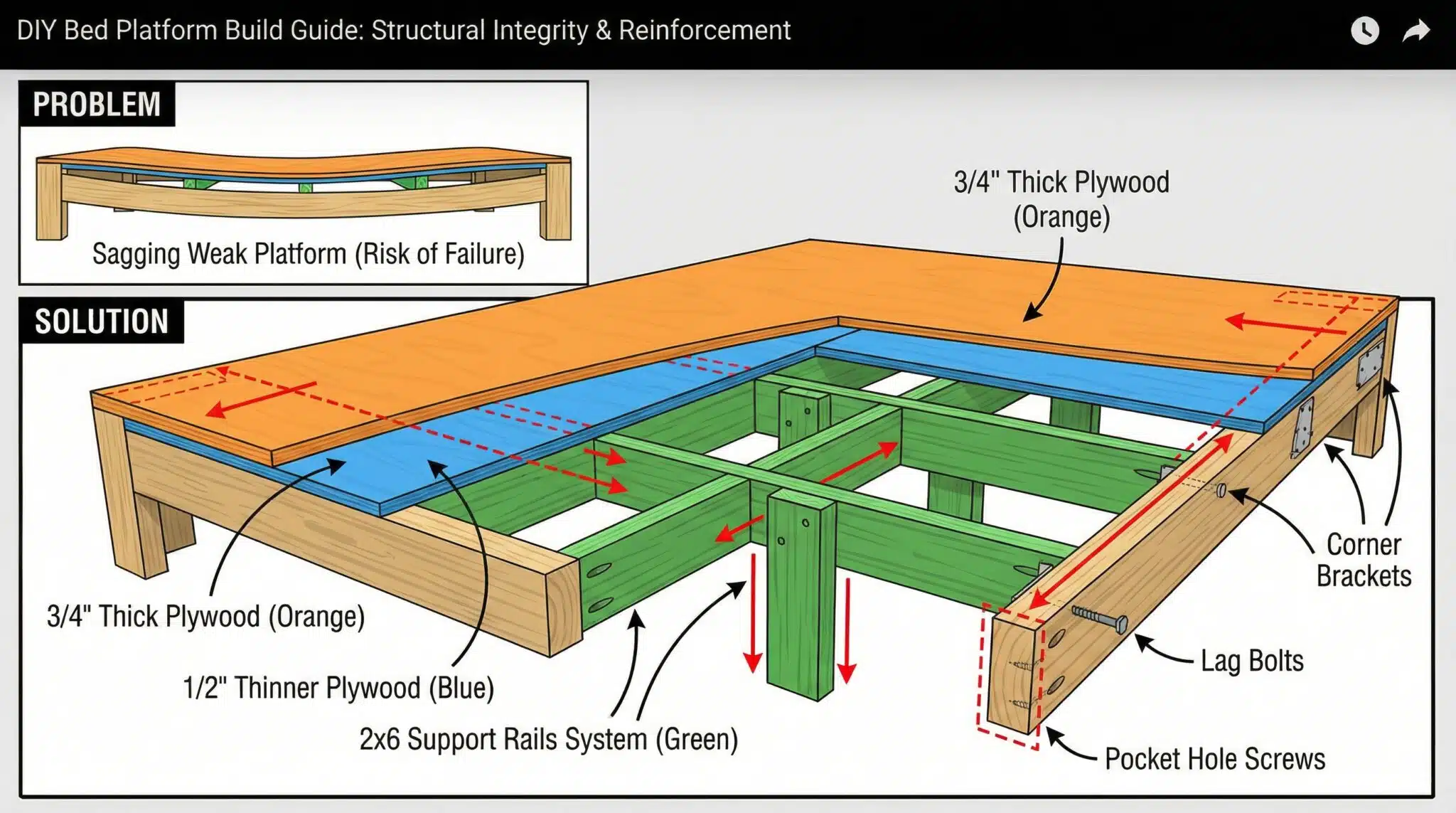
Why Your “Nice, Thick” Plywood Bed Platform Still Sags (And How to Stop It)
Let me guess: you built (or bought) a platform bed, you used “good” 3/4″ plywood because the internet said it’s sturdy, and now your mattress has a suspicious little dip like it’s trying to become a hammock.
It’s not because you bought “cheap plywood.” It’s usually because of one boring but deadly detail almost everybody skips:
The span.
(Yes, I know. Measuring. The audacity.)
If you only remember one thing from this whole post, make it this: plywood doesn’t fail because it’s thin — it fails because it’s forced to act like a diving board.
The real villain: the unsupported span
“Span” is just the open gap between supports—side rails, slats, a center beam, cross braces… whatever is actually holding things up.
Anywhere your plywood is bridging a gap with nothing underneath, it’s basically being asked to do a job it never applied for.
The quick test (do this before you buy anything)
Grab a tape measure and find the widest unsupported gap in your frame.
- If your biggest gap is 24″ or less: you’re usually fine with 3/4″ plywood (assuming decent support).
- If you’re at 24-36″: you’re entering “why does my bed feel like a trampoline?” territory.
- If you’re over 36″ with no mid support: I don’t care how thick your plywood is—it will sag. Maybe not today, maybe not tomorrow, but soon. (And it’ll be at 2 a.m. when you roll to the middle.)
Personally, I’d rather spend $15-$30 adding support lumber than shell out for thicker plywood that’s still going to lose the fight.
Plywood is a diving board (and your mattress is the cannonball)
Here’s the mental image that fixes everything:
- Short diving board = stiff
- Long diving board = boinggggg
Same plywood, different span, totally different result. That’s why a queen platform can feel rock solid in one house and feel like a sad canoe in another.
My no drama thickness guidelines
These are “sleep well and don’t think about it again” numbers:
- Up to 24″ span: 3/4″ plywood is generally OK
- 24-36″ span: go thicker or (my preference) add more support
- Beyond 36″ span: don’t do it—add a center rail and/or cross braces
If you’re building from scratch, it’s usually smarter to design the frame so no span exceeds 24″. That’s the magic number where plywood stops trying to ruin your life.
Bed size reality check (because king beds are greedy)
Twin and full beds are the chill friends of the bed world. They don’t demand much.
Kings? Kings are divas.
What I’d do by bed size
- Twin/Full: 3/4″ plywood on a solid perimeter frame is typically fine. Center support is optional (but nice).
- Queen: I strongly recommend a center rail running head to foot with legs supporting it (more on that in a second). You can often still use 3/4″ plywood if the span is controlled.
- King: plan on real structure. Kings are wide enough that “perimeter only” is basically asking the plywood to do CrossFit indefinitely.
And if you’ve got a higher combined sleeper weight (or you just like a bed that feels like a stage floor), beef up the support first, then upgrade thickness if you still need it.
The “laminated plywood” trick (great for kings)
If you can’t find the perfect thick sheet (or the price makes you clutch your pearls), you can laminate two sheets of 3/4″ together with construction adhesive and screws to make a stiffer panel.
Is it more work? Yes.
Is it strong? Also yes.
Is it fun wrestling big sheets of plywood in your hallway? Absolutely not. But it works.
Don’t get hypnotized by plywood grade stamps
Plywood stamps look like someone fell asleep on a keyboard: BCX, CDX, Exposure 1, Exterior… it’s a whole thing.
Here’s what actually matters for a bed platform:
1) Avoid MDF and particle board
I know it’s tempting because it’s flat and cheap and looks harmless.
But MDF/particle board + long term weight + normal household humidity = sag city. Also, if they get damp, they don’t “recover.” They just… degrade like a bad relationship.
Use real plywood.
2) The letters (A/B/C/D) are about looks, not strength
- A = smooth/prettiest
- B = good, small patches
- C = knots/patches, still structural
- D = rougher, bigger voids
For a bed platform, you’re usually not entering it into a beauty pageant. You want solid and reliable.
3) Glue rating matters if you live where air has feelings
- Exposure 1 = handles temporary moisture (fine for most bedrooms)
- Exterior = better for sustained humidity/wet conditions
My default pick: BCX Exposure 1
Budget but works option: CDX Exposure 1 (rougher, more voids)
Humid basement/coastal life: go Exterior rated
And since this is a bed (where you spend a third of your life, no pressure), I also like to look for CARB Phase 2 / low emission markings when possible. Some plywood off gasses more than you’d expect, and you don’t need eau de formaldehyde as your nightly ambiance.
The support layout that saves basically everything
If you’re fighting sag, I’m going to say the words you may not want to hear:
You probably need a center rail.
Center rail: the best money you’ll ever spend on this project
- Queen: I like a 2×10 center rail, running head to foot
- King: step up to a 2×12 if you can
But here’s the part people mess up: the rail needs legs.
If it only rests on the head and foot, it can still bow. Add legs so the rail is supported in multiple spots (at least one in the center; more if your floor is uneven or you want it extra solid).
This is the difference between “nice platform bed” and “why am I sleeping in a shallow U.”
Budget upgrade that works shockingly well
If you already bought 3/4″ plywood and you don’t want to re-buy materials: you can stiffen things by adding reinforcement boards underneath (like 2x8s) running across the span, glued and screwed.
Think of it like adding ribs under the plywood so it can’t flex as much. You get a sturdier deck without paying for unicorn thick plywood.
Slats vs. solid plywood: your mattress needs air, not a swamp
A solid plywood deck feels supportive, but it can trap moisture under your mattress—especially with foam mattresses, humid climates, basements, or rooms where the HVAC situation is… vibes based.
And trapped moisture can turn into mold faster than you’d like to believe with tatami mat mold care in mind. (Nothing will ruin your DIY pride like flipping your mattress and seeing the underside trying to start a science fair project.)
If you’re using slats:
- Keep spacing around 3″ (and 4″ max)
Wider than that and some mattresses will start to dip between slats and develop waves/impressions.
If you’re using solid plywood:
Add ventilation. You can:
- Drill 1-2″ vent holes in a grid pattern (not right near the edges—don’t weaken the perimeter)
- Or do a hybrid: slats + a “bunky board” style layer
If you’re in a truly humid spot (coastal, basement, Pacific Northwest vibes), I’d lean slats or Exterior rated plywood + ventilation from day one.
Quick heads up: your mattress warranty might be picky
Some mattress brands are weirdly strict about foundations. And yes, some will absolutely try to blame “improper support” for issues.
A few specifically don’t love raw plywood under a mattress (often because of moisture and airflow issues, not because it collapses).
If you want to be safe with floor mattress base options:
- Check your mattress requirements (especially for memory foam/latex)
- If they want a “foundation,” consider adding a bunky board layer or using approved slat spacing
- If you’re unsure, email the manufacturer with your plan and get it in writing
Annoying? Yes. Worth it? Also yes, because mattresses are expensive and customer service is not a hobby.
If your platform is already sagging/squeaking, here’s the fix menu
Sagging in the center
That’s almost always missing support.
- Add a center rail
- Add legs under it
- Reduce span to 24″ or less wherever possible
Squeaking and creaking
That’s wood rubbing wood, or fasteners that have loosened.
- Tighten everything (start at the center support and work outward)
- Add felt/wax between contact points
- Add more screws where plywood meets the frame
Mold under the mattress
- Improve airflow immediately (slats or vent holes)
- If plywood is damaged/delaminating, replace it (don’t “hope” mold goes away—mold loves optimism)
Plywood delaminating (layers peeling)
Often a humidity + wrong plywood grade combo.
- Replace with BCX Exposure 1 or Exterior rated
- Add ventilation so it doesn’t happen again
Assembly stuff that sounds fussy but saves you later
I know nobody starts a DIY bed platform project because they’re passionate about screw spacing. But:
- Use decent screws (deck screws are great)
- Pre-drill near edges so you don’t split plywood (splits = squeaks and weakness later)
- Put screws frequently enough that the plywood can’t shift (movement is what causes noise)
Also: sand any splintery edges. Your mattress fabric should not be slowly getting shredded because you left the plywood in its “fresh from the lumberyard” era.
My “don’t regret this” checklist before you build
Before you cut wood or throw money at thicker plywood, run through this:
- Measure your biggest unsupported span (aim for ≤ 24″)
- Plan support: perimeter frame + center rail (queens/kings) + legs
- Pick plywood you won’t hate later: BCX Exposure 1 is a solid default
- If it’s humid where you live: consider Exterior rated plywood and/or slats
- Plan airflow (slats or vent holes) before you trap moisture under your mattress
- Double check mattress foundation requirements if you care about the warranty
- Build it tight: pre-drill, screw it down well, and eliminate rubbing points
If you do those things, you can absolutely build a platform that stays flat, quiet, and supportive for the long haul—without buying plywood so thick it needs its own zip code.
And if you want to tell me your bed size + what your current support layout looks like (even just “perimeter frame, no center rail, plywood on top”), I can help you sanity check the span before you start tearing things apart.