

If your back hurts at night, especially along the side of your mid-to-low back, you might be dealing with your Latissimus Dorsi (your “lats”).
I know that can feel confusing, because you’re not even moving while you sleep, so why does it ache more?
In this blog, I’ll explain what the lat muscle is and what it actually does, then I’ll walk you through why certain sleeping habits (like twisting, arms overhead, or a bad pillow height) can make it angrier.
I’ll also cover the best sleeping positions to reduce pulling on the muscle, which positions to avoid, and quick bedtime fixes like heat vs. ice, gentle stretches, and simple home relief options.
Finally, I’ll share clear signs it’s time to see a doctor or physio.
What is the Latissimus Dorsi (& Why It Aches at Night)?
The Latissimus Dorsi (often called “lats”) is one of the biggest muscles in your back. Picture a large fan shape covering most of your mid and lower back.
Key Facts
- Connects near your spine, ribs, and pelvis
- Attaches to your upper arm bone near the shoulder
- Helps with pulling motions, such as pull-ups, rowing, climbing, and swimming
- Assists when you reach overhead or bring your arms down from above
Why Sleeping Can Trigger It
Even though you’re just lying still, sleep can irritate an already sore lat muscle:
- Twisting posture: Rolling into awkward positions throughout the night
- Poor pillow height: Creates neck and upper back tension that travels down
- Shoulder position: Arms overhead or shoulder rolled forward, pulls on the lat attachment points
- Hours of stillness: Staying in one position too long without natural movement can create stiffness
Best Sleeping Positions for Latissimus Dorsi Pain
Sleep on your back with a pillow under your knees, or on your non-painful side with a pillow between your knees. Avoid stomach sleeping and keep your arms down (not overhead).
Best 1: Sleep on Your Back (Spine-Friendly Setup)
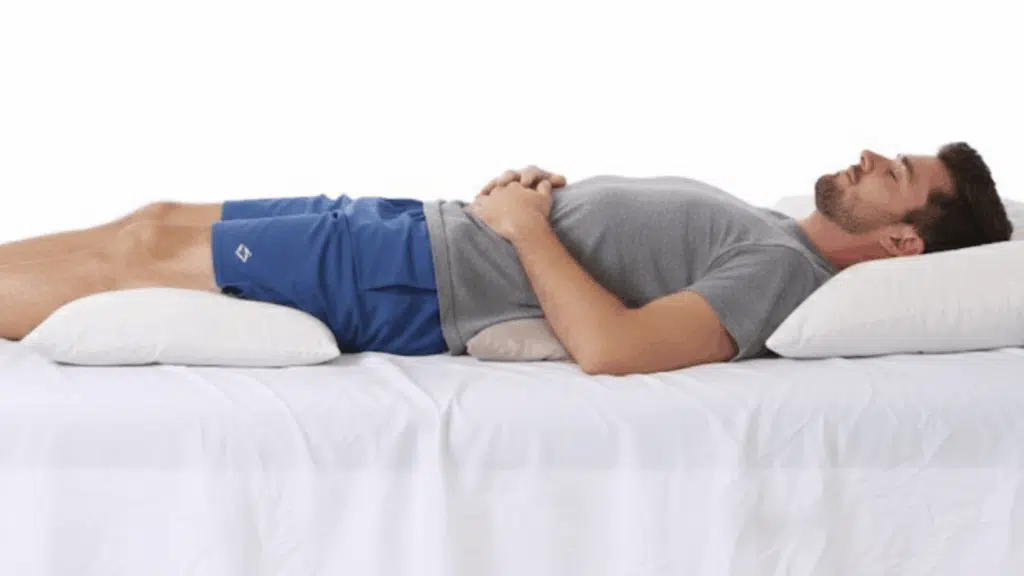
This position keeps everything aligned and takes pressure off your lats.
Step-by-step setup:
- Lie flat on your back on a medium-firm mattress
- Place a pillow under your knees (or use a rolled towel). This reduces strain and supports your natural spinal curve
- Use a neck pillow that keeps your head neutral, not tilted up too high
- Rest your arms relaxed by your sides, avoiding putting them overhead, which can pull on the lat muscle
- Optional: If you have a gap under your lower back, add a small rolled towel for extra support
Why It Helps: This position reduces twisting and keeps your spine in a neutral line throughout the night. Your lat muscle stays relaxed without any pulling or stretching.
Best 2: Sleep on Your Side (Non-Painful Side)

Side sleeping works well if you set it up correctly.
Step-by-Step Setup:
- Lie on the side that doesn’t hurt. This keeps pressure off the sore lat
- Put a pillow between your knees to keep your hips and spine aligned
- Hug a pillow or use a body pillow in front of you; this reduces shoulder and lat pull
- Choose a head pillow thick enough to fill the gap between your shoulder and neck
- Keep your body in a more extended position, not curled up tightly
Pro Tip: Think of keeping your spine like a straight line from head to tailbone when you look down at yourself from above.
Positions to Avoid in Latissimus Dorsi Pain
1. Stomach Sleeping (Why it Can Worsen Pain)
When you sleep on your stomach, your neck stays rotated to one side for hours. This twists your spine and can pull on the lat muscle attachment points near your shoulder and spine.
The arched position in your lower back also creates tension up the entire back chain.
2. Tight Fetal Position (Why it Can Increase Pressure)
Curling up into a tight ball might feel cozy, but it can stiffen your mid-back and compress the joints between your ribs and spine. This compressed position puts extra pressure on the lat muscle throughout the night.
Better approach: If you’re a side sleeper, keep just a slight natural bend in your knees and hips, not a tight curl.
3. The “Arm-Over-Head” Habit
Lots of people sleep with one or both arms stretched up above their head. This position keeps the lat muscle stretched for hours.
When the muscle is already irritated, this overnight stretch can increase soreness and stiffness by morning.
Fix: Train yourself to keep your arms at your sides or to hug a pillow.
Fast Fixes that Make Positions Work for Latissimus Dorsi Pain
Mattress Support (Firm vs Medium-Firm Guidance)
Your mattress makes a huge difference. Here’s what to look for:
- Goal: Keep your spine neutral, not bowed up or sagging down
- Sweet spot: Medium-firm support works for most people with back pain
- Too soft: Your hips and shoulders sink too deeply, creating a curve
- Too firm: Can create pressure points, but usually better than too soft
When lying on your side, imagine a straight line running from your head through your spine to your tailbone. That’s the alignment you want.
Heat vs Ice Before Bed
| Therapy | Use It when | Best for |
|---|---|---|
| Ice | You have a new strain or sharp flare-up The area feels swollen or inflamed Pain just started after an activity | Calming inflammation + numbing sharp pain |
| Heat | You have stiffness and tightness (not sharp pain) The muscle feels tight before sleep You want to relax the muscle | Loosening tight muscles + improving comfort |
Never sleep on a heating pad or ice pack. Set a timer and remove it before falling asleep.
Gentle Stretches for Latissimus Dorsi Pain
Safety first: Stop immediately if you feel sharp pain. Stretching should feel like a gentle pull, never painful. Consider seeing a physical therapist for personalized guidance.
Beginner-Friendly Lat Stretch
- Stand facing a wall or doorway frame
- Reach your arm up and slightly to the side, placing your palm flat
- Gently lean your body away from the wall, creating a stretch along your side and back
- Hold for 20–30 seconds while breathing normally
- Repeat 2–3 times on each side
Breathing tip: Exhale as you lean into the stretch. This helps your muscles relax.
“Child’s Pose” Variation With Side Reach
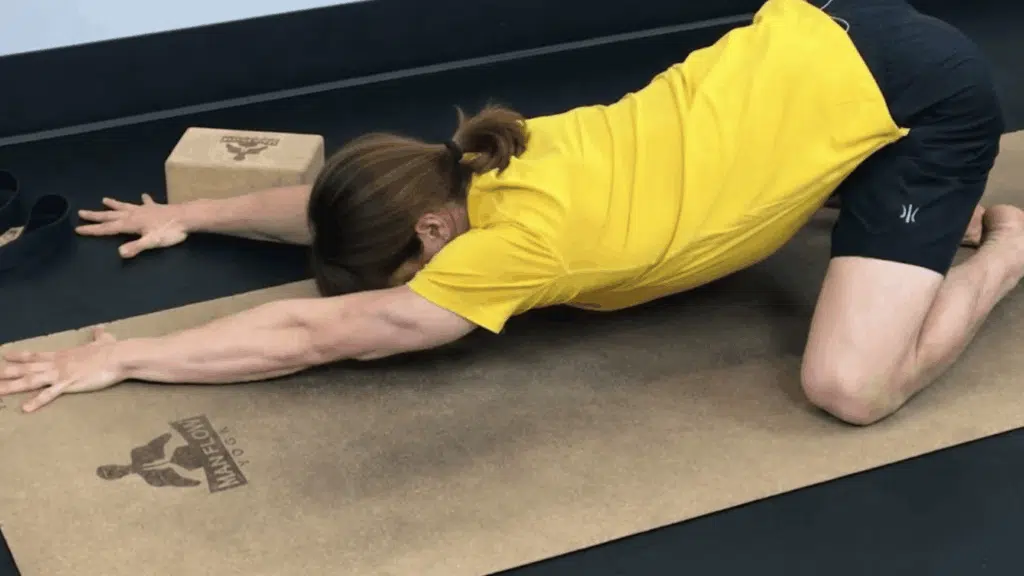
- Kneel on the floor and sit back on your heels
- Stretch your arms forward on the ground
- Walk both hands to the right side to stretch the left lat
- Hold for 20–30 seconds, feeling the stretch along your left side
- Walk hands to the left to stretch the correct lat
- Repeat 2–3 times on each side
Comfort Modification: Place a cushion under your knees or between your bottom and heels if needed.
Foam Roller / Ball Release (Trigger Point Focus)
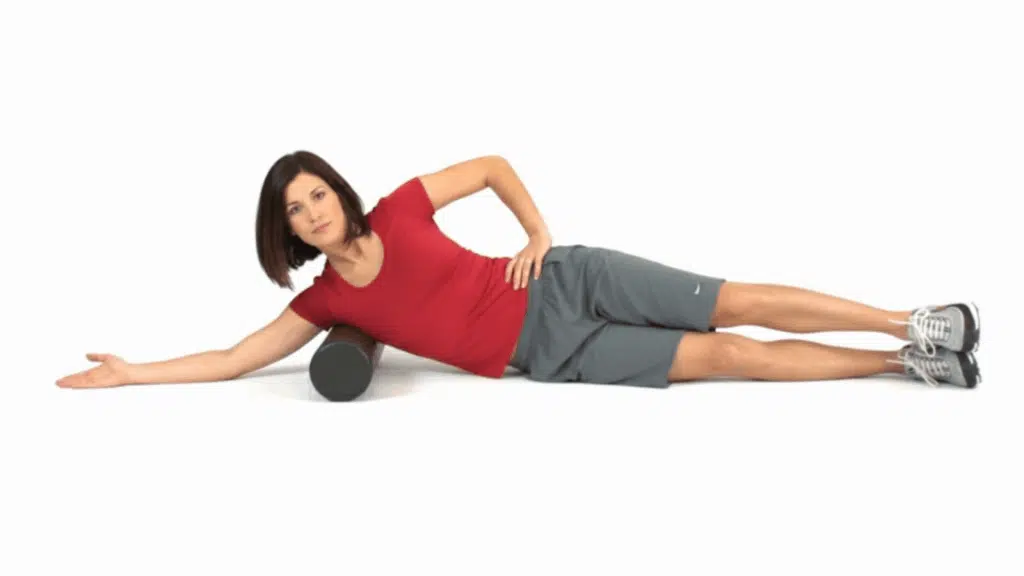
- Lie on your side with a foam roller or tennis ball under your lat muscle (below your armpit, on your side back)
- Avoid rolling directly on your spine
- Gently roll or apply pressure to tender spots
- Hold on tight for 30–60 seconds
- Move slowly and breathe through any discomfort
Pressure Guidance: Use gentle to moderate pressure, not aggressive. You want it to feel like a “hurts so good” sensation, not sharp pain.
Other Home Relief Options that Pair Well with Better Sleep
| Relief Option | What to Do | How It Helps | Quick Tips |
|---|---|---|---|
| Rest & load management | Avoid painful moves briefly; ease back into activity | Lowers the strain so the lat can settle | Don’t stop all movement; avoid pain spikes; increase gradually |
| Massage | Pro massage or gentle self-massage (roller/ball) | Releases tight spots; boosts comfort | Use light pressure; avoid spine and bony areas |
| Epsom salt bath | Warm soak 15–20 min before bed | Relaxes muscles; improves comfort | Keep water warm, not hot; stop if dizzy/worse |
| Hydration + easy mobility | Hydrate; gentle stretches or light walk | Supports muscle function; reduces stiffness | No sharp pain; keep it easy, not intense |
When to See a Doctor or Physio (Don’t Guess Forever)
Make an Appointment if:
- Pain is intense or getting worse despite home care
- Symptoms last more than 2 weeks
- Pain keeps returning even after it seems to heal
- The pain significantly limits your daily function
- You had a shoulder injury or trauma (lat pain can overlap with shoulder issues)
- You have numbness, tingling, or weakness in your arm
- You’re unsure what’s causing the pain
A healthcare provider can properly diagnose the issue and create a treatment plan. Physical therapists are beneficial for addressing muscle imbalances and teaching proper form.
Wrapping It Up
Lat pain can be really annoying, but I want you to know it’s often fixable with minor changes.
When I focus on keeping my spine straight, keeping my arms down, and supporting my knees or hips with a pillow, my back usually feels calmer by morning.
I also like using the right tool at the right time: ice for a sharp flare-up, heat for tight, stiff muscles.
Add a gentle stretch or a little trigger-point release, and your lat gets a chance to relax instead of staying tense all night. If the pain keeps coming back, spreads into your arm, or feels scary, I don’t “push through” it; I get help.
Want a simple checklist you can follow tonight? Drop a comment, and I’ll share one.