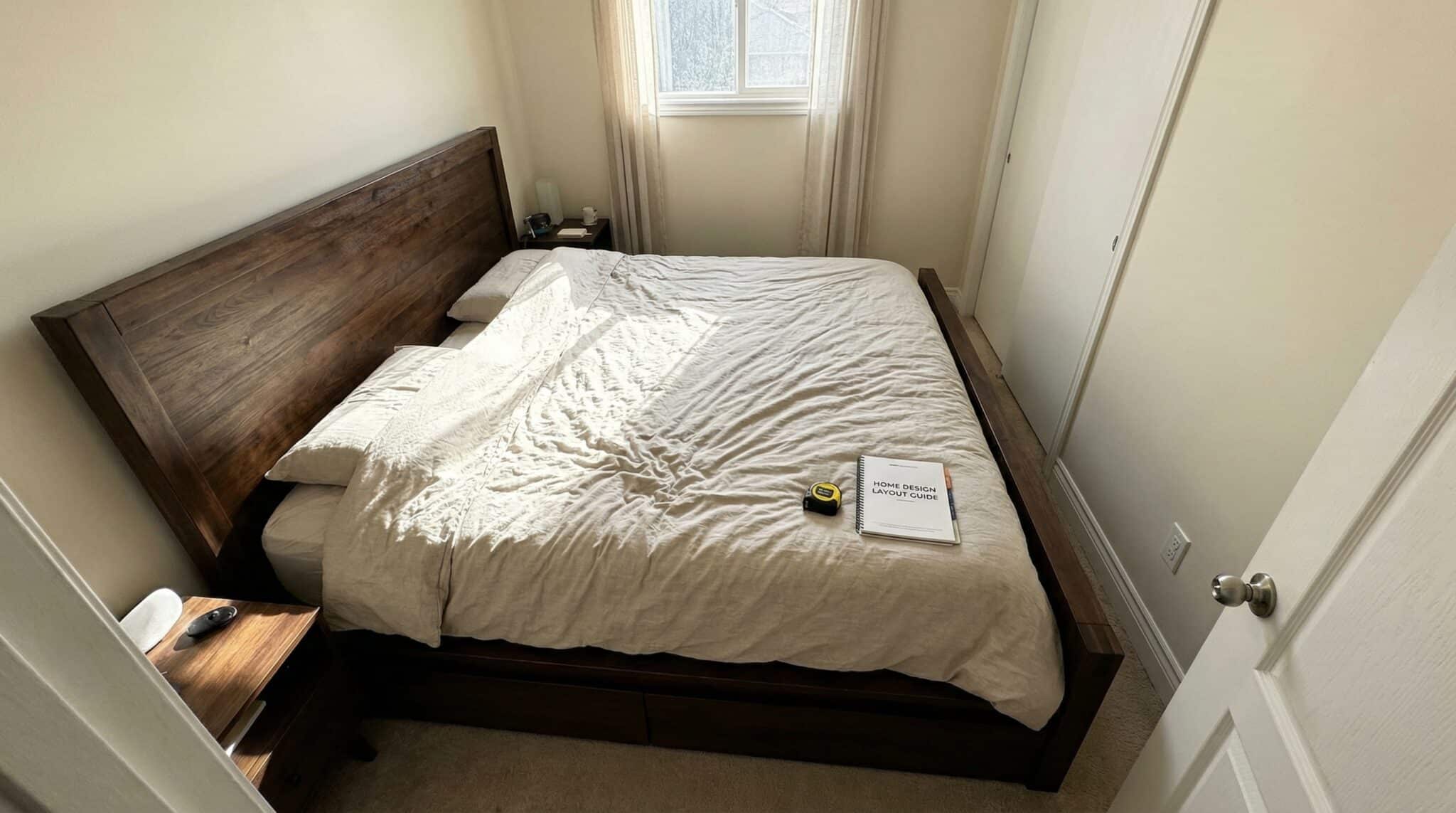

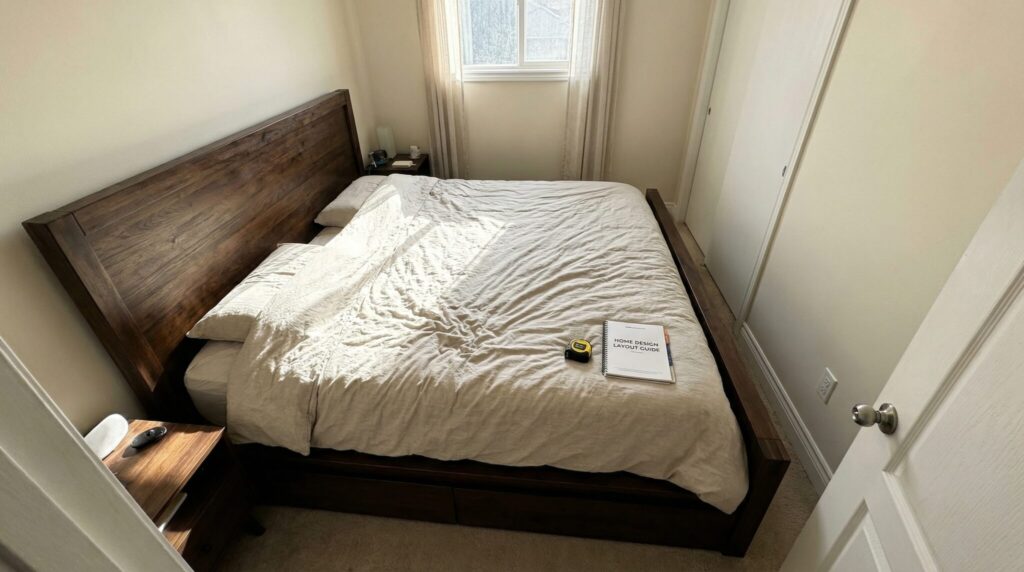
Can a King Bed Fit in a 10×10 Room? (Yes… but it’s a whole thing.)
You absolutely can put a king bed in a 10×10 bedroom. The real question is: do you want to live like you’re sleeping on a luxury raft that’s docked inside a shoebox?
Because here’s the deal: a standard king mattress is 76″ x 80″. Your room (in a perfect world scenario) is 120″ x 120″. On paper, that sounds… fine-ish. In real life, once you add a frame, baseboards, a door that swings, and your basic human need to walk without bruising a hip, it gets tight fast.
I’m not here to talk you out of your big bed dreams. I’m here to help you avoid the “why do I feel rage every time I change the sheets?” lifestyle.
The reality check: how much space is left?
If you center a king bed in a true 10×10 room, you end up with roughly 22 inches on each side.
Twenty two inches is about “edge of the fridge” territory. You can squeeze by… but it’s not exactly “peaceful bedroom sanctuary.” It’s more “sideways crab walk while holding laundry.”
Most designers recommend 24-36 inches for a walkway that feels normal. And if you’re picturing nightstands? Even “small” nightstands tend to eat up the little breathing room you have left.
Also: those numbers assume mattress only dimensions. A lot of bed frames add extra width and depth (more on that in a second). So your “22 inches” can quickly become “why is my thigh always catching on this corner.”
Two layouts that actually work (and one that’s a trap)
1) The “corner king” (aka: the most realistic option)
If you shove the bed into a corner headboard on one wall, side of the bed on the other you suddenly gain a usable open side.
You’ll typically have around 44 inches on the open side, which feels downright luxurious in comparison. Enough space to walk, enough space for a tiny bedside surface, enough space to not feel like you’re navigating an obstacle course.
The trade off? Whoever sleeps on the wall side is boxed in. If that person is you and you get up to pee at night, congratulations you’ve chosen a nightly climbing hobby.
This layout is great for:
- Solo sleepers who want maximum bed
- Couples where one person always sleeps on the open side (and doesn’t mind it)
- Guest rooms (guests can suffer a little, it builds character)
2) The centered king (equal access, equal annoyance)
Centering the bed gives both people access… but both sides are narrow. Nightstands usually become floating shelves (or you just accept a life where your phone lives on the floor like a goblin).
This layout only really works if your bedroom is basically just for sleeping and you’re not trying to cram in a dresser, desk, chair, Peloton, and your emotional support laundry pile.
The trap: angling the bed
Yes, it looks cute in staged photos. No, it doesn’t magically create more space. It just creates a useless triangle of floor you can’t actually use for anything except collecting dust and regret.
Your bed frame matters more than you think (because inches disappear fast)
Here’s the sneaky part manufacturers don’t scream from the rooftops: king bed spacing rules start with a “king” frame that can make your footprint 82-86 inches wide instead of the mattress’s 76.
And in a 10×10 room, those extra inches are the difference between:
- “This is cozy”
- and “I hate everything and also my shin hurts”
My personal picks for tiny rooms:
- Low profile metal frames (usually close to mattress size)
- Simple platform frames with slats (also usually tight and clean looking)
What I’d avoid in a 10×10:
- Storage drawer beds. The drawers need clearance to open. If your walkway is already a skinny little strip, those drawers are basically decorative lies.
- Anything chunky with a big overhang or thick side rails
Also: I’m opinionated about headboards in small rooms. Keep them shorter (under ~36″) if you can. Tall headboards can make a small room feel like it’s wearing shoulder pads to a cramped elevator.
What furniture can you fit with a king? Not much. Choose your fighters.
Once the king goes in, you don’t get to keep every other piece of furniture like it’s a hostage negotiation.
If you want the room to feel functional (and not like you’re living inside a mattress showroom), here’s what works for master bedroom dimensions:
- Skip bulky nightstands.
Do floating shelves instead at about shoulder height when you’re lying down. You need a spot for a phone, water, glasses, charger. Not a whole oak end table from 1997. - Go vertical for clothes.
A tall, narrow dresser is your best friend. Think slim footprint, more height. - Use under bed storage on purpose.
Under a king, you’ve got a ton of storage potential. Just don’t turn it into the Island of Misfit Stuff. Clear bins + labels = sanity.
If reading that made you feel cranky (“but I want my nightstands and a bench and a vanity and…”), that’s your sign that a king might be forcing too many compromises.
When a queen bed makes more sense (and feels way better)
A queen is 60″ x 80″, and centered in a 10×10 room it leaves about 30 inches per side.
That extra space doesn’t sound dramatic on paper. In real life, it’s the difference between:
- sliding sideways like you’re sneaking past someone in a movie theater
- and walking like a normal person who pays taxes
Choose a queen if:
- You both want easy in and out access
- You want real nightstands (even narrow ones)
- Your room needs other furniture (dresser, desk, chair)
- You don’t want to do clearance math every day of your life
Yes, you lose sleeping width compared to a king. But unless you and your partner sleep like inflatable tube men, most people adjust quickly.
Quick note: If you’re tall tall (over 6 feet), a California King (72″ x 84″) can be a nice compromise slightly narrower than a standard king and a bit longer. But don’t buy anything until you do the test below.
Do this before you buy anything: the painter’s tape test
I swear by this. It’s simple, cheap, and it prevents the classic “I measured but I still hate it” situation.
What you need
- Painter’s tape
- Tape measure
- A couple small boxes (to pretend they’re nightstands)
What to do
- Measure your room at floor level and again around 36 inches up (old houses especially love to be crooked ask me how I know).
- Tape out the full bed footprint on the floor, including the frame overhang and headboard depth (don’t cheat future you will be mad).
- Add boxes where nightstands would go (or where you think they’ll go).
- Open your doors and closet fully. Make sure nothing smacks into the taped outline.
- Live with it for 2-3 days.
Walk around it. Get dressed. Pretend you’re carrying a laundry basket. Do the nighttime shuffle to the bathroom.
Bonus sanity check: think about delivery. King mattresses are 76″ wide and your doors are probably 32-36″. You’re going to be angling and pivoting like you’re in a low budget episode of Friends. Make sure the path from the front door to the bedroom isn’t a nightmare.
So… should you put a king bed in a 10×10 room?
A king can work in a 10×10 if:
- The room is mostly for sleeping (not living, working, and storing every object you’ve ever owned)
- You’re okay with a corner placement or very tight side clearances
- You choose a slim frame that doesn’t steal precious inches
But if you want the room to feel easy like you can breathe, walk, and change sheets without swearing a queen is usually the happier answer.
Do the tape test. Your body will tell you the truth way faster than your brain will.