

Have you ever made your living room look adorable blanket draped just so, candle lit, little mug of something warm and then you sit down and feel… inexplicably irritated? Like your space is doing all the right things but your brain is unimpressed?
Yeah. That’s usually because “hygge” and “cozy” get tossed around like they’re the same vibe, and they’re not at least not in the way most of us use them online.
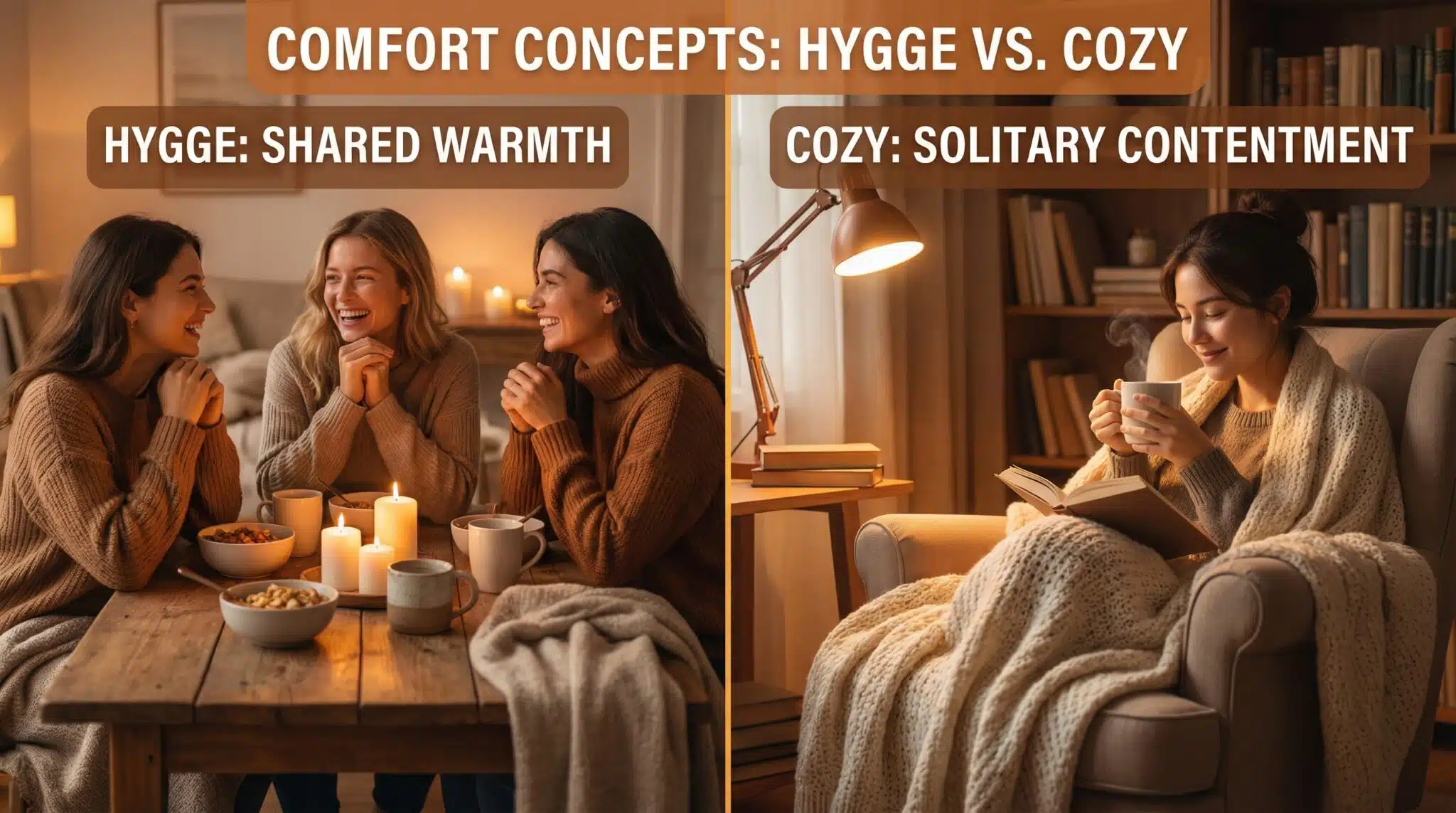
The short answer: Cozy is about physical comfort (soft, warm, low effort relief). Hygge is about intentional comfort (a calm, present atmosphere often social, but it can be solo too) [Cambridge Dictionary: “hygge”; Wiking, 2016].
Key exception: Hygge isn’t “people only” a quiet candlelit night with a book can absolutely count [Wiking, 2016].
When it matters less: If your space already helps you unwind, you don’t need the “perfect” label—keep what works.
Here’s my one line take (with a tiny update for accuracy):
Cozy is a sensation. Hygge is a practice.
Once you figure out which one you actually need on a given day, your home stops feeling like it’s trying yet failing to soothe you.
The 10 Second Test: What Are You Picturing?
Close your eyes and imagine your perfect comfy evening.
- If you see comfort first blanket, warmth, low effort, “please nobody ask me a question” you’re craving cozy.
- If you see presence first soft light, a calmer pace, a sense of “we’re safe here,” maybe with one or two people (or just you, fully offline) hello, hygge (pronounced roughly “HOO-guh”) [Cambridge Dictionary: “hygge”].
That’s it. No need to inventory your throw blankets (even if you own seventeen; I’m not here to judge your textile lifestyle).
Hygge vs. Cozy: The Quick Definitions (So We’re Not Guessing)
Cozy is a general English idea: physical snugness and ease warmth, softness, relief, comfort. It can be solo or social.
Hygge is a Danish concept that’s often described as a feeling of comfortable, content well being created through simplicity, warmth, and presence. It’s commonly social, but not exclusively (solo hygge is a real thing) [Cambridge Dictionary: “hygge”; VisitDenmark: Hygge overview; Wiking, 2016].
Hygge vs. Cozy: Side by Side Comparison
| Category | Cozy | Hygge |
|---|---|---|
| Core idea | Physical comfort and ease | Intentional comfort + contentment (a calming atmosphere) [Wiking, 2016] |
| Origin | General English usage | Danish word/concept popularized globally in recent years [Cambridge Dictionary: “hygge”; Wiking, 2016] |
| Social vs. solo | Either (often solo) | Either (often social, but can be solo) [Wiking, 2016] |
| What it looks like | Nesting, soft textures, “I’m recovering” energy | Warm light, presence, simple rituals, “we’re here” energy |
| Common misconception | “Cozy = aesthetics only” | “Hygge = hosting” or “hygge = winter only” [VisitDenmark: Hygge overview] |
Hygge vs. Cozy: Key Differences (5 Point Checklist)
If you want the quickest possible answer, it’s this:
- Cozy prioritizes the body. Warmth, softness, low effort, quick relief.
- Hygge prioritizes the moment. Presence, ease, and a calmer rhythm created on purpose [Wiking, 2016].
- Cozy can be accidental. Hygge is usually a small decision (“let’s make this feel gentle”).
- Cozy is often more private. Hygge is often more relational but not required.
- Cozy can be “zone out.” Hygge tends to be more “tune in” (even if it’s tuning in to your own quiet).
Neither is “better.” They’re just different tools.
When to Choose Hygge (AKA: You Need Presence—Maybe People, Maybe Just Less Noise)
Hygge works when you’re craving connection or calm presence, but you don’t have the energy for a full “hostess era.” This is not about perfect appetizers or curated playlists that make you feel like you should be wearing linen.
Hygge is for:
- Breaking the isolation spiral where you’ve been “too busy” to see anyone… for a while.
- After work decompression when you need a clean line between “I am an employee” and “I am a human again.”
- Low stakes togetherness with one or two people you actually like (tea, soup, a walk, a puzzle).
- Solo hygge nights where you want calm + presence: warm light, phone away, a simple ritual, and no frantic multitasking [Wiking, 2016].
- Repeatable rituals like Sunday tea, monthly potluck, or “come over and complain gently” night.
If the idea of people sounds exhausting right now, that’s not a moral failure. That may just mean you need cozy today.
When to Choose Cozy (AKA: Time to Hibernate)
Cozy is for the nights when you’re running on fumes and an extra conversation feels like work.
Cozy is perfect for:
- Solo recovery (after work, sick days, introvert recharge, general life fatigue)
- Fast comfort (no planning, no “setting the mood,” just blanket and done)
- Screen friendly relaxing (comfort show + layered blankets = completely valid)
- Quiet self-care that’s actually restful, not a new to do list disguised as wellness
Sometimes the most productive thing you can do is rest. Cozy is basically maintenance mode for your brain.
How to Set Up Your Space for Hygge (Connection Without the Cringe)
Hygge spaces don’t look a certain way. They behave a certain way. The room gently nudges you (and/or other people) toward being present without feeling like forced bonding.
Here’s what makes the biggest difference:
1) Fix the lighting (overhead lights aren’t helping)
If you do nothing else, do this: turn off the Big Light.
Hygge lighting is warm and scattered several little pools of light instead of one glaring overhead situation. If you want specifics, many people aim for warm bulbs (often labeled “warm white”), plus a couple lamps and/or candles if you like them [Wiking, 2016].
2) Make seating face each other (yes, even a little)
This is the sneaky one people skip, and it often matters more than your throw pillow situation.
Angle chairs toward each other. Pull the sofa forward. Create a loose circle. You want easy eye contact and conversation that doesn’t feel like a cross room performance.
3) Add something to hold (snacks are social glue)
You don’t need a charcuterie board the size of a coffee table. You need something to sip or nibble because it gives hands a job and makes people linger.
Coffee. Tea. Soup. Cookies. Popcorn. Bonus points if it’s even slightly “made” (warmed, brewed, assembled) because that tiny bit of effort signals: we’re here on purpose.
That’s hygge. Not matching napkins.
How to Build a Cozy Sanctuary (Fast Comfort, No Guests Required)
Cozy is quick access comfort. You should be able to flop down and feel better in under a couple minutes. If you have to get up three times to find the remote, a charger, and a blanket… your setup in a compact bedroom layout is working against you.
Here’s my cozy formula:
1) One ridiculously comfortable seat + layers
Pick your spot: couch corner, recliner, bed, whatever. Then layer textures like you’re building a nest for an elegant woodland creature.
Think: soft + chunky + smooth. Warm bedroom styling ideas include a decent throw, a pillow you actually like, maybe a foot blanket (it sounds extra until it changes your life).
Keep essentials within arm’s reach:
- remote
- charger
- water
- lip balm (why are we always dry?)
- the snack
2) Eat the comfort food, no performance required
Cozy food can be “homemade,” but it can also be takeout eaten under a blanket while you watch the same show you’ve watched 12 times. This is not a cooking competition.
And yes, I fully support “house clothes” that never see daylight. Some sweatpants are emotionally indoor only. As they should be.
Who Should Be a Little Careful (Quick, Practical Edge Cases)
- If you have asthma, migraines, or scent sensitivity: skip strongly scented candles/diffusers. Try unscented candles or warm lamps instead (same mood, fewer side effects).
- If you have kids or pets: open flames are a real hazard use flameless candles or place candles high and truly supervised.
- If you’re in a small space or have roommates: “hygge” works best with expectations try a set start/end time so it doesn’t feel like surprise hosting.
- If you’re on a budget or renting: lighting is your highest impact move swap bulbs, add a plug in lamp, use removable hooks. No big purchases required.
- If you’re socially anxious or burned out: hygge doesn’t have to mean guests. Start with solo hygge (phone away + warm light + one calming ritual) [Wiking, 2016].
Three Mistakes That Kill the Vibe (Ask Me How I’ve Learned)
Before you light seventeen candles and still feel irritated, here are the classic mood killers:
1) Turning it into a shopping project.
If “hygge” makes you sprint to buy ten new beige items… we’ve missed the point. Use what you have. Lighting and a little softness do most of the work.
2) Keeping the phone out “but nearby.”
For hygge, screens are a vibe assassin. Put the phone away away. (If you don’t, your attention doesn’t fully land.) Cozy is different cozy can absolutely involve a screen.
3) Thinking hygge is only for winter.
Sure, it’s famous for cozy winters, but you can hygge year round: porch hangs, fire pit nights, slow dinners, rainy day coffee. Hygge isn’t a season it’s a choice [VisitDenmark: Hygge overview].
Your Simple Plan for Tonight (Because You Don’t Need Homework)
One question: do you need solitude or presence?
Be honest. No telling yourself “I want to socialize” when what you actually want is silence and noodles.
Then do one tiny thing to support that choice:
- If you want hygge: turn off the overhead light and make the space invite presence (seats angled together or phone away for solo hygge).
- If you want cozy: build the nest (blanket + charger + snack within reach).
That’s it. One light. One chair. One blanket. Your living room should earn its keep.
Frequently Asked Questions
What is the difference between hygge and cozy?
Cozy is physical comfort (warmth, softness, low effort relief). Hygge is a Danish concept of intentional comfort and contentment an atmosphere you create through warmth, simplicity, and presence, often with others but sometimes solo [Cambridge Dictionary: “hygge”; Wiking, 2016].
Can hygge be alone?
Yes. Solo hygge can be a quiet evening with warm light, a simple ritual (tea, reading), and fewer digital distractions basically “being where your body is” [Wiking, 2016].
How do you pronounce “hygge”?
A common English approximation is “HOO-guh,” though pronunciations can vary by speaker and region [Cambridge Dictionary: “hygge”].
Is hygge only for winter?
Not at all. It’s associated with Danish winters, but the idea (comfort + presence) works year round: slow meals, porch chats, rainy day coffee, or a calm, candlelit night in [VisitDenmark: Hygge overview].
What’s the difference between hygge and lagom?
Hygge is about warm, comforting atmosphere and contentment. Lagom is a Swedish idea often translated as “just the right amount” (balance/moderation) [Encyclopaedia Britannica: Lagom].
Is cozy a style or a feeling?
Both. “Cozy” can describe a look (soft textures, warm light), but the goal is the feeling: ease, safety, and physical comfort. If it looks cozy but doesn’t feel cozy, adjust for your body (temperature, lighting, clutter, seating).
When should I seek help if home never feels relaxing?
Consider talking to a healthcare or mental health professional if irritability, anxiety, low mood, or insomnia lasts more than 2-4 weeks, if you’re withdrawing from everyone and can’t “reset,” or if sleep problems come with loud snoring, gasping/choking, or unsafe daytime sleepiness.
Sources
- Cambridge Dictionary. “Hygge” (definition + pronunciation). https://dictionary.cambridge.org/dictionary/english/hygge (overview)
- Wiking, Meik. The Little Book of Hygge: Danish Secrets to Happy Living. William Morrow, 2016. (book)
- VisitDenmark. “Hygge” (cultural overview). https://www.visitdenmark.com/denmark/things-do/hygge (overview)
- Encyclopaedia Britannica. “Lagom” (definition/overview). https://www.britannica.com/topic/lagom (overview)