

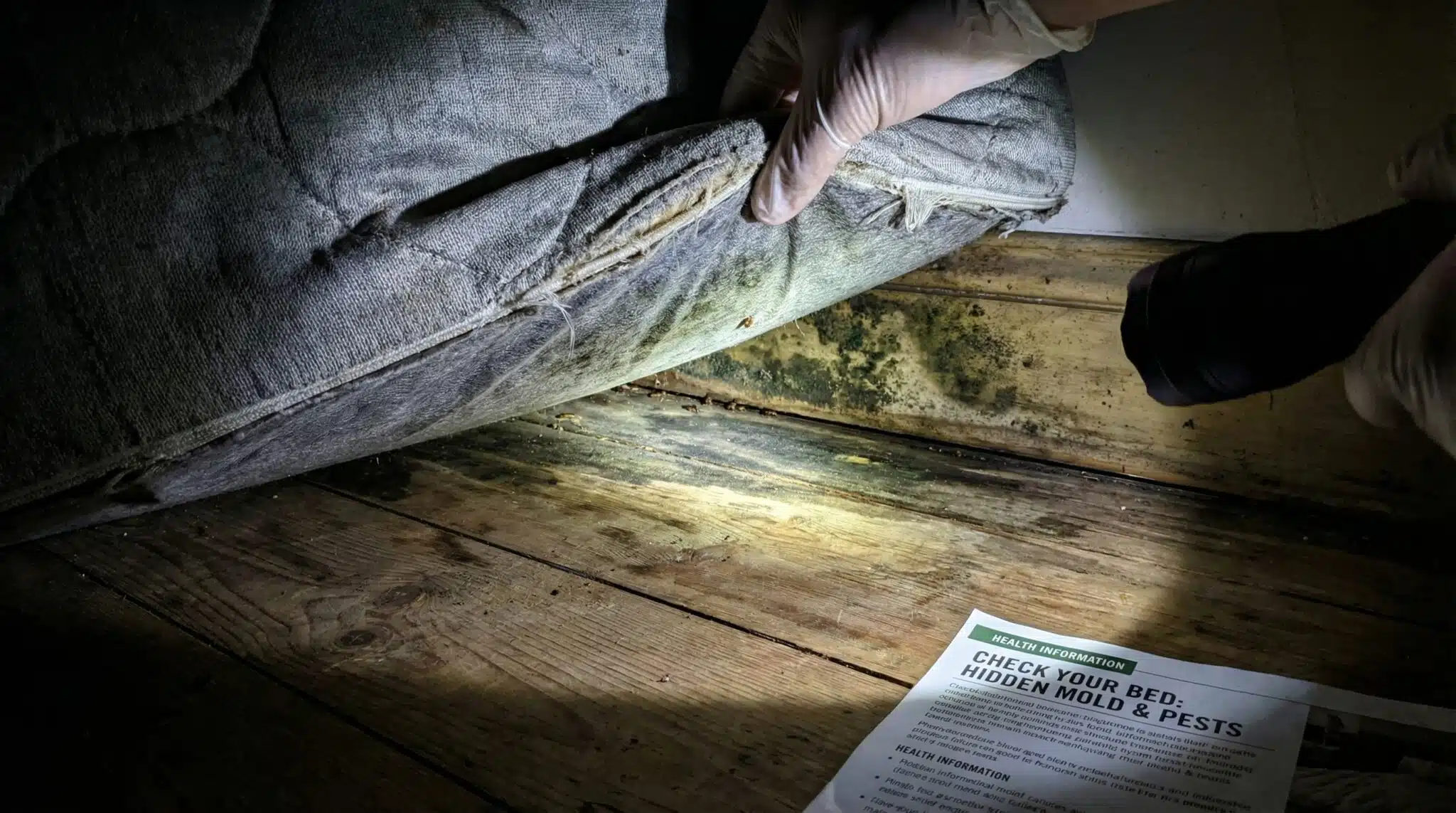
What’s Lurking Under Your Floor Mattress? (Spoiler: Moisture. It’s Always Moisture.)
Sleeping on a mattress on the floor sounds simple, right? Minimalist. Cozy. Very “I have my life together.”
And then one day you go to rotate your mattress and you get hit with a smell that can only be described as “wet basement meets gym sock.” Not ideal. Not restful. Not the vibe.
Here’s the deal: floor sleeping itself isn’t automatically gross or dangerous. The problem is what happens when a warm, squishy mattress sits on a surface that can’t breathe. That underside turns into a dark little cave where moisture hangs out… and mold is like, “Oh hi, I live here now.”
Let’s make sure nothing is throwing a tiny fungus rave under your bed tonight.
The 60 Second “Do I Need to Panic?” Check
Go do this now. Yes, now. I’ll wait. (Kidding. But seriously.)
- Sniff test: When you lift the edge of the mattress, do you smell musty/earthy/old towel-ish?
- That’s your warning light.
- Underside hand test: Lift one corner and run your hand along the bottom fabric.
- Dry? You’re fine. Keep reading for prevention.
- Cool or slightly damp? Prop it up ASAP and get air moving.
- Wet? Stop sleeping on it until it’s fully dry. Mold can get a foothold fast.
- If you see actual mold (spots, fuzz, “why is it freckled?”): skip to the “Moisture Strikes” section below. If stains keep coming back, replacement may be the safer call.
- If you suspect bed bugs (bites, little black dots, shed skins): don’t drag the mattress through your house like a horror movie mistake. Isolate it, consider an encasement, and call a pro.
Also: spend the $15-$30 on a little hygrometer (humidity reader). Put it near mattress height. It’s boring, but it’s also the difference between “totally fine” and “why is my bedroom a terrarium?”
Why Floor Mattresses Get Moldy (Even If You’re Clean)
Mold needs three things: moisture, darkness, and time.
A floor mattress gives it:
- Darkness underneath (cute and cave like)
- Warmth from your body
- Moisture… because humans are basically leaky heat sources at night
You can sweat a surprising amount while sleeping. That moisture travels down into the mattress. If the bottom is pressed against carpet or a cold slab of concrete with zero airflow, the moisture just… stays. And when moisture stays, mold shows up like an uninvited cousin who “just needs to crash for a week.”
The Humidity Numbers I Want You to Know (No Math Anxiety)
If you only take one nerdy fact from this post, make it this:
- Under 45%: lovely, mold hates it
- 45-50%: still good
- 50-60%: caution zone your mattress needs airflow and you need to pay attention
- Over 60%: high risk floor sleeping starts to feel like a part time job you didn’t apply for
If your bedroom hangs out above 60% a lot (hello, humid climates and basements), you’ll likely need a dehumidifier and a better setup than “mattress plopped on the floor.”
Early Warning Signs (Because By the Time You See Spots, It’s Already Rude)
Visible mold is late stage. Here’s the earlier stuff:
- Musty smell when you lift the mattress = moisture is building
- Damp underside = you need a full dry out day
- Yellow/brown/gray staining = early growth or repeated moisture exposure
- Condensation on the floor around the edges = warm meets cold, and water is condensing like a sad science experiment
If you catch it early, you can usually fix the situation before it becomes a whole saga.
Your Floor Type Matters More Than You Think
Not all floors behave the same. Some are basically moisture sponges in a trench coat.
Higher risk surfaces
- Carpet: I’m sorry, but carpet + floor mattress is the messiest duo. It traps moisture, traps dust, traps everything.
- Unfinished concrete: can pull moisture from below and gets cold, which encourages condensation
- Worn hardwood: can absorb moisture and eventually get damaged (and then you’re dealing with a floor problem too fun!)
Lower risk surfaces
- Sealed concrete, tile, vinyl: more moisture resistant (still needs airflow, though)
- Sealed cork: warmer and naturally more mold resistant (a quiet overachiever)
If you’re on carpet right now and you’re having issues, I’d bet actual money that the carpet is a big part of it.
Mattress Type: Some “Breathe” and Some… Don’t
Quick and opinionated breakdown:
- Memory foam: comfy, yes. Also a moisture holding marshmallow. Higher risk on the floor because it doesn’t breathe well.
- Innerspring/hybrid: better airflow thanks to coils and internal space
- Latex: generally more resistant than foam, but it still needs a breathable layer underneath on sketchy floors
If you’ve got dense foam on the floor in a humid room, you’re basically playing moisture roulette.
“Okay But What About Bugs?” (Yes, Let’s Talk About the Floor Level Crowd)
Being closer to the floor can mean:
- More dust settling near you (dust mites love humidity + dust)
- Easier access for bed bugs (they don’t have to climb anything rude little freeloaders)
- The occasional carpet beetle/ant/spider situation (I am not here to emotionally support spiders, sorry)
A big help: keep clutter away from the mattress area. Clutter is like a pest hotel. Great amenities. Lots of hiding places. Zero stars, do not recommend.
High Risk Situations Where I’d Personally Get Off the Floor
Sometimes the answer isn’t “try harder.” Sometimes the answer is “change the setup.”
Floor sleeping gets much trickier if:
- You’re in a basement or ground floor room that runs cold/damp
- You live in a humid climate (hello Gulf Coast, Southeast, Pacific Northwest)
- You’re co-sleeping with an infant (milk/spit up/diaper leaks = moisture chaos)
In these cases, you’re not doomed but you’ll need better airflow underneath and probably a dehumidifier. Or, honestly, a simple low frame and call it a day.
The Non-Negotiables: How to Stop Moisture From Moving In
If you do nothing else, do these:
1) Don’t put the mattress directly on the floor
You need airflow under it. Even a small air gap helps, but 2-4 inches is much better.
2) Don’t put plastic sheeting under it
This is one of those “sounds smart, works horribly” ideas. Plastic can trap moisture between the floor and the mattress like a sad little swamp.
3) Use a protector that encases all six sides
Top only protectors are like wearing a raincoat but refusing to wear shoes. Moisture comes from above (sweat/spills) and below (condensation).
4) Air it out regularly
Strip the bedding, prop the mattress up against a wall, and let it breathe for a few hours to gauge how often to air it.
- Humid areas: weekly (or more after rainy weeks)
- Drier areas: every couple weeks might be fine
Yes, it’s annoying. No, it doesn’t take that long. Think of it like brushing your teeth basic maintenance that prevents expensive drama.
When Moisture Strikes (What to Do Without Making It Worse)
If you spill something:
- Blot, don’t scrub. Scrubbing pushes liquid deeper.
- Dry it fast: fans, airflow, dehumidifier if you have one.
If the underside feels damp:
- Prop it up for a full day in the driest conditions you can manage.
- Don’t remake the bed until it’s truly dry. Sheets trap moisture like a warm little blanket of bad decisions.
Also: if you regularly go to bed with wet hair and your mattress is on the floor… please don’t. It’s like watering the underside of your bed one nap at a time. (Ask me how I know. I won’t tell you, but I know.)
What Should Actually Go Under a Floor Mattress?
Here are the under mattress options I like, depending on your space and how committed you are to upkeep:
- Low slatted platform / low frame (4-6″ clearance): the easiest “set it and mostly forget it” upgrade
- Roll up slats: great for renters or temporary setups on hard floors
- Tatami mat: breathable, classic, easy to air out (but don’t treat it like it’s waterproof because it’s not)
- Coconut coir mat: breathable and sturdy, good in higher humidity (still needs airing)
- 3D mesh/vented underlay: helpful when you’re close to safe humidity but need extra airflow insurance
Pick the one you’ll actually maintain. The “best” option is the one you won’t abandon after two weeks.
Signs You Should Just Use a Bed Frame Instead (No Shame, Only Sleep)
If any of these are true, I’d seriously consider getting the mattress off the floor:
- Your humidity stays above 60% even with effort
- Your basement/room shows condensation or water staining
- Your home already has mold issues elsewhere
- You have dust mite allergies or breathing problems
- You know deep in your soul you will not keep up with airing it out
That last one is the big one. A floor mattress setup can work, but it’s not “set it down and never think about it again.” If you want low maintenance, a simple frame wins.
Quick Cost Reality Check (Because This Isn’t Always Cheaper)
Once you add:
- a breathable barrier,
- a full encasement protector,
- a hygrometer,
- and possibly a dehumidifier…
…you’re often in the same ballpark as buying a basic bed frame anyway. The real difference isn’t money it’s maintenance.
And I would rather you spend $200 on a frame than $800 replacing a mattress you accidentally turned into a science project.
Bottom Line: The “Safe Floor Mattress” Checklist
If you want to sleep on the floor without secretly growing a new ecosystem, you need three things:
- Airflow under the mattress (no direct on floor setup)
- Humidity under control (ideally under 50%, definitely not living above 60%)
- A regular airing routine (because moisture doesn’t care that you’re busy)
Do the underside check tonight. If it’s even a little damp, prop it up and get air moving. And please get the $20 hygrometer. It’s the least glamorous home item you’ll ever buy, and it will save you the most grief.