
I used to think arranging my bed according to Feng Shui meant following some universal “best direction” rule. Turns out, your ideal sleeping position is completely personal, based on your birth year and something called a Kua number.
This feng shui bed direction chart breaks down exactly which feng shui directions support your energy and which ones don’t.
But here’s what most guides won’t tell you: compass alignment doesn’t matter if your bed is in a terrible position.
I’m walking you through the actual hierarchy, commanding position first, then your favorable directions, then how to adapt when your bedroom layout won’t cooperate.
What Bed Direction Means in Feng Shui
When you look up “bed direction,” you’re trying to figure out which way your head should point while you sleep, not which wall to put your bed against or which way your feet face.
If you’ve been confused about this, you’re not alone. Here’s what’s actually being measured:
Your bed direction: the compass direction your head points toward (North, South, East, etc.)
Your room’s facing direction: which way your bedroom door or windows face
These aren’t the same thing. Your bedroom might face East, but you could position your bed so your head points South.
When you’re calculating your ideal sleeping direction, you’re finding where your headboard should point, your room’s orientation doesn’t change that.
If you’ve been mixing these up, don’t worry. Most Feng Shui advice does too.
Check If Your Bed Is in a Good Basic Position
Before you pull out a compass, make sure your bed placement makes sense. Even if you align your bed perfectly with your ideal direction, you won’t sleep well if the position feels wrong.
What You Need: The Commanding Position
Stand in your bedroom and check if your bed:
- Lets you see the door while lying down (but doesn’t sit directly in line with it)
- Has a solid wall behind the headboard
- Isn’t under a window or floating in the middle of the room
Why you should care about this more than compass degrees: If your bed faces your “lucky” direction but sits under a window where you feel exposed, or in a spot where you can’t see the door, you’ll never fully relax.
Your nervous system overrides any compass benefit. If your room layout forces you to choose between a commanding position and your favorable direction, pick the commanding position.
You can always adjust the energy with other Feng Shui tweaks, but you can’t fix feeling unsafe while you sleep.
How to Find Your Kua Number
You can’t just Google “best sleeping direction” and use whatever comes up. Your ideal direction depends on your Kua number, a personal calculation based on your birth year and gender.
Once you know your Kua number (it’s between 1-9, skipping 5), you’ll fall into one of two groups:
- East Group (Kua 1, 3, 4, 9): Your favorable directions are East, Southeast, North, South
- West Group (Kua 2, 6, 7, 8): Your favorable directions are West, Northwest, Southwest, Northeast
How to Find Your Kua Number
You can calculate it yourself, but the easiest way is to use an online Kua calculator [link]. You’ll need your birth year and gender.
To give you an idea of how it works, here are a few examples:
| Birth Year | Male Kua | Female Kua |
|---|---|---|
| 1990 | 1 (East) | (5)8 (West) |
| 1985 | 6 (West) | 9 (East) |
| 1992 | 8 (West) | 7 (West) |
Use the full calculator [here] to find yours accurately.
What If You and Your Partner Have Different Kua Numbers?
This happens all the time. If you’re both sleeping in the same bed but have different ideal directions, here’s what you can do:
- Prioritize whoever spends more time in bed or has health concerns
- Rotate your bed direction seasonally
- Choose a neutral direction, not perfect for either of you, but not unfavorable either
You’re not looking for perfection. You’re looking for what works in your actual bedroom with your actual life.
Real Bedroom Layouts: How to Apply Your Feng Shui Direction
Most bedrooms have windows, doors, or closets blocking ideal walls. Here’s how to position your bed when layout constraints limit your directional options.
1. Window Blocks Your Best Wall
When your most favorable wall has a window, you need to adjust bed placement while maintaining feng shui principles and structural support.
East Group (Kua 1, 3, 4, 9):
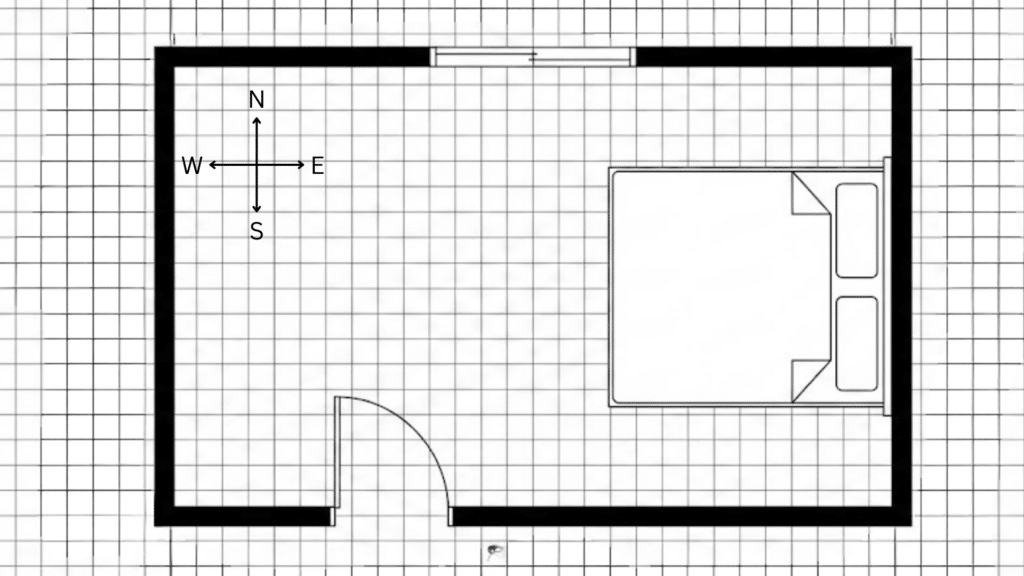
- North wall has window → shift bed to East wall instead
- Headboard faces East (still favorable)
- Maintains solid wall backing and door visibility
- Alternative favorable directions: South, Southeast
West Group (Kua 2, 6, 7, 8):
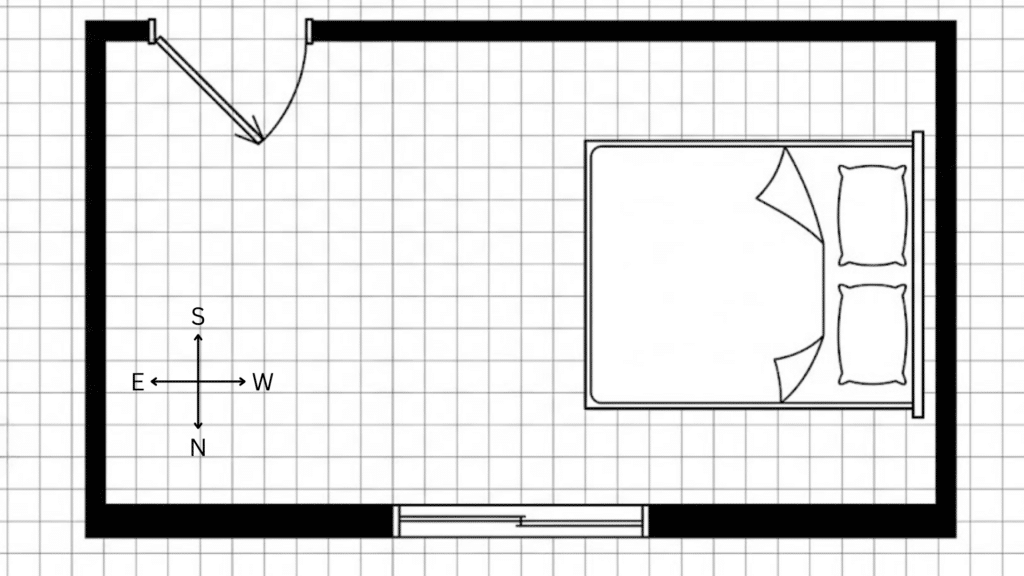
- North wall has window → not favorable anyway for West Group
- Position bed on West wall (ideal direction)
- Solid wall achieved, commanding position maintained
- Alternative favorable directions: Northwest, Southwest, Northeast
2. Door Blocks Your Ideal Direction
When the door placement conflicts with your favorable direction, strategic positioning and visual buffers maintain both function and energy flow.
East Group (Kua 1, 3, 4, 9):
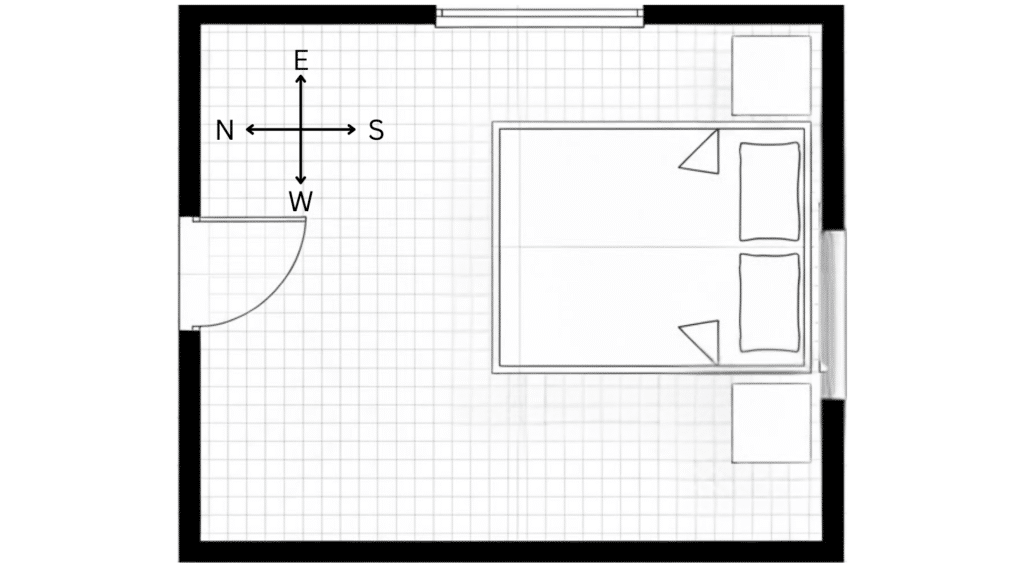
- Door on North wall eliminates that option
- Position bed on South wall (headboard facing South, still favorable)
- Angle bed slightly to avoid direct door alignment
- Use nightstands as visual buffer
West Group (Kua 2, 6, 7, 8):
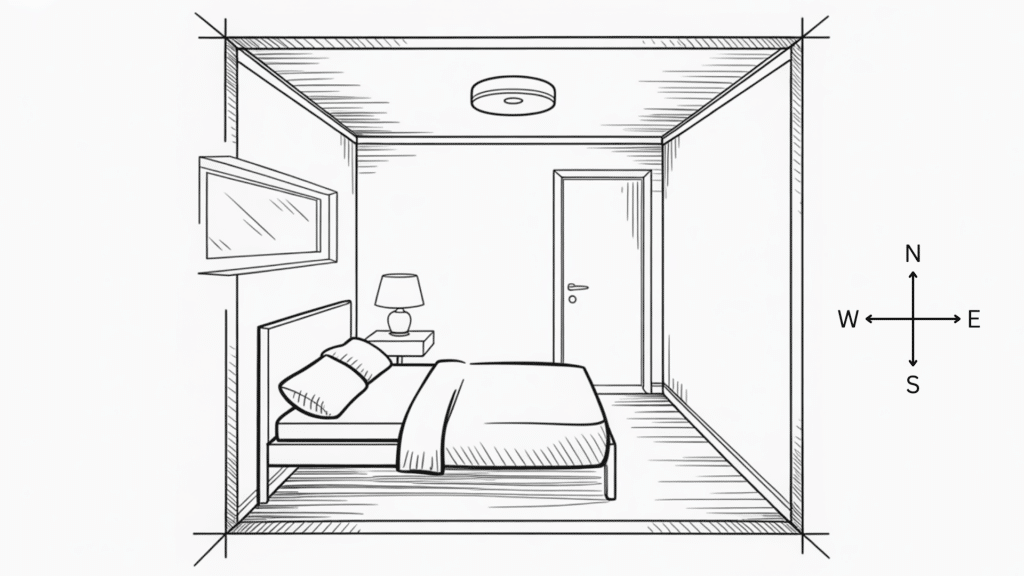
- Door on North wall (North unfavorable anyway)
- Position bed facing Southwest in corner placement
- Maximizes solid wall contact, avoids door line
- Maintains full view of entrance
3. Narrow Room with Limited Wall Options
Narrow rooms limit headboard placement options, forcing you to prioritize commanding position and structural support over directional preferences when necessary.
East Group (Kua 1, 3, 4, 9):
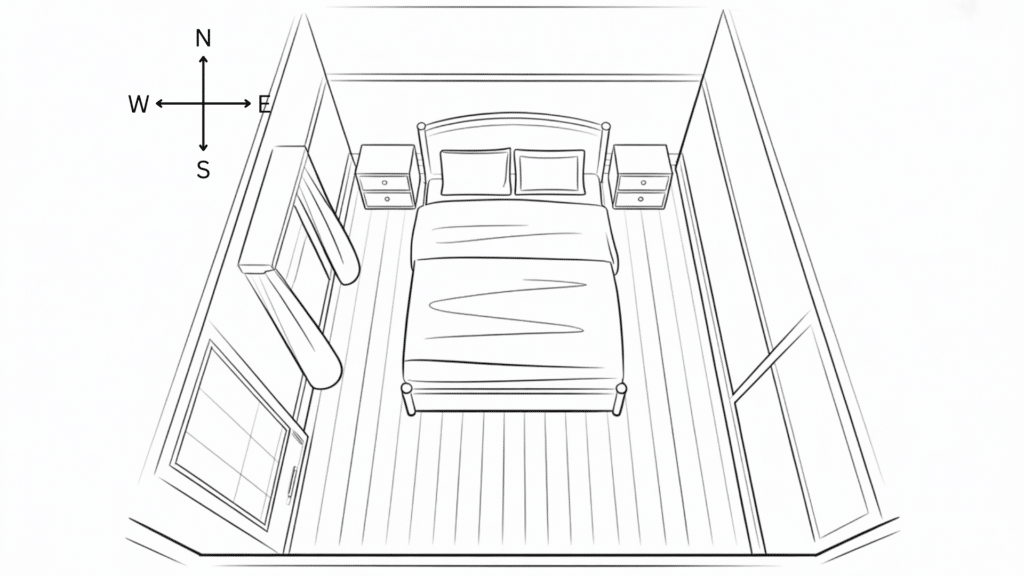
- Only two headboard walls available: North or South
- Choose North (favorable direction)
- Compact nightstands accommodate narrow space
- Full commanding position despite room constraints
West Group (Kua 2, 6, 7, 8):
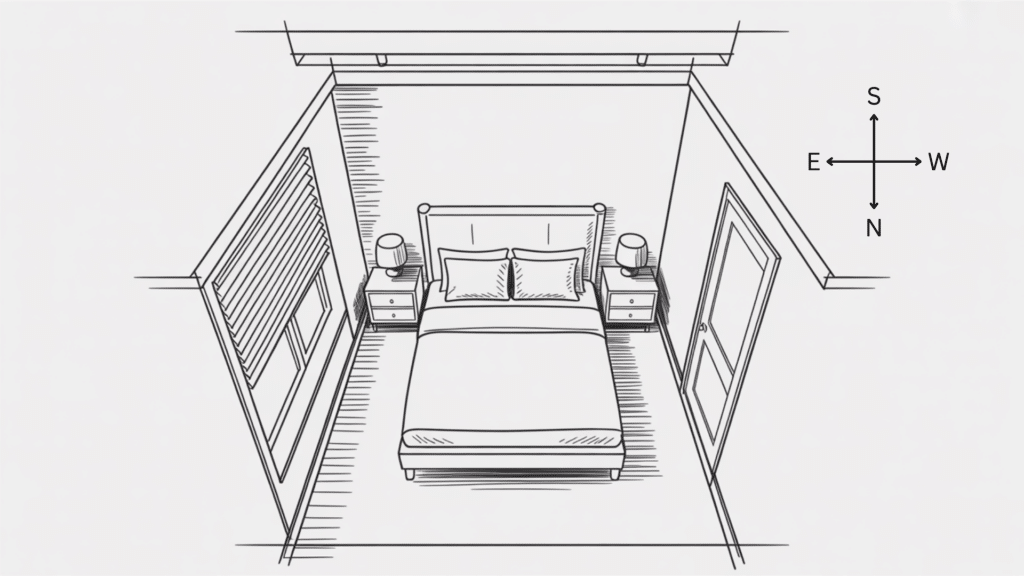
- Only North or South walls available, both unfavorable
- Choose South for better commanding position and door view
- Compensate with tall solid headboard, symmetrical nightstands, balanced lighting
- Function overrides directional perfection when no favorable options exist
Common Bedroom Direction Mistakes
Getting your compass direction right doesn’t matter if your bed placement violates basic Feng Shui principles. Avoid these layout errors first.
Mistake 1: Bed Directly Facing the Door
- Your feet shouldn’t point straight out the door (“coffin position”)
- Creates subconscious exposure and disrupts rest
- Fix: Angle bed slightly, add footboard buffer, or reposition to see door without direct alignment
Mistake 2: Prioritizing “Lucky Direction” Over Function
- If your ideal direction blocks closets, vents, or nightstands, it’s not ideal
- Can’t crawl over your partner daily for Feng Shui
- Fix: Choose the favorable direction that works with real furniture and movement
Mistake 3: Ignoring Commanding Position
- Perfect compass alignment without door visibility fails
- You need to see the entrance while lying down
- Fix: Always see the door, break direction rules if necessary
Commanding position and solid backing trump compass direction. Get the fundamentals right before worrying about degrees.
Feng Shui Bed Direction Checklist
Use this to audit your bedroom setup. You don’t need to check every box, but the more you hit, the better your space works.
Bed Position
You can see the bedroom door from your bed
Your bed isn’t directly in line with the door
Solid wall behind your headboard (not a window)
Bed isn’t under a window
Bed Direction
You’ve calculated your Kua number
You know which group you’re in (East or West)
You’ve measured your current bed direction with a compass
Your headboard points toward one of your four favorable directions (or the best available option)
If You’re Compromising
Commanding position is prioritized over ideal direction
You have a strong, tall headboard for stability
Nightstands and lighting create balance
The room feels comfortable and functional
Partnership
If sharing a bed, you’ve decided whose Kua to prioritize or found a neutral direction
The Bottom Line
I’ve given you the complete feng shui bed direction chart with all eight Kua numbers, showed you how to measure your current setup, and walked through three real bedroom layout problems most people actually face.
Feng shui directions aren’t about perfection but working within constraints. If your window blocks your best wall or door limits options, you still have three other favorable directions.
And when none of them work? You strengthen everything else: solid headboard, commanding position, visual balance.
Use the checklist to audit your space, reference the chart when you’re stuck, and remember that a functional bedroom beats a “perfectly aligned” uncomfortable one.
Drop a comment if your layout throws you a curveball I didn’t cover.