
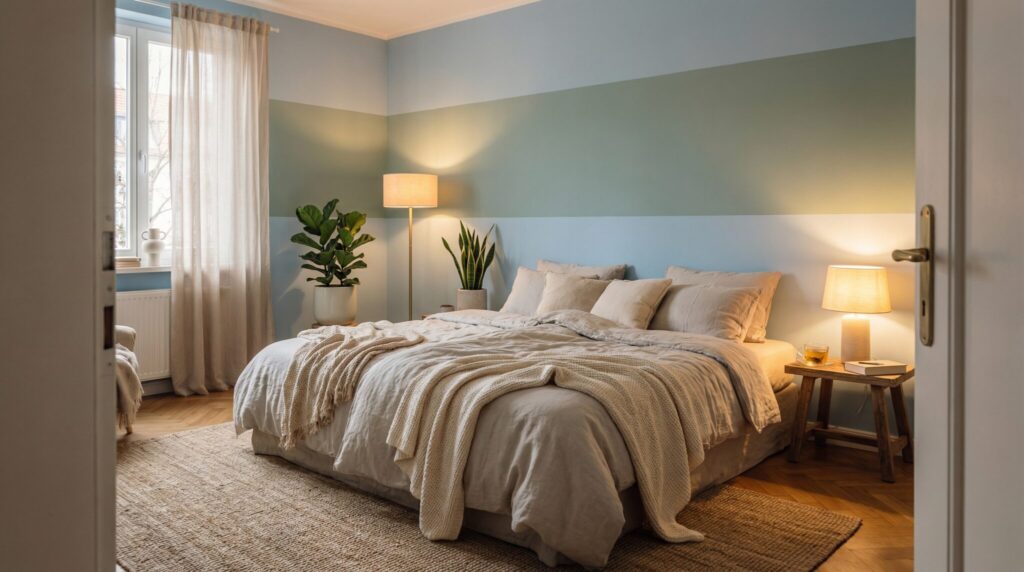
Why Your Bedroom Color Might Be Ruining Sleep (and How to Fix It Without Losing Your Mind)
Let me start with the most annoying truth: you can do everything “right” for sleep magnesium, sleepy tea, lavender spray you found at Target in a moment of optimism and still lie there staring at the ceiling like it personally offended you.
Sometimes the problem isn’t you. Sometimes it’s your bedroom screaming “WAKE UP AND SOLVE TAXES!” through… paint color and lighting.
There’s a study floating around where blue bedrooms averaged close to eight hours of sleep a night (and purple rooms were way, way worse). Do I think paint is magic? No. Do I think your walls and bulbs can absolutely mess with your brain after dark? Oh yes. Ask me how I know. (I once had a “cozy” bedroom that somehow felt like an airport bathroom at 10pm. Spoiler: it was the lighting. I was basically trying to sleep inside a refrigerator display case.)
So let’s fix your room’s vibe quickly, cheaply, and without pretending you’re going to become a minimalist who never leaves a water glass on the nightstand.
First: Your Walls Aren’t Just “Color.” They’re a Nervous System Setting.
Your brain reacts to color faster than your logical thoughts can catch up. Cool colors (blue, green) tend to nudge your body toward “rest and digest.” Warm colors (red, orange) are like a tiny internal espresso shot.
But here’s the part people miss (and I say this lovingly): it’s not just the color family it’s the intensity.
A soft, dusty yellow can feel calmer than a bright electric blue. And neon anything? Neon is for signs that say “OPEN 24 HOURS,” not for the place you’re trying to drool peacefully onto your pillow.
If you remember nothing else: muted = calmer. saturated = your eyeballs doing jumping jacks.
And before you repaint anything… we need to talk about the real villain.
The #1 Sleep Wrecking Mistake: Your Light Bulbs Are Betraying You
You can paint your room “Serene Whispering Cloud” (or whatever paint names are doing these days) and still feel wired if your bulbs are blasting cool, blue-ish light at night.
Here’s the quick fix that makes a shockingly big difference:
- Swap your bedroom bulbs to 2700K “soft white.”
Not daylight. Not cool white. Not “clinic chic.” Soft white. If your bulb says 5000K, it’s basically yelling at your melatonin. - Do it in every fixture you actually use.
Overhead, bedside lamp, reading light anything that’s on after dinner. - Start warming/dimming the room about 60-90 minutes before bed.
Don’t go from full stadium lighting to total darkness like you’re in a power outage. Ease into it. Your body likes a slow off ramp.
Honestly? Do this tonight and see how your room feels. Lighting is the cheapest glow up with the biggest payoff.
The Best Bedroom Colors for Sleep (My Non-Scientific, Been There Opinion)
1) Blue: The Classic “Please Let Me Sleep” Color
Blue tends to perform best in sleep studies, and I get why. The right blue feels like your room put on a cozy hoodie.
Pick blues that look like:
- foggy morning
- soft denim
- watery, gray-ish aqua
Avoid blues that look like:
- pool liner
- primary blue crayon
- deep navy cave (unless you truly love moody more on that below)
If you’re standing in the paint aisle, squinting and whispering “is this too bright?”… it’s too bright.
2) Green: The MVP for Bedrooms That Do More Than Sleep
If your bedroom is also your “I answer emails in bed and regret it” space, green is a great compromise. It’s calming, but it doesn’t make you feel like you’re sinking into a nap at 2pm.
Think sage, soft mint, gray green.
Skip anything that reads like a school hallway or a hospital scrub. (You’ll know.)
3) Soft Neutrals: The Reliable Friend Who Shows Up On Time
If bold color stresses you out or your bedroom is tiny go neutral.
I’m talking warm off whites, creamy beige, soft taupe, warm gray. These reduce visual “noise,” which is basically your brain’s version of too many browser tabs.
One warning: avoid bright, stark white. It can feel clinical and it bounces light everywhere. Cozy is the goal, not “I’m here for my 8am appointment.”
4) Pink + Lavender: Cute, But Only if You Keep Them Whisper Soft
Dusty pink can feel soothing (especially if you’re wound tight all the time), and pale lavender can be surprisingly calm.
But if you go full bubblegum or “royal purple drama llama,” your room starts feeling… active. Like it wants to have a conversation. At midnight.
Colors I’d Think Twice About (Yes, Even if You Love Them)
- Red / Orange / Bright Yellow: energizing. Sometimes fun for a gym wall. Not for a bedroom unless you want your heart rate to participate in bedtime.
- Very saturated purple: it can feel mentally stimulating in a weird “thinking thoughts” way. Pale lavender? Fine. Grape soda? No.
- Super dark walls: can be gorgeous, but they’re high stakes. If your lighting is bad, dark walls go from “moody boutique hotel” to “why am I sleeping in a cave?”
If you do want a dark color, just promise me you’ll balance it with warm lighting and lighter bedding so it looks intentional not like you gave up halfway through a design crisis.
The Paint Trick That Saves You From Regret: Test It Like a Normal Person (Not a Paint Influencer)
Please don’t paint an entire room because a tiny chip looked cute under fluorescent store lights. That’s how people end up repainting on Sunday night in rage.
Do this instead:
- Grab 2-3 sample pots.
- Paint big swatches on poster board or foam board (so you can move them around).
- Check them:
- by the window
- in the darkest corner
- next to your bedside lamp
- Live with them for 2-3 days. Morning, afternoon, night.
If you’re annoyed by the color by day three, imagine living with it for five years.
Can’t Paint? Totally Fine. You Can Still “Color Hack” Your Sleep Space.
If you rent, you’re broke, you’re tired, or you simply don’t want to start a project that ends with you whisper crying into painter’s tape build an everyday room style use textiles.
Your bed takes up a huge chunk of what you see. So:
- choose blue/green bedding (or a soft neutral set)
- keep the rest simple
- add one or two accents if you want, but don’t turn it into a pillow circus
And if you want green without committing to green walls: add a plant.
Pothos, snake plant, ZZ plant aka the holy trinity of “I’m alive-ish even if you forget I exist.”
Real Talk: What Color Can’t Fix
Color helps… but it’s not a sleep miracle.
A decent chunk of people report better sleep after changing their bedroom color, but plenty don’t. Because if you’re scrolling your phone in a room lit like a Costco warehouse, paint can only do so much.
A few basics that matter a lot:
- keep the room cool (most people sleep best around 60-67°F)
- reduce screens before bed (I know, I know)
- minimize visual clutter
(If you can see a pile of stuff from bed, your brain starts inventorying it like, “Should we deal with that tomorrow? What about now? How about now??”)
If You’re on a Budget, Here’s the Order I’d Do This In
1) Lighting first.
Cheapest, fastest, immediate improvement.
2) Bedding second.
Big visual impact without committing to paint.
3) Paint last.
Worth it, but only after your lighting is right or you’ll repaint and still feel “off” at night.
If you want the simplest “do this tonight” version: swap to 2700K bulbs, dim the lights earlier, and follow a few cool room design ideas and make your bed look like it belongs in a calm spa instead of a chaotic dorm room. Then, if your walls are still giving “I can’t relax here,” we’ll talk paint.
And if you tell me you’re currently sleeping in a bright red room with daylight bulbs… I’m not judging you. I’m just gently confiscating your light switches.