
Candles for Coziness: Best Scents, Placement Tips, and Safety Rules (Plus How to Burn Cleaner)
Candles are supposed to make your house feel like a cozy little sanctuary not like you’re auditioning for a “why is the air spicy?” science fair project.
And yes, I’m about to be that person: some candles (especially the cheap, pretty ones that smell like “Mountain Sunrise Linen Cupcake” or whatever) can smoke, throw off soot, and irritate sensitive lungs usually because of how they’re made and how they’re burned, not because you did something morally wrong. The good news: you don’t need to become a candle chemist. You just need to know what to buy, where to put it, and how to stop it from acting up.
The short answer: For maximum coziness with minimal mess, choose a reputable candle (ideally 100% soy or beeswax), keep the wick trimmed (~1/4 inch), give it space (about 12 inches from anything flammable), and never leave it unattended [NFPA Candle Safety. National Candle Association Safety].
Key exception: If you have asthma/allergies/migraines or pets/kids who treat coffee tables like parkour consider unscented candles, candle warmers, or LED candles instead.
When it matters less: If you burn candles occasionally for short periods in a ventilated room and follow basic safety rules, you can relax about “perfect” wax types and focus on placement and wick care.
Table of Contents
- Start With What It’s Made Of (Not the Label Font)
- Pick a Scent Like You’re Picking a Mood
- Candle Placement: Cute, Yes. Flammable, No.
- The “Annoying but Makes Everything Better” Candle Care
- If You Want Cozy Without Fire, I Support You
- Frequently Asked Questions
Candle Safety Checklist (the non-negotiables)
- Never leave a burning candle unattended extinguish it before you leave the room or the house [NFPA Candle Safety].
- Keep about 12 inches (30 cm) of clearance from anything that can burn (curtains, books, bedding, décor) [NFPA Candle Safety].
- Place on a stable, heat safe surface (trim wobble = trim drama).
- Keep away from drafts (fans, vents, open windows) to reduce flicker and smoking [National Candle Association Safety].
- Trim the wick to ~1/4 inch before each burn to help reduce soot and “mushrooming” [National Candle Association Safety].
- Don’t burn for more than ~4 hours at a time (let it cool before relighting) [National Candle Association Safety].
- Keep candles out of reach of kids and pets. Consider flameless options if knock overs are likely [NFPA Candle Safety].
- Bonus adulting: make sure you have working smoke alarms [NFPA Home Smoke Alarms].
1) Start With What It’s Made Of (Not the Label Font)
I get it. You see a gorgeous jar, a moody label, maybe a little gold foil moment… and suddenly you’re ready to hand over $32 like you’re supporting the arts. But the wax and the wick matter more than the branding. (Painful, I know.)
Wax that’s worth your money
A quick reality check: any candle can produce some soot/particles if it’s burning inefficiently (too long wick, drafts, not enough oxygen), and indoor particle pollution is a real thing in general not just a Candle Discourse™ thing [EPA PM Basics]. Wax type can matter, but burn conditions matter a lot.
- Beeswax: The fancy pants option. It tends to burn longer and, in many setups, produces less visible soot though results still depend on wick type, fragrance load, and airflow [National Candle Association Safety]. It’s also pricier because bees didn’t exactly open a factory and start mass producing for us.
- 100% soy wax: My everyday pick. Many people find it burns with less visible soot than some paraffin candles, but “clean” varies by brand and how you burn it [EPA PM Basics]. Also: don’t get tricked by the word blend “soy blend” can mean “soy… and also a bunch of other stuff.” If you want soy, look for 100% soy.
- Paraffin: This is the one I personally avoid when I can. Not because it’s automatically evil, but because some paraffin candles are more prone to visible soot when the wick is oversized, untrimmed, or in a draft. If you’re going to use it anyway, ventilate and don’t burn it for hours like it’s a space heater [EPA PM Basics. National Candle Association Safety].
Quick wick reality check
Look for cotton or wood wicks from reputable makers. And if you ever see a metal core wick, it should clearly state it’s zinc or tin. Lead core wicks are not recommended, and U.S. industry guidance has moved away from them for years [CPSC Lead in Candle Wicks. National Candle Association Safety].
My personal rule: if the candle is giving “mystery wick” energy, I put it back. I don’t need suspense in my home fragrance journey.
Quick comparison table (so you can shop faster)
| Option | What it’s like | Evidence on “clean burning” | Best for | Watch out for |
|---|---|---|---|---|
| Beeswax | Slow, warm burn | Mixed/depends on burn conditions [EPA PM Basics] | Long burns, low maintenance vibes | Higher cost. Scent is naturally “honey-ish” |
| 100% soy | Smooth, cozy, popular | Mixed/depends on brand + wick + airflow [EPA PM Basics] | Everyday use, good scent throw | “Soy blend” can be mostly not soy |
| Paraffin | Strong scent, widely used | Mixed. Can soot more if wick is too large/drafts [EPA PM Basics] | Strong fragrance lovers | More visible soot if burned poorly |
| Cotton/wood wick | Common wick types | Wick trim + draft control matter most [National Candle Association Safety] | Most households | Wood wicks can crackle, can run hot if oversized |
2) Pick a Scent Like You’re Picking a Mood
The right candle can make you feel like you have your whole life together… even if there’s a laundry pile in the corner that’s been promoted to “permanent furniture.”
Here’s a cheat sheet:
- Relax / cozy: vanilla, amber, sandalwood, cedar
- Focus / “I swear I’m productive”: lemon, peppermint, rosemary
- Sleepy time: lavender, chamomile
- Nostalgia / fall feelings: cinnamon, clove
One thing people miss: after a bit, you can go “nose blind” and think the candle isn’t working anymore. It often is your brain just adjusts.
Also: please don’t light three different scents in one room unless you’re trying to recreate the perfume aisle at a department store. One room, one vibe.
If you’re sensitive (asthma/allergies/migraines): consider unscented candles, lower fragrance options, or a candle warmer so you can control intensity. If any scent triggers wheezing, coughing, headaches, or nausea, that’s your sign to switch tactics (cozy shouldn’t come with symptoms) [EPA PM Basics].
3) Candle Placement: Cute, Yes. Flammable, No.
This is where candles go from “Pinterest” to “please don’t call the fire department.” The baseline rule is about 12 inches of clearance from anything that can burn curtains, books, throw blankets, that decorative stack of magazines you swear you’re going to read [NFPA Candle Safety].
Also: stable, heat safe surface only. No wobbly shelves. No “it’ll probably be fine” ledges.
Living room
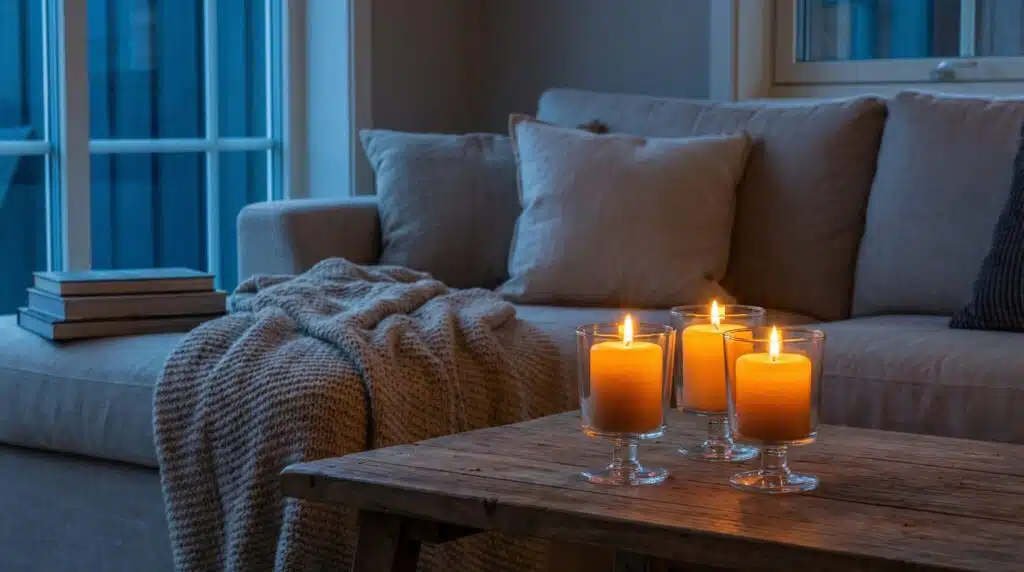
Coffee tables, sideboards, mantels great. I love grouping candles in odd numbers (three is the classic) and mixing heights so it looks intentional instead of “I dropped these here while carrying groceries.” A tray helps corral them and looks polished.
Cozy placement recipe (easy win):
- Small living room: 1 medium jar candle on a tray + 1 small accent candle (keep both away from throw blankets)
- Larger living room: 1 “statement” candle + 2 smaller ones spaced out (don’t cluster them under shelves or low décor)
Avoid: placing candles under low mantels/shelves or near HVAC returns moving air can cause flicker and smoking [National Candle Association Safety].
Kitchen
The kitchen already smells like something. Sometimes it’s garlic. Sometimes it’s last night’s fish. Sometimes it’s “why does the fridge smell like that?” So I like fresh, clean scents here citrus, herbs after you cook, not next to the stove while you cook. Heat + flame + grease-y air is not the vibe.
Lighting a candle after dinner is my little signal that the kitchen is closed. Like turning the sign to “sorry, we’re done serving chaos.”
Bedroom (aka: the danger zone for sleepy people)
You can absolutely do candles in the bedroom just keep it a foot away from bedding and drapes, and extinguish it before you get into bed (not “before you fall asleep,” before you get into bed) [NFPA Candle Safety]. If you want the vibe and zero risk, this is prime territory for calming bedroom paint shades and a candle warmer or LED candle.
Bathroom
Bathrooms make scents feel louder because it’s a smaller space. One candle is plenty. Set it on a stable counter away from towels and robes, light it a few minutes before your bath/shower, and enjoy your five star hotel fantasy.
Kids + pets (because somebody is going to knock it over)
If you have kids, cats, dogs, or a roommate who gesticulates wildly while telling stories: treat open flames like a “special occasion” item. Put candles out of reach, use a deep holder, and strongly consider LED candles or warmers for daily ambiance [NFPA Candle Safety]. (Also: birds can be especially sensitive to airborne irritants flameless is often the safer call.)
4) The “Annoying but Makes Everything Better” Candle Care
This part is like flossing. Nobody wants to do it. Everyone’s glad when they do. And it saves you money because candles are not exactly a budget hobby anymore.
Get an even melt pool (aka: don’t let it tunnel)
Wax has memory. Dramatic, yes. Real enough, also yes.
The first time you burn a candle, let it stay lit until the melted wax reaches the edges of the jar often about 2-4 hours, depending on size [National Candle Association Safety]. If you blow it out too soon, you can get tunneling (a sad hole down the middle) and waste a bunch of wax on the sides.
If tunneling happens: the foil “hat” trick can help by reflecting heat inward, but do it safely:
- Keep foil clear of the flame
- Stay with the candle the entire time
- Stop if the flame gets unusually high or the jar overheats
(If it’s consistently misbehaving, it may be an oversized wick or a poorly made candle don’t fight it forever.)
Trim the wick. Always.
If you do only one “responsible adult” thing today, let it be this:
- Trim the wick to about 1/4 inch before relighting [National Candle Association Safety].
- Keep candles away from drafts (open windows, fans, vents) [National Candle Association Safety].
Long wick = bigger flame = more soot. Drafts = flickering flame = smoky jar and uneven burn. Two tiny changes, huge difference.
Also worth doing: if you see wick trimmings, matches, or debris in the wax, remove them before lighting (they can act like extra fuel) [NFPA Candle Safety].
Know when to stop (in one session and forever)
- Try not to burn longer than ~4 hours at a time. Let the wax cool before relighting [National Candle Association Safety].
- Stop when about 1/2 inch of wax is left. Burning to the bitter end can overheat the container [National Candle Association Safety].
If you hate the smoky “blow out” moment, use a snuffer. Wick dipping can work too, but do it carefully hot wax can splash, and it’s not a great “multi-tasking” technique.
Quick troubleshooting (because soot happens)
| Problem | Likely cause | Fix |
|---|---|---|
| Black soot on jar/walls | Wick too long, draft, oversized wick, dirty wax pool | Trim to ~1/4 inch, move away from vents, remove debris, stop using if it keeps smoking [National Candle Association Safety] |
| Candle is smoking a lot | Draft or wick “mushrooming” | Extinguish, trim, relocate, don’t keep burning through heavy smoke [NFPA Candle Safety] |
| Tunneling | Short first burn | Longer first burn, try foil “hat” while supervised |
| Weak scent | Nose blindness or wrong room size | Step out and return, try a stronger candle for large spaces, use a warmer for steady throw |
| Flickering flame | Drafts/airflow | Move away from fans/vents/open windows [National Candle Association Safety] |
| Jar cracks or feels dangerously hot | Overheating, burning too long, damaged container | Extinguish, don’t relight, discard safely |
5) If You Want Cozy Without Fire, I Support You
Sometimes a real flame just isn’t realistic pets, kids, roommates who “forget,” or, you know… you.
- LED candles: The good ones now look shockingly real. Get the kind with a wax shell and a moving flame effect.
- Candle warmers: These melt wax from the top down and give you scent without an open flame. Many people also find the scent throw steadier.
Cozy should not come with anxiety. Period.
My candle philosophy in one sentence: buy better made candles when you can, keep the wick trimmed, don’t place it like you’re trying to tempt fate, and stop burning it before it turns into a smoky little menace.
Now go light something lovely and may your air (and your walls) stay fresh and un-blackened.
Frequently Asked Questions
Do “clean burning” candles actually make a difference for indoor air?
Sometimes. Any burning candle can create particulate matter (soot), and how cleanly it burns depends a lot on wick length, drafts, and how long you burn it not just wax type [EPA PM Basics. National Candle Association Safety]. If you’re sensitive, prioritize ventilation, wick care, and consider flameless options.
Are soy candles safer than paraffin candles?
Not automatically. Many people report less visible soot with soy, but “cleaner” varies by brand, wick, fragrance load, and burn conditions. If minimizing soot is the goal, trimming the wick and avoiding drafts often makes the biggest difference [National Candle Association Safety].
How long should I burn a candle the first time to prevent tunneling?
Often about 2-4 hours basically until the melt pool reaches the edges of the container [National Candle Association Safety]. Bigger candles can take longer. Don’t rush the first burn.
Where should I place candles for maximum coziness (and minimum risk)?
Aim for eye level surfaces (sideboard, coffee table) on a stable tray, with about 12 inches of clearance from anything flammable [NFPA Candle Safety]. For cozy lighting, pair candles with warm lamps/dimmers so the candle isn’t doing all the mood work by itself and borrow from ultimate comfort bedroom ideas.
Is it okay to burn candles in a bedroom?
Yes if you keep it well away from bedding and extinguish it before you get into bed [NFPA Candle Safety]. If you’re even slightly likely to doze off, switch to a warmer or LED candle.
What should I do if my candle is smoking or sooting a lot?
Put it out, let it cool, trim the wick to ~1/4 inch, and move it away from drafts [National Candle Association Safety]. If it still smokes heavily after that, it may be a poor wick/wax setup consider not using it indoors.
When should I seek help about symptoms or safety concerns?
Seek medical advice if candle use is followed by wheezing, chest tightness, persistent cough, severe headaches/migraines, or symptoms that don’t resolve after stopping exposure and ventilating. And for safety: if there’s an active fire or you can’t control it immediately, leave and call emergency services don’t try to “out aesthetic” a real hazard [NFPA Candle Safety].
Sources
- National Fire Protection Association (NFPA). “Candles.” https://www.nfpa.org/education-and-research/home-fire-safety/candles (safety guidance)
- National Fire Protection Association (NFPA). “Smoke Alarms.” https://www.nfpa.org/education-and-research/home-fire-safety/smoke-alarms (safety guidance)
- National Candle Association. “Candle Safety.” https://candles.org/fire-safety-candles/ (industry safety guidance)
- U.S. Consumer Product Safety Commission (CPSC). “CPSC Warns Consumers About Lead in Candle Wicks.” https://www.cpsc.gov/ (consumer safety notice/overview)
- U.S. Environmental Protection Agency (EPA). “Particulate Matter (PM) Basics.” https://www.epa.gov/pm-pollution/particulate-matter-pm-basics (overview)