Fruit at night feels like the saintly choice, right? Like, “Look at me, choosing produce instead of inhaling a sleeve of cookies over the sink.” Very wholesome. Very responsible.
And then your body is like, “Cool. I’d like to spend the next four hours burping orange flavored fire while you stare at the ceiling.”
Ask me how I know.
Here’s the thing: fruit isn’t “bad” before bed. Timing is the real drama queen. Move your snack earlier by about 30 minutes (sometimes more) and suddenly you’re sleeping like a normal person again instead of performing a one woman reenactment of The Nightly Reflux Olympics.
Let me walk you through the simple version—what to eat, when to eat it, and how to stop waking up at 2 a.m. mad at a grape.
The “Don’t Regret This Snack” Quick Rules
If you only read one section, make it this one (because your pillow is calling, I get it):
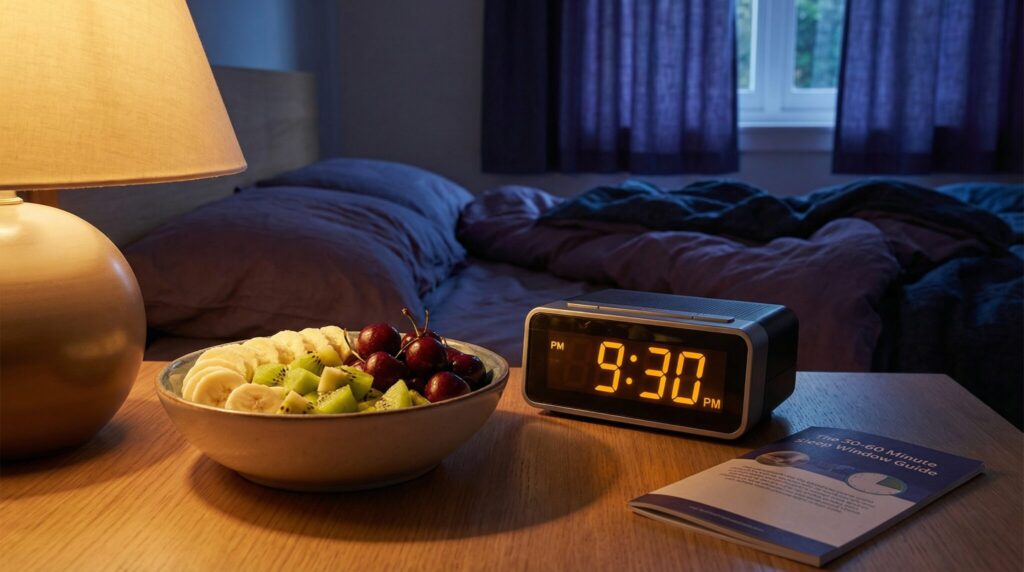
- Most fruit is fine 30-60 minutes before bed if it’s a small portion.
- Sleep friendlier picks: tart cherries, kiwi, banana, grapes.
- Fruits that need a curfew (aka more time): citrus, dried fruit, and super fibrous stuff (apples/pears/raspberries).
– Plan on 90+ minutes for citrus/high fiber.
– Plan on 2+ hours for dried fruit.
- Portion size changes everything. A few bites ≠ a full fruit salad “moment.”
- If you get heartburn, bloating, gurgling, or 2-3 a.m. wake ups, your snack is probably too late (or too big, or too acidic).
Consider this your late night fruit permission slip—with fine print.
The Best Fruits to Eat Before Bed (AKA the Chill Ones)
Not all fruit behaves the same at night. Some fruits are basically a cozy blanket. Others are that one friend who’s lovely… but always shows up at the worst possible time.
Tart cherries (the overachiever)
Tart cherries are one of the few foods that naturally contain melatonin (the hormone involved in your sleep wake cycle). If you want to test drive this, try:
- a small handful of frozen tart cherries, or
- a few ounces of tart cherry juice
about 30-60 minutes before bed.
Worth noting: sweet cherries (like Bing) don’t seem to have the same effect, so don’t come for me if your cherry bowl didn’t magically turn you into Sleeping Beauty.
Kiwi (tiny but mighty)
Kiwi is weirdly impressive. Some research has found that two kiwis about an hour before bed helped people fall asleep faster and stay asleep longer. It’s also generally low acid, which is a big win if your stomach tends to get spicy at night.
Banana (the reliable friend)
Bananas are gentle, easy, and not usually reflux-y. They’ve got magnesium and potassium (muscle relaxing vibes) and carbs that can support serotonin production. Translation: if you want the safest, simplest option, banana is usually it.
Grapes (sweet, easy, no big commitment)
Grapes are quick, snacky, and easy to portion (unless you’re me and you eat them like popcorn while “just watching one episode”). They also contain small amounts of melatonin and tend to be pretty low acid.
If you’re going to do fruit before bed regularly, I’d start with one of these and see how your body reacts.
The Fruits That Need a Bedtime Curfew
Some fruit is perfectly healthy… just not right before you lie down and turn horizontal like a beached whale who wants eight hours of peace.
Citrus (aka reflux roulette)
Oranges, grapefruit, lemon—delicious, refreshing, and acidic. Acid + lying down = increased chance of reflux, even if you “never get heartburn.”
If you want citrus like oranges near bedtime, aim for 90 minutes before bed (longer if you’re sensitive). Having it with a little protein can help some people, but honestly? I’d just move it earlier and spare yourself the midnight throat burn.
High fiber fruit (great… but busy)
Apples, pears, raspberries—these are fiber heroes. Fiber is fantastic for daytime digestion. At night, it can mean your gut is still throwing a little afterparty when you’re trying to sleep.
Give these at least 90 minutes, and 2 hours is even better if your stomach is dramatic.
Dried fruit (do not be fooled by its small size)
Dried fruit is sneaky because it’s tiny but concentrated. More sugar, more fiber, more “why am I awake right now.”
If you love dates or dried apricots, I’m not here to crush your dreams—I’m just begging you to eat them in the afternoon. If you insist on dried fruit at night, give it 2+ hours before bed and keep the portion small.
Pineapple (and other high acid choices)
Pineapple can be another reflux trigger because it’s acidic. Same general rule: eat it earlier unless you enjoy sleeping propped up like you’re auditioning for a Victorian fainting couch.
Why Timing Matters (Your Body Isn’t Being Mean, It’s Being Physics)
Fruit feels “light,” so it’s easy to assume it won’t matter. But late night digestion can mess with sleep in a few boring but real ways:
- Digestion takes work. Your body doesn’t fully power down if it’s still processing a snack. (Think: trying to run a dishwasher during a power outage.)
- Blood sugar can spike then dip. Fruit sugar hits pretty fast. Some people get a little energy bump when they want the opposite, then wake up later when blood sugar drops.
- Lying down makes reflux easier. Gravity stops helping. Acid can creep up. And then you’re wide awake questioning every decision you’ve ever made, including that “innocent” orange.
So no, you’re not weak. You’re just… horizontal.
Portion Size: The Plot Twist No One Talks About
Half a banana is one thing. A full bowl of mixed fruit is another. (And yes, I have personally turned “just a little snack” into a full produce situation while standing in front of the fridge like a goblin.)
Here’s the easiest way to think about it:
- Small portion: can often work 30-60 minutes before bed
Examples: 1 kiwi, half a banana, small handful of grapes, a few tart cherries
- Bigger portion: needs more time
Examples: a cup of fruit, two bananas, fruit + yogurt + granola + “oops now it’s a parfait”
A super unscientific but surprisingly helpful test:
If you lie down and can feel the fruit sitting there like a paperweight, it was too much or too late.
Signs You’re Eating It Too Late (Your Body’s Not Subtle)
If any of these sound familiar, your timing window needs adjusting:
- Heartburn/reflux when you lie down
- Bloating, gurgling, “why is my stomach doing interpretive dance?”
- Waking up at 2-3 a.m. for no obvious reason (sometimes blood sugar, sometimes just fruit + fluids = bathroom trip)
- Trouble falling asleep because you feel full, uncomfortable, or weirdly alert
This isn’t a moral failing. It’s feedback. Your body is basically leaving you a Yelp review.
My Simple Fruit Before Bed Cheat Sheet (No Table, No Fuss)
Assuming a small serving:
- 30-45 minutes: tart cherries, grapes
- 45-60 minutes: kiwi, banana
- 60-90 minutes: most berries (they’re not villains, just a little fibrous)
- 90+ minutes: apples, pears, citrus
- 2+ hours: dried fruit
If you already deal with reflux or a sensitive stomach, don’t try to be a hero—lean toward the longer end.
How to Find Your Perfect Timing (Because You’re Not a Robot)
Your “best” fruit timing depends on stuff like citrus before or after meals:
- what you ate for dinner,
- how stressed you are,
- how much you ate,
- and whether your stomach is currently in its “I hate you” era.
If you want the simplest experiment:
- Pick a sleep friendly fruit (banana, kiwi, tart cherries, grapes).
- Eat a small portion.
- Do it one hour before bed for three nights.
- Notice what changes: reflux, wake ups, how fast you fall asleep, how you feel in the morning.
Adjust from there. Earlier if you’re uncomfortable. Slightly later if you’re totally fine and genuinely hungry.
And if you have persistent reflux, severe symptoms, or sleep issues that won’t quit, it’s worth talking to a healthcare professional—because sometimes it’s not the fruit. Sometimes it’s the whole situation.
Tonight, though? Try the 30-60 minute buffer and keep it small. Your future self (the one who isn’t awake at 2:47 a.m. bargaining with the universe) will be very grateful.